If you already have website traffic, I bet conversion rate optimization — that is, turning more of your website visitors into customers — is high up on your list of priorities.
This guide will walk you through pretty much everything you need to know about conversion rate optimization — from why it is important to how you can go about building your own testing and optimization strategy.
You’ll find information that will help you improve the performance of your website, as well as the tools you’ll need to be successful.
Understanding conversion rate optimization (CRO)
What is a conversion?
A conversion is any specific action taken by your prospects, anywhere throughout your sales process, on your website or outside of it.
For example, for an e-commerce store, one of the most important actions (if not the most important one) would be the purchase of a product.
But, depending on the type of business you’re running and your business model, there could be many different actions happening:
- Purchasing a product.
- Signing up for a newsletter.
- Registering for a free trial.
- Downloading an ebook.
- Clicking on an advertisement.
- Etc.
You can also go one step further and break each major action into smaller micro-steps.
Thus, for example, the main action of purchasing a product could be broken down into the following steps:
- Clicking on a Facebook or AdWords ad.
- Visiting the product page.
- Adding the product to the cart.
- Filling out the order form.
- Checking out / making the payment.
- Receiving the product.
- Returning the product for a refund.
- Coming back to purchase more/other products.
What is a conversion rate?
A conversion rate is the percentage of people who complete a specific action or a micro-step.
By measuring conversion rates, you can find out if your efforts are effective. You can also compare different efforts to decide which one performs better.
The higher the conversion rate, the better the performance.
What is a good conversion rate?
Conversion rates vary from action to action, business to business and industry to industry.
Therefore, to answer the question of what constitutes a good conversion rate, is not that simple (and, often, can be misleading).
Luckily, there exist reliable data sources, which will allow us to set at least some benchmarks. First, according to WebFx, the average conversion rate is 2-5% and a good conversion rate is above 10%.
The folks at WordStream also took a closer look and identified average CTRs from search advertising across different industries.
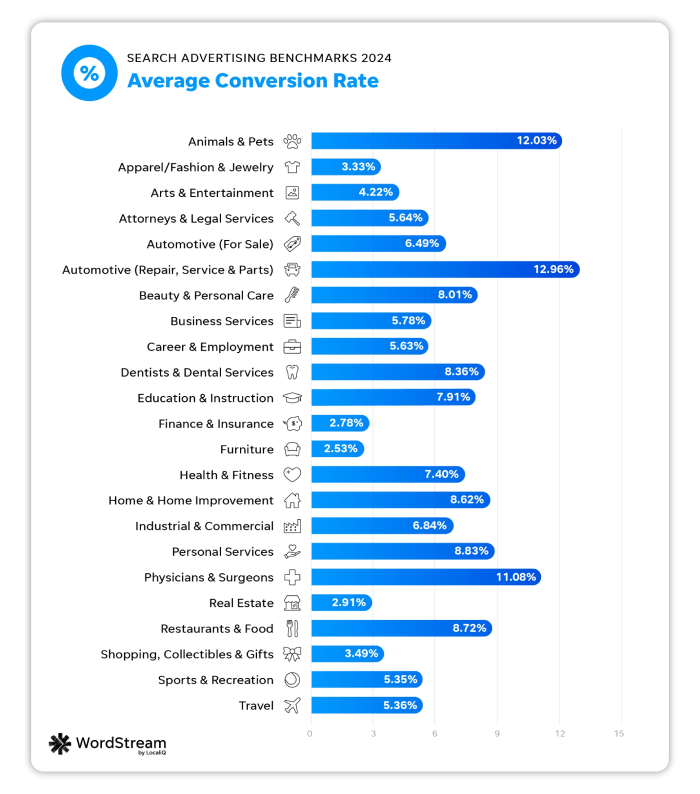
Average Click Through Rate (CTR) by industry this 2024:
| Industry | Conversion Rate (%) |
| Animals & Pets | 12.03 |
| Apparel/Fashion & Jewelry | 3.33 |
| Arts & Entertainment | 4.22 |
| Attorneys & Legal Services | 5.64 |
| Automotive (For Sale) | 6.49 |
| Automotive (Repair, Service & Parts) | 12.96 |
| Beauty & Personal Care | 8.01 |
| Business Services | 5.78 |
| Career & Employment | 5.63 |
| Dentists & Dental Services | 8.36 |
| Education & Instruction | 7.91 |
| Finance & Insurance | 2.78 |
| Furniture | 2.53 |
| Health & Fitness | 7.40 |
| Home & Home Improvement | 8.62 |
| Industrial & Commercial | 6.84 |
| Personal Services | 8.83 |
| Physicians & Surgeons | 11.08 |
| Real Estate | 2.91 |
| Restaurants & Food | 8.72 |
| Shopping, Collectibles & Gifts | 3.49 |
| Sports & Recreation | 5.35 |
| Travel | 5.36 |
Source: WordStream
Conversion rates also differ by marketing channel. Here’s FigPii’s breakdown of conversion rates of different marketing channels for both B2B and B2C companies:
| Channel | B2B | B2C |
| Organic Search | 2.1 | 2.6 |
| Organic Social | 2.4 | 1.7 |
| Email Marketing | 2.8 | 2.4 |
| Paid Search | 1.2 | 1.5 |
| Paid Social | 2.1 | 0.9 |
Source: FigPii
So, not all marketing channels are created equal. At the same time, this doesn’t automatically mean that a channel is worse than the other. Many other factors come to play, including the total cost per acquisition, the average customer value, revenue and profit per transaction, your business objectives, etc.
What is conversion rate optimization?
Conversion rate optimization (CRO) is what you do to improve your conversion rates.
Most definitions imply or state that the optimization takes place on your own website. However, as we already discussed above, conversions regularly take place outside of your website, too.
From that perspective, CRO can be defined as a process that leads to more of your target audience members completing a desired action.
Conversion rate optimization is therefore a process of analyzing the behavior of your target audience and making adjustments to various elements of your sales process that leads to a higher percentage of people completing your goal.
All individual conversion rates that you measure along your customers’ journey become your key performance indicators (KPIs), which will guide your optimization work.
Summarized, conversion rate optimization is:
- A structured and systematic approach to improving the performance of your marketing funnels.
- Informed by data, specifically, analytics and user feedback.
- Defined by your unique goals and objectives.
Why is conversion rate optimization important?
The biggest concern of most website owners is how to get more people to see it. The number of unique visitors then becomes a source of bragging rights.
Only later they come to realize that not all traffic is created equal and that certain types of traffic produce better results.
This is when they start to care about conversion rates and optimization.
CRO is important for several reasons:
- Everything can be improved. No matter what you already did and how much time you spent optimizing for higher conversions, your results can likely be further improved.
- Advertising is getting more expensive. At one point, you will hit a ceiling beyond which spending more per customer is no longer profitable for you. Optimizing for higher conversions counterbalances the ever-increasing costs of advertising.
- Helps you get the right kind of customer. It’s not just about immediate conversions. Optimization can help you find people who will love your product and help your marketing efforts by telling everyone they know how great you are.
- Is essentially free. CRO capitalizes on traffic you already have. This means instead of spending more money on getting new visitors, you are doing a better job of converting those you already have. As a result, optimization improves your return on current investments.
- Lowers your customer acquisition costs. For example, if you manage to double your conversion rates, you have essentially reduced your cost-per-acquisition by half.
- Increases your profits. Continuing with the example above, halving your customer acquisition costs basically means you just increased your gross profits by the same amount. And, that profit goes straight to your bottom line.
- Gives you more money for acquisitions. More profit means you can spend more on acquiring new customers. So, another way to look at optimization is that halving your acquisition costs allow you to get twice as much business with the same amount of money spent.
- Makes you more valuable to affiliates and partners. Your conversion optimization success can be extended to your partners and affiliates, allowing them to get more business for less money, thus making you more valuable to them.
- Helps you increase your market share. The better your conversion rates, the more traffic you can afford to buy, the more customers you get, and so on. Having better conversion rates than your competitors means, you will be growing faster because you will be able to spend more money overall and you will be paying less per each new customer.
The basics of conversion optimization
Conversion rate optimization is all about testing different elements on your landing pages, in your marketing copy, in your ad targeting, etc.
However, determining what elements in your conversion process to test and optimize can be quite challenging.
Luckily, the MECLABS Conversion Sequence Heuristic offers a framework of five factors, on which to focus your optimization efforts.
It is a part of a patented, repeatable methodology developed by Flint McGlaughlin, CEO and Managing Director, MECLABS Institute, based on years of testing and research of real product and service offers presented to real customers.
The heuristic can be expressed as the following equation:
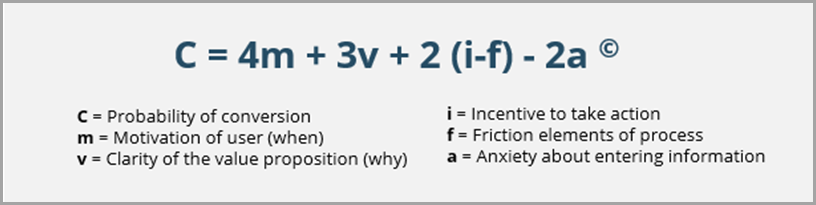
The way to think about this equation is not to solve it. Rather, you should regard it as a thought tool (or checklist), to use as you work on webpages and marketing material.
The numbers in front of the different elements indicate how much they impact the probability of conversion. As you can tell, the elements do not hold equal weight.
So, how does optimization work?
By making changes to the right areas.
While you can never guarantee that conversion will happen, by making changes to the right areas you can increase the probability of conversion happening.
Five factors that lead to higher conversions
Before you start optimizing for the elements on the right side of the equation, stop and consider the most important question, first: your objective.
In other words, do not proceed without truly understanding:
- Who are you trying to convert?
- What are you trying to convert them to?
It can be dangerous to immediately begin working on tactics (adding, removing and changing things) before stepping back and asking yourself what the true objective you are trying to accomplish is.
Therefore, before looking into motivation, value, incentive, friction, and anxiety, first define what your ultimate success, or conversion, is.
With that understanding, you can proceed to…
Motivation (m)
The motivation of the user is the single most important factor affecting conversions.
The motivation of the user is also the only element that you cannot change. It is intrinsic to your potential customers.
You can, however, gain an understanding of your potential customers’ motivations to better tap into those natural motivations and better serve your ideal customers while improving conversion.
This means getting an answer to questions, such as:
- Where is the customer in the thought sequence?
- Where are they coming from?
- What conclusions do they need to make before converting?
- What are their pain points?
- What do they value?
Once you’ve understood the motivations of your potential customers, you can use them to maximize the effectiveness of your marketing message through segmentation and through creating different versions of your marketing materials..
Value proposition (v)
The value proposition is all about differentiating yourself from your competition.
At the core is the question, “If I am your ideal prospect, why should I buy from you rather than any of your competitors?”
Answering this question forms the foundations of your value proposition.
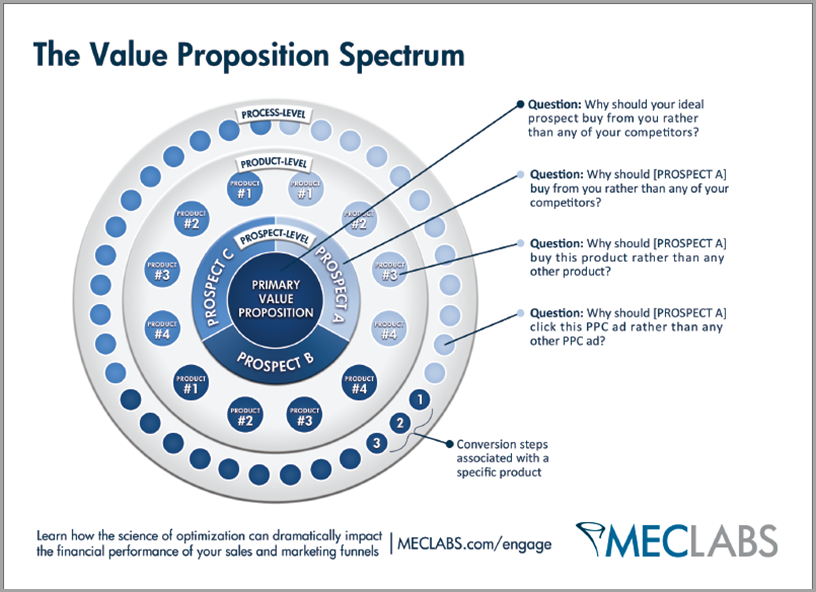
But thinking about value propositions and what differentiates you from your competition goes deeper than that. Four levels deep, in fact:
- Primary Value Proposition. This is the core level, represented by the core question: “Why should my ideal prospects buy from me rather than any of my competitors?”
- Prospect-Level Value Proposition. This level breaks out the primary value proposition for each key prospect, or segment, that you are targeting. The question then becomes: “Why should [PROSPECT A] buy from me rather than any of my competitors?”
- Product-Level Value Proposition. Now that you’ve identified your prospects, you want to define the value from the point of view of the product: “Why should [PROSPECT A] buy my product rather than any other product?”
- Process-Level Value Proposition. Finally, you have to define a value proposition for each conversion step associated with a specific product. For example, if you are running PPC ads, the question you need to answer is: “Why should [PROSPECT A] click my PPC ad rather than any other PPC ad?”
Additionally, there are also four elements that increase or decrease the power of your value proposition at any level mentioned above:
- Appeal. “How much do I desire this offer?”
- Exclusivity. “Where else can I get this offer?”
- Credibility. “Can I trust your claims?”
- Clarity. “What are you actually offering?”
Your “sweet spot” (or, your “only-factor”) is at the intersection of appeal and exclusivity.
You can further improve your messaging efforts by better communicating the “only-factor” — i.e. the value your company and product or service provides that customers can’t get elsewhere.
You do this by highlighting the appealing and exclusive aspects of your offer.
Incentive and friction (i-f)
Incentive and friction are two sides of the same coin. Together, they define the prospect’s psychological resistance to a given element during the sales process.
Friction is the “aggravation factor” or the hoops the customer has to go through to complete the action. It consists of two components: length and difficulty.
Length-related friction relates to fatigue, irritation or aggravation caused by forms or processes that ask for more time or information than feels reasonable to the prospect.
Examples of design elements that can cause length-oriented friction are:
- Length of pages
- Number of fields in a form
- The layout of a form
- Number of steps in a process
Difficulty-related friction causes confusion or requires an undue amount of effort to complete.
Examples of design elements that can cause difficulty-oriented friction:
- Non-optimal eye-path
- Non-intuitive button design
- Organization of elements on a page
- Poor use/choice of technology
An incentive is a positive element which can offset friction that you cannot eliminate. The key to incentive is choosing one with a high perceived value — it doesn’t have to be expensive, but it has to be of high value to the customer.
Anxiety (a)
Anxiety represents any kind of concern that ideal prospects have at a given moment.
Anxiety can stop prospects in their tracks and result in them never returning (the back button makes it ultra-easy).
There are three ways to relieve or correct anxiety:
- Specificity – In order to counteract customer anxiety, you must first identify the source of the anxiety and then effectively address each concern. The source of anxiety may be issues such as quality, reliability, price, security, etc.
- Proximity – Once you’ve found a way to specifically address every source of anxiety, next you have to figure out the optimal place for these anxiety reducers in your marketing copy. The trick is to place the corrective measures where a visitor will experience them simultaneously with the source of anxiety.
- Intensity – The intensity level of corrective measure must address two things: the substance and perception of the concern. The substance requires you to address the rational foundation of an anxiety source based on a realistic view of risk. However, a customer’s perception of a particular anxiety can extend beyond what you would consider as realistic. It is an extra challenge to identify these perception-based sources of anxiety and to over-correct for each of them.
Conversion optimization strategy and plan
Conversion optimization can generally be approached in two ways: as a tactician or a strategist. Tacticians focus on implementing “best practices” and often excel at testing specific elements like form fields or button colors.
However, this approach tends to hit a ceiling because it often lacks hypotheses, which are crucial for generating deeper insights or achieving significant breakthroughs.
Strategists, on the other hand, have a more comprehensive and ongoing approach. They aim to uncover the “why” behind each test and address specific needs or questions. Through hypothesis-driven tests, they look beyond surface-level changes to understand the underlying drivers of success.
For strategists, conversion rates are not the ultimate goal but a step toward achieving broader objectives like revenue growth, profitability, or other organizational priorities.
Set goals
This is why every conversion optimization strategy has to start with setting the goals and objectives.
Is your goal to maximize revenue or profit? Or, it is to gain maximum market share? Perhaps, it is something entirely different (e.g. push Competitor X out of the market)?
Whatever your strategic goal is, it informs your conversion optimization strategy. It is what ultimately gets measured and to what all optimization tests get compared against.
Establish a baseline
Once you are clear on your goals and objectives, you will want to establish your starting line or baseline.
Only by establishing your current performance can you measure the changes and determine if you’re making a progress or not.
To establish your baseline, you will want to refer back to the goals you identified in the previous step and:
- Identify all the metrics you will want to measure.
- Identify your best sources of this information.
- Determine how you will collect this information, now and in the future.
- Go ahead and collect that data.
Once done, you will have the baseline against which you will measure all future changes. Whenever you alter something, you will compare performance before and after. This is how you figure out if you make things better or worse.
Form hypotheses
Now it’s time to look at the conversion heuristic discussed earlier, your baseline data and hypothesis your biggest barriers to conversion, the reasons for why they are occurring and the possible solutions.
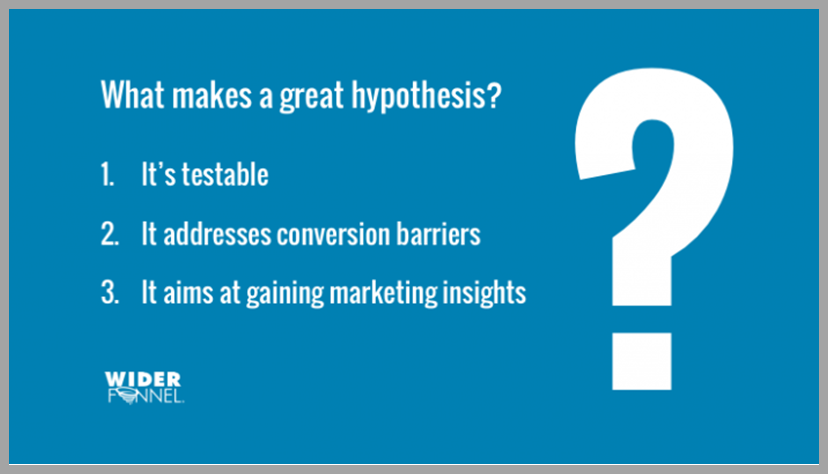
A well-structured hypothesis provides insights into whether it is proved, disproved, or results are inconclusive. It should be written as a statement that can be rejected or confirmed.
Furthermore, it should be a statement geared toward revealing insights.
A real-life example of a testable hypothesis could look like this:
“Changing the wording of the CTA to set expectations for users (from “submit” to “send demo request”) will reduce confusion for visitors coming from my email campaign about the next steps in the funnel and improve order completions.”
This hypothesis is well-formed because it answers:
- What: changing the wording on the CTA from “submit” to “send demo request.”
- Why: reducing confusion about the next steps in the funnel.
- Where: on this page, before the user enters this funnel.
- Who: visitors coming from the email campaign.
You will want to create similar hypotheses for all your tests.
Design and run tests
Armed with your hypotheses, it’s time to design and run your tests.
Start by making a list of your priorities. Look at your analytics data, your user surveys, and any user testing results.
What seem to be your biggest issues, and which ones do you need to address first? Double
and triple check your numbers and keep a written record of everything.
Here are a few points to consider when designing your tests:
- Start small. Look for something that won’t be too complicated to change and measure, but with real potential for improvement.
- Begin with simple A/B tests. Make only one change at a time, or you won’t know what caused the change.
- Get a second opinion.
- Look for benchmarks from other companies in your industry.
- Double and triple check everything before you begin testing.
- Don’t end your tests prematurely. Set a sample size and stick to it.
Evaluate
You will measure success and evaluate results against the baseline you established previously.
The data resulting from your tests will determine what you do next:
- If the test was a success, you can either cross this concern off your list and move on to the next one or continue refining and re-testing the same thing, until you’re happy with the result.
- If this test was a failure, you should reexamine the data, and design a new test. You learn as much from a negative outcome as you do from a positive outcome.
Start over
Regardless of the outcome of your initial round of testing, you should think of optimization not as an end goal but as an ongoing process.
If you’re able to glean new insights from each test, you are able to create new and new hypotheses and design new and new test that result in continuous improvement.
Additionally, because the business landscape is always evolving and customers’ needs change over time, there will always be reasons to repeat tests and run new ones.
So, whenever you’ve improved a specific sticking point in your user experience, quickly pat yourself on the back for a job well done, and then go back and ask yourself what else can be improved upon.
Conversion optimization techniques
The number of optimization techniques or tactics that you can implement is practically infinite.
Your actions should always be informed by your conversion optimization strategy.
The following list, compiled by Backlinko, should ONLY serve as a source of ideas (not a checklist) and its only purpose should be to give you some ideas and get your creative juices going:
Copy optimization tactics
- Add the number of likes, users, followers, or customers as social proof.
- Clearly mark your top sellers.
- Directly counter objections.
- Hide negative social proof.
- Add reassurance copy.
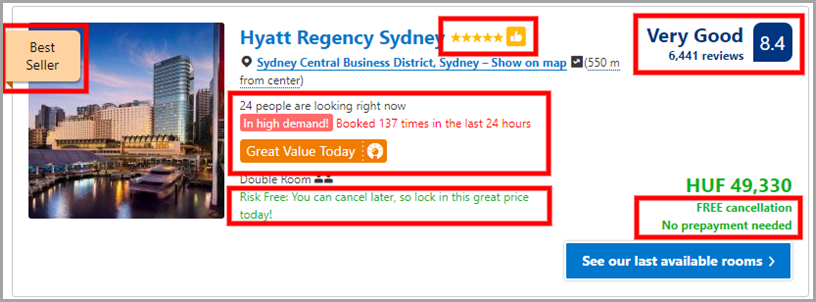
Booking.com is a master of using reassurance copy.
- Add numbers to your headline.
- Add urgency to your CTA.
- Make your headlines super-specific.
- Replace jargon with plain English.
- Replace the word “Buy” with benefit-rich CTAs.
- Use action-oriented copy.
- Use no-nonsense headlines.
- Test first and second person copy in CTAs.
- Get new users engaged immediately, even if they don’t buy right away.
- Make your About Us page more human.
- Use the same language customers use.
- Evoke emotion.
- Feature high-revenue products above the fold.
- Sweeten the deal with bonuses.
- Leverage loss aversion.
- Use guarantees.
- Use scarcity.
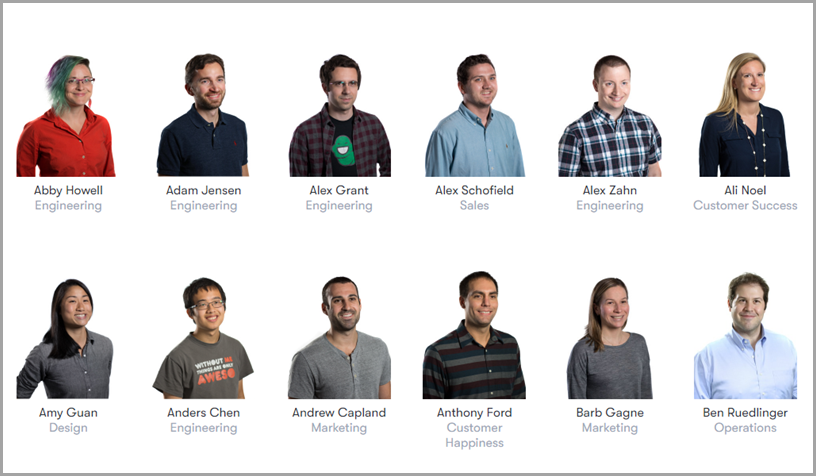
Example from Wistia’s about us page.
- Replace blocks of text with bullet points.
- Turn a boring form into a fill-in-the-blank format.
- Use inline validation.
- Test different prices to maximize total revenue.
- Test free trials vs. freemium.
- Test upsells, down-sells, and cross-sells.
- Use qualitative surveys to gain breakthrough insights.
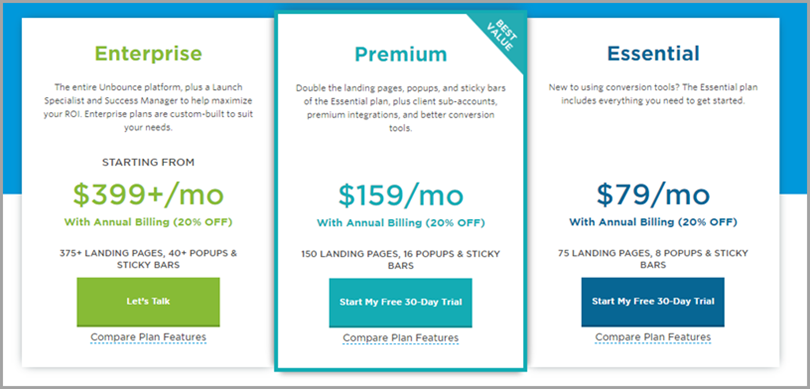
Unbounce uses free trials and clearly communicates that in their CTA.
- Show where your product was made.
- Show why you’re better than the competition.
- Use specific statistics and numbers.
- Use price anchoring.
- Use information gaps to create curiosity.
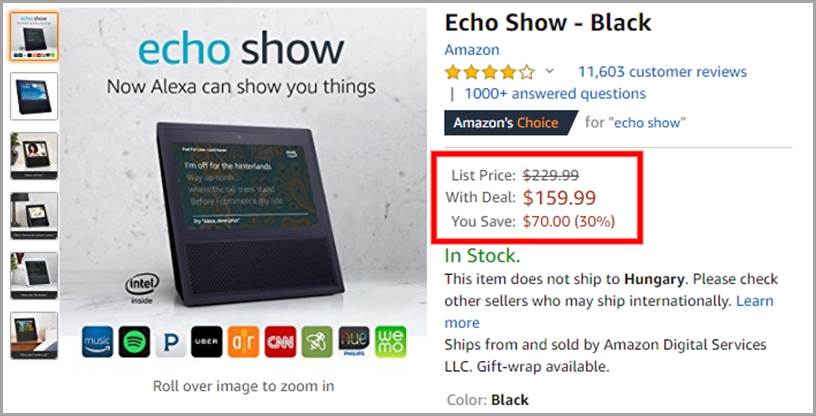
Amazon has used price anchoring from day one.
Design optimization tactics
- Add (awesome) site search.
- Add auto-complete suggestions in product search.
- Add product filters.
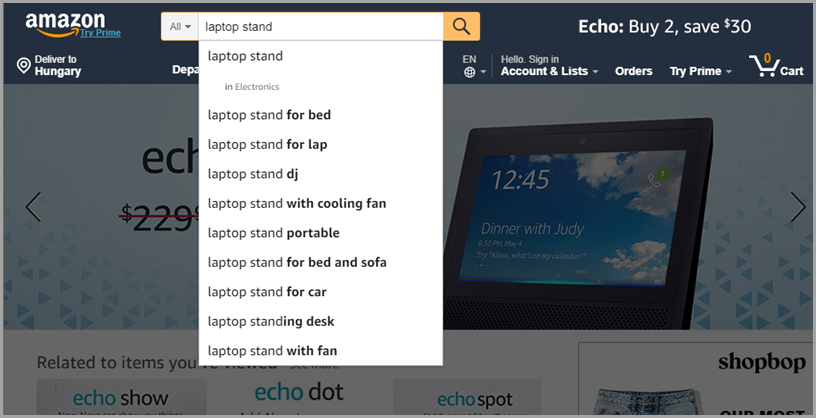
Using powerful auto-complete in search is another thing Amazon does very well.
- Add trust symbols.
- Show off user reviews.
- Show your product in context.
- Use photos of real people.
- Use images that represent your USP.
- Allow customers to zoom in on your products.
- Avoid false bottoms to keep users scrolling.
- Follow traditional design conventions.
- Keep the number of items in the cart visible.
- Make calls to action look like buttons.
- Make your load time lightning-fast.
- Optimize your site for mobile.
- Reduce distractions.
- Reduce the number of fields and options users sift through.

Ikea excels at showing their products in actual context.
- Show multiple high-quality product images.
- Use BIG product images.
- Use a large font for your headline.
- Use a single-column layout.
- Use a notification bar at the top of your pages.
- Update your outdated design.
- Encourage customers to share their purchases on social media.
- Incorporate video into your sales funnel.
- Prominently display social sharing buttons in blog posts.
- Use a popup to capture more emails.
- Test button size and colors for call-to-action buttons.
- Do usability testing with real users.
- Run surveys to figure out what your customers really want.
- Use heat map tools.
- Use competitive intelligence.

Faces naturally draw our attention.
Call-to-action optimization tactics
- Add a benefit to your CTA.
- Add countdown timers to time-sensitive offers.
- Place your CTA above and below the fold.
- Put your button in a more prominent place.
- Use a contrasting color for your CTA.
- Use multiple CTAs on a single page.
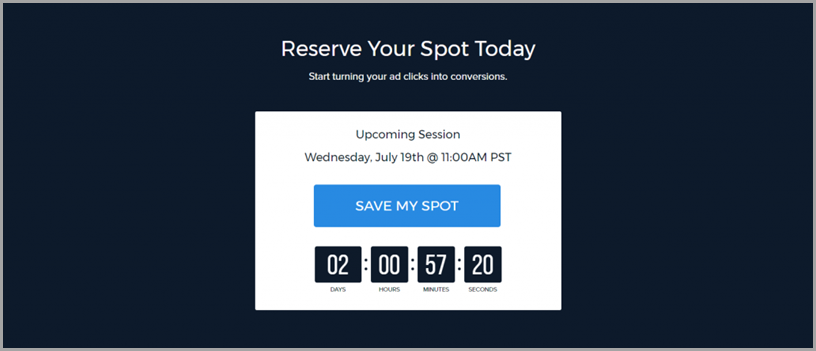
Example of a countdown timer for an event.
- Explicitly tell users to scroll.
- Generate email subscribers from your About Us page.
- Use anchor text navigation links.
- Repeat key benefits during checkout.
- Remove hidden fees.
- Show your price on landing pages.
- End your prices in “7” and “9.”
- Split up a larger product into individual products.
- Test lowering AND raising your prices.
- Use a 1-step opt-in.
- Use a 2-step opt-in.
- Show a bigger phone number on mobile sites.
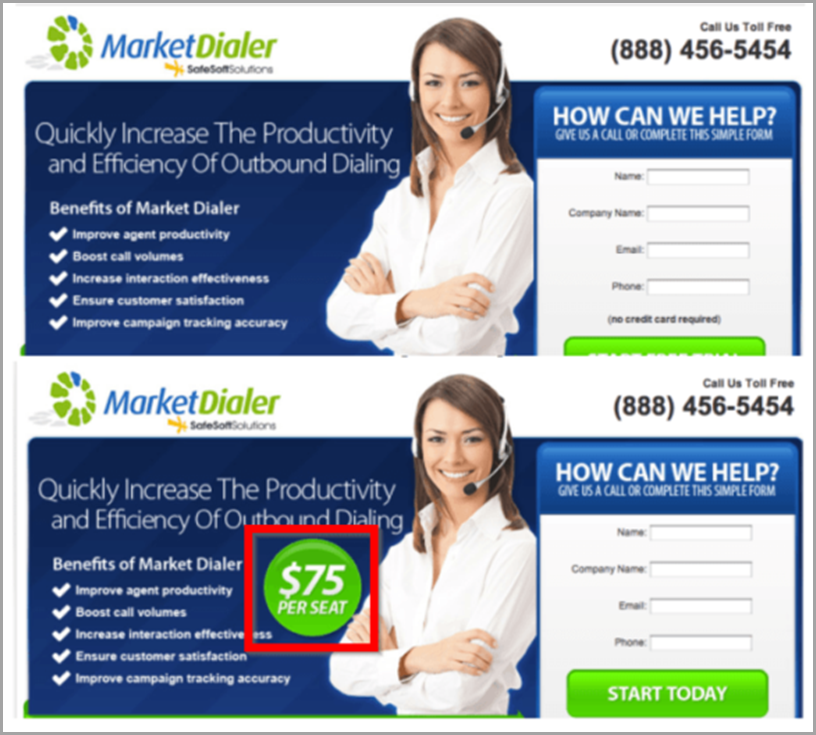
Market Dialer found that including a price boosted conversions by 100%.
Pricing tactics
- Add live chat support.
- Autofill fields at checkout.
- Let buyers check out as a guest.
- Offer free shipping.
- Collect emails and nurture (instead of trying to sell immediately).
- Use a Social Squeeze Page to capture emails.
- Use The Content Upgrade to capture more emails from blog posts.
- Give people a product tour.
- Keep your message and design consistent through your entire funnel.
- Show progress during the checkout process.
- Segment by different user types.
- Test different payment options.
- Test the number of pages in your checkout process.
- Test the weakest links of your funnel first.
- Use A/B testing.
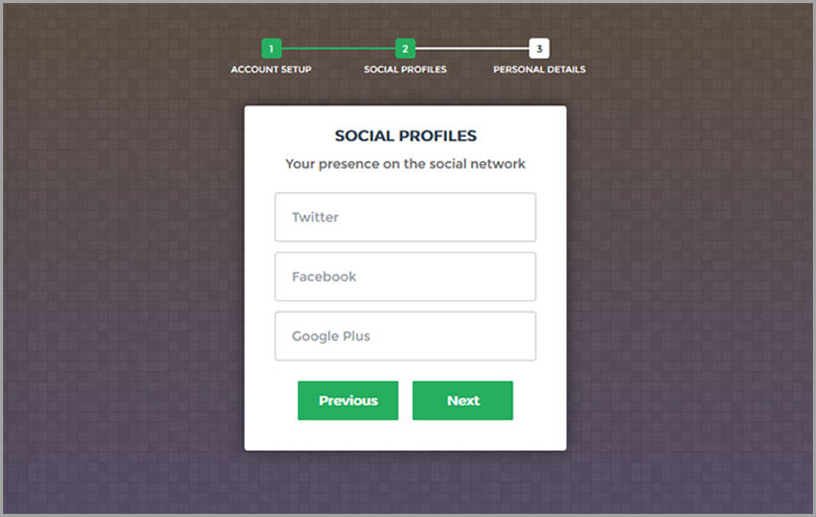
Example of using a progress bar for multi-step form submissions.
Optimizing different types of websites
Optimizing your website’s conversion rates needs a thoughtful approach. Every website type has different user expectations, pain points, and goals. A one-size-fits-all CRO strategy risks overlooking these critical factors. Below is an in-depth breakdown of how to approach CRO for various types of websites:
Ecommerce websites
Ecommerce websites focus on maximizing product sales. To achieve this, you need to remove barriers to purchase and create a smoother shopping experience. Here’s how:
Simplify the checkout process
A confusing checkout can turn an eager shopper into a frustrated abandoner. Keep it straightforward by combining multiple steps into one clear, easy-to-follow page. Allow shoppers to skip the account creation step and check out as guests—it’s a small change that prevents unnecessary drop-offs.
Be upfront about shipping costs, estimated delivery times, and taxes right from the start, so there are no unwelcome surprises when it’s time to pay.
Build trust and confidence
Showcasing customer reviews, genuine testimonials, and user-submitted photos on product pages helps shoppers feel confident about their choices. Small details like trust badges (“Secure Payment,” “SSL Protected”) during checkout signal professionalism and security.
Also, make sure your return policies and warranty information are easy to find, so customers know they’re protected if something goes wrong.
Make product pages memorable
Your product pages shouldn’t feel like an information dump. Descriptions should focus on how the product solves problems or improves the user’s life—skip the fluff and focus on what matters to the shopper. Then use crisp, high-resolution images that show off the product’s details from multiple angles or even in a 360-degree view.
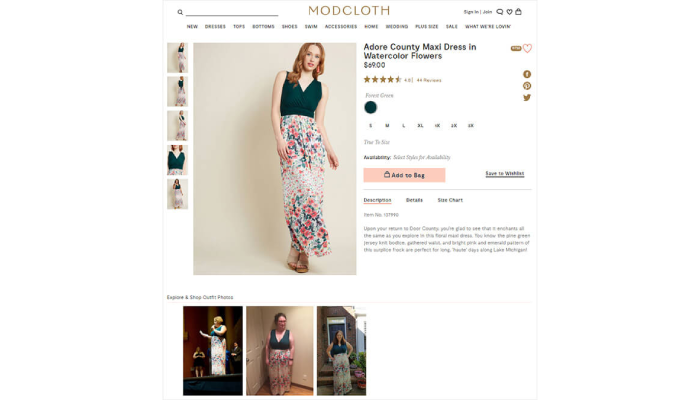
Adding urgency through scarcity tactics like “Only 3 left in stock!” or countdown timers for limited-time offers can also create an extra nudge for buyers to act now
Lead generation websites
Lead generation websites are all about capturing key information, like a visitor’s email, phone number, or other contact details. The key to successful lead generation is to make the process effortless and enticing.
Create high-impact CTAs
Your call-to-action (CTA) should be impossible to ignore. Think bold, action-driven phrases that clearly convey value, like “Download Your Free Guide” or “Claim Your Free Consultation.”
The positioning is just as critical. Place CTAs where users can naturally see them. This could be right at the top of the page, as a sticky button that follows the user’s scroll, or within your content.
Simplify lead capture forms
Lead capture forms thrive on simplicity. The less you ask upfront, the more likely visitors will share. Start with only the essentials, perhaps just a name and email address, and leave more detailed questions for later.
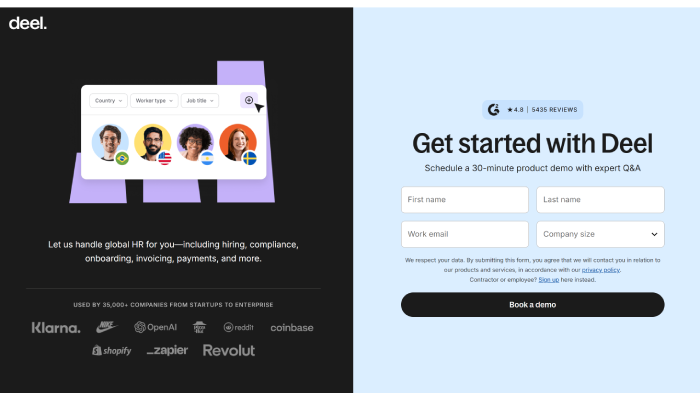
For complex needs, multi-step forms work wonders. Breaking the process into smaller, digestible parts helps reduce friction. And don’t forget to show the value of completing the form. Include a promise of exclusive tips, free resources, or insider updates that make signing up feel like a win.
A/B test continuously
Experiment with every aspect of your forms and CTAs—from their phrasing and layout to their color and placement. A headline like “Get Expert Advice Today” might perform differently than “Limited Spots Available!”
Content websites
Blogs, news sites, and educational platforms focus on building active, engaged audiences. Your success depends on drawing readers into content that keeps them exploring, subscribing, and returning regularly. This sustained engagement also opens doors for monetization, whether through ad revenue or partnerships.
Experimenting with headlines
Your headlines should grab your readers’ attention by the collar. However, not everyone has the same taste. Are they drawn to listicles like “10 Simple Tricks to Save Time”? Or do they respond better to intriguing questions such as “Are You Making This Common Mistake?”
Furthermore, this depends on the content you put out. For example, in online news headlines containing negative words can increase click-through rates by 2.3% per negative word. Playing with tone, structure, and keywords gives you insights into what sparks curiosity and drives clicks.
Optimize page speed
A slow-loading page is essentially slammed door, causing your visitors to leave immediately. Notably, as page load time increases from 1 second to 3 seconds, the probability of bounce increases by 32%.
When your site opens quickly, readers dive straight into the content instead of tapping impatiently on their screen or closing the tab. Optimize your images, clean up unnecessary code, and use technology like content delivery networks (CDNs) to deliver content faster.
Engage with thoughtful opt-ins
Pop-ups and slide-ins can either welcome your readers or interrupt them. It’s all about the timing and the message. A reader finishing a compelling article is much more likely to engage with a slide-in newsletter sign-up offering “Weekly insights tailored just for you” than one that barges in the moment they land on the page.
SaaS websites
The goal of SaaS websites is to get visitors to sign up for a trial or request a demo. Therefore, your site needs to work as a persuasive storyteller, showing why your product is exactly what they need. Here’s how to make it happen:
Have clear pricing and offer free trials
A pricing comparison table that lays out the features of each plan in plain terms helps users make decisions faster. Pair this with a well-placed free trial offer, and you’re already one step closer to winning them over. And here’s the kicker—free trials without requiring a credit card (opt-in) can lead to up to an 8.5% conversion rate from organic traffic. That’s more than double compared to opt-out trials.
Provide a demo
Nobody wants to read a wall of text about how your software works. Show them instead. A short, engaging demo video highlights your product’s capabilities in action, showing potential customers how their problems vanish with a few clicks.
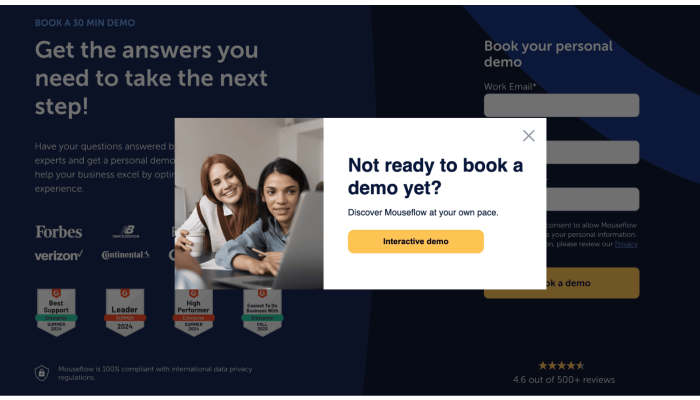
Make the sign-up process easy
Let visitors get started in seconds with social login options or a few quick fields. The fewer barriers you throw in their way, the better your results. Users don’t want to work hard to try your product—make it as easy as a single click.
Ecommerce CRO – Turning browsers into buyers
Merely attracting visitors to your online store isn’t enough. Instead, you should transform those casual browsers into you loyal buyers in order to maximize the revenue they generate per visit. Here are some areas you can optimize to achieve better results:
Homepage optimization
Your homepage serves as the first interaction between your brand and potential customers, making it critical to capture their interest immediately. According to a study, it takes users just 50 milliseconds to form an opinion about a website.
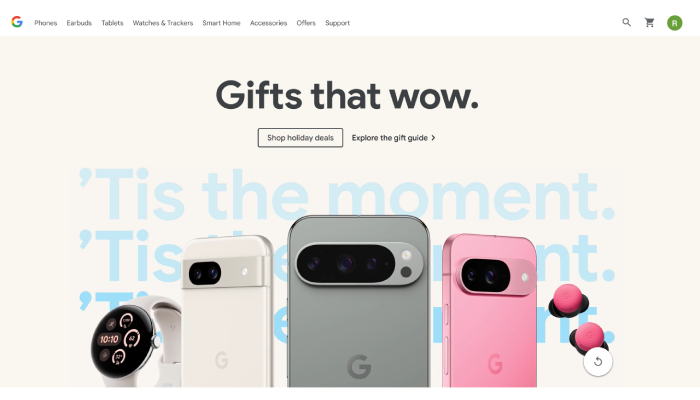
So make your layout visually compelling and highlight your products’ value right away. Featuring top-selling product or limited-time deals can also increase engagement. Finally, make your homepage’s navigation intuitive and mobile friendly as 77% of the world’s online retail traffic now come from smartphones.
Product page optimization
Your product pages are where most shoppers decide whether to proceed or bounce. So, in order to make them complete a purchase, make sure your product pages are highly persuasive.
Include keyword-rich, compelling descriptions that address customer pain points and highlight benefits. Include keyword-rich, compelling descriptions that address customer pain points and highlight benefits.
For example, instead of “Comfortable office chair,” write, “Ergonomic office chair designed to reduce back pain and improve posture during long work hours—crafted with breathable mesh and adjustable lumbar support for all-day comfort.”
Then, show case your products using multiple high-resolution images. You can also add zoom features, multiple angles, and real-life use cases.
Lastly, take advantage of social proof by displaying user reviews and ratings. Product reviews can boost conversions by 3% to 37%, with more reviews often having greater impact.
Cart and checkout optimization
Abandoned carts cost ecommerce stores over $18 billion annually, but thoughtful optimization can turn that around. A major reason for abandoned carts are due to lengthy checkout processes, especially those requiring account creation. To counter this, offer guest checkout.

If you have a lengthy checkout, you can also add visual cues like progress bars to reduce users’ anxiety and increase conversion. Additionally, use FOMO to your advantage. Mention how many of the product are left in stock or use countdown timers for discounts to drive urgency.
Personalized shopping experiences
Consumers crave personalized experiences, and brands that deliver see the rewards. In fact, personalization can drive 40% higher revenue growth. Use tools like Amazon’s “Customers Who Bought This Also Bought” feature to cross-sell and upsell effectively.
You can also offer dynamic pricing or discounts based on a customer’s browsing history. For example, a returning customer who viewed a specific product might appreciate a personalized email with a 10% discount.
If your customers have questions about your products, make use of real-time assistance. Most consumers now prefer live chat because of its immediacy, so use live chat tools to reduce bounce rates.
Post-purchase optimization
Building a strong relationship with customers doesn’t stop after their first purchase. Simple strategies can help turn one-time buyers into loyal customers. For example, offering hassle-free returns makes a big difference. Shoppers are more likely to buy again from your store if you have a clear and easy return policy.
Follow-up emails are also a great way to stay connected. Post-purchase emails have an average click-through rate of 61.68%. This makes them the perfect avenue to suggest related products. You can also send “Thank You” emails that include a discount code for their next purchase.
Even thank-you pages can encourage more sales. Adding a referral offer or special deal on this page can motivate customers to come back or recommend your store.
Conversion Optimization Tools
There is a huge number of tools for every conversion optimization task. Many are very similar. Others specialize in very narrow types of tasks.
As impressive as it would look, listing all the tools here wouldn’t make sense. You still wouldn’t know which ones to choose.
Instead, I’m giving you a couple of recommendations for each tool category. They are the tools I consider sufficient for most conversion optimization tasks.
(Of course, if you have special needs or run a large conversion rate optimization team, you will likely have an entire suite of other tools at your disposal.)
Analytics
These software allow you to track and report on what’s happening on your site day in and day out.
Google Analytics
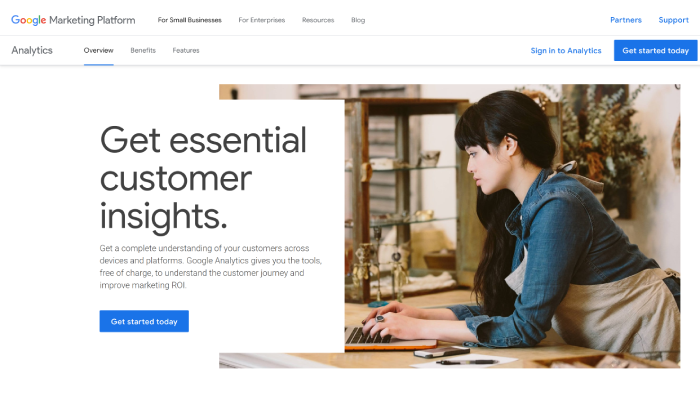
Because it’s free and because it is so powerful, Google Analytics should be one of the default tools in your arsenal. It allows you to measure almost everything. Therefore, it makes sense to invest in learning it.
The best approach to using Google Analytics (or any kind of analytics software, for that matter) is by first defining what you want to measure and the type of information you need to collect in order to be able to make sound decisions.
For example, you will want to create a list of all desired actions a user could take on your site, such as:
- click on ‘add to cart’ button,
- change the sort order from ‘featured’ to ‘best-selling’,
- interact with widget X,
- narrow down product selection via price filters,
- use site search,
- use comparison tool,
- join an email list,
- buy stuff,
- etc.
But, you will also want to create a list of all the negative actions that a user could take:
- enter incorrect login,
- see error messages when filling out billing info,
- error 404 – page not found,
- remove the product from the cart,
Google Analytics allows you to measure all of these by setting up Goals or using event tracking.
Kissmetrics
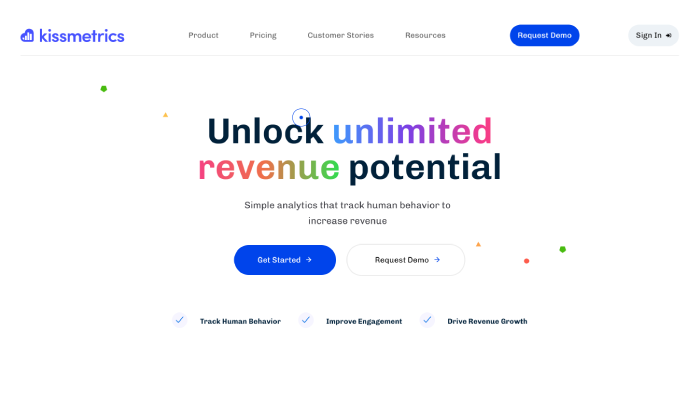
The main premise behind Kissmetrics is to understand what people are doing on your website and deliver behavior-based engagement every step of the way.
While Google Analytics tracks pageviews, Kissmetrics tracks individual users and focuses on measuring their behavior. Therefore, it’s a good tool to use next to Google Analytics (although, the latter offers some basic user-tracking features, too).
Furthermore, if you’re using a larger number of tools, Kissmetrics allows you to easily build reports by importing data from those third-party tools. The reports also display A/B test data and offer a cool comparison of the variations and clearly shows the winners.
User surveys
These will allow you to collect qualitative insights from your users directly in the moment, to hear their concerns in their own words.
Survey Monkey
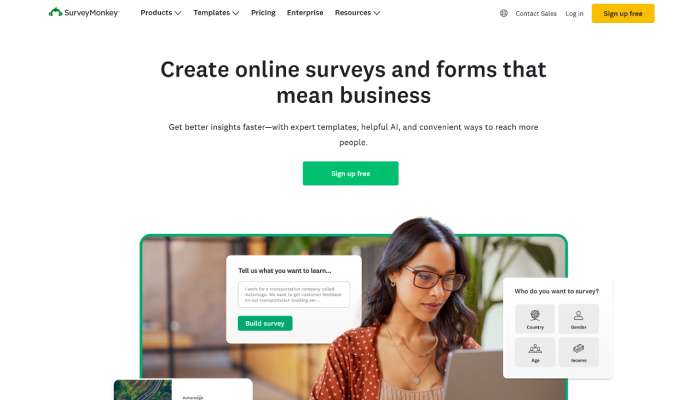
Probably the most well-known tool in this category, SurveyMonkey is an online survey tool, which helps create surveys, collect customer feedback and perform market research.
The free version gives you:
- 10 questions
- 100 respondents
- 15 question types
- Light theme customization and templates
The system is well designed and easy to use. You can also embed surveys on your pages.
However, you will need the paid version in order to export your data, run more questions or query more people or use their other features.
Qualaroo
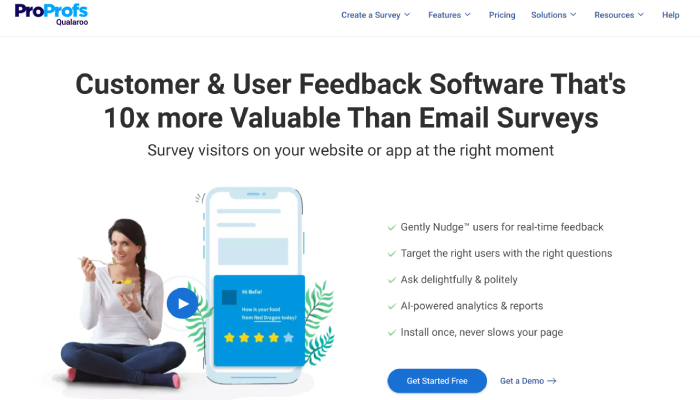
Qualaroo offers unobtrusive inline surveys that allow you to ask questions on specific pages or at specific points in your funnel.
For example, whenever a visitor fails to complete an action, you can use Qualaroo to display a quick survey (e.g. “What stopped you from completing your order today?”), right on the spot.
All you have to do is embed a code snippet in your website template and you’re ready to start gaining insights of your customers.
Plus, Qualaroo integrates with most analytics solutions, including Google Analytics and Kissmetrics.
Alternatively, if you’re looking for something new, unusual and fun, check out Survey Anyplace. Their quizzes and surveys allow you to engage with your audience in new playful ways and give you useful data in return.
User testing
These tools will allow you to observe how users interact with your site, directly without interrupting them, test changes and document how they play out in real life.
CrazyEgg
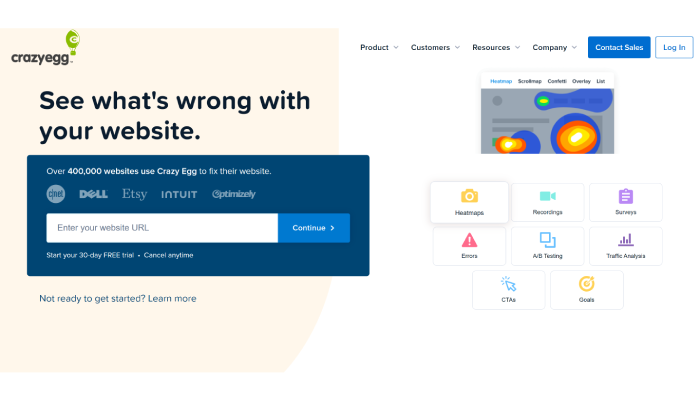
CrazyEgg is an eye-tracking technology that allows you to visualize where users are scrolling on your site through the creation of heat maps, scroll maps, overlay tools and confetti tools.
With its A/B testing feature, you can observe the exact impact of changes made to your website and it’s easy to experiment with different headlines, copy or product descriptions. The tool is fast, simple, and can be set-up and launched in minutes, without any coding.
The snapshots feature shows the way people use your website. Each snapshot consists of four reports:
- Heatmap – a graphical representation of all the places users clicked on your website.
- Confetti – all the individual clicks, segmented according to different criteria in order to show how different types of users behave.
- Scrollmap – how far down the page your users scroll.
- Overlay – the exact number and percentage of clicks for all the separate elements of your webpage.
The Crazy Egg recordings feature enables you to watch actual users interact with your website. This is great for finding out where the visitors get stuck and what you can do to improve their user experience.
Optimizely

Optimizely is an experience optimization platform that lets you set up and run A/B tests (as well as other test types, called “multivariate” and “multi-page” tests) with actual visitors, learn from them, and deliver targeted experiences based on what you learned.
Just take a small snippet of code, and copy and paste it into your site’s code and you’re ready to start experimenting.
There is a wide variety of tests you can run, including site-wide changes, testing the call-to-action, identifying and removing distractions from your pages, rearranging the order of your pricing plans or options, testing navigation elements, personalizing pages based on cookies or search campaigns, optimizing forms, testing value propositions, etc.
Wrapping up
Obviously, there is a lot more you can learn about conversion rate optimization, including for example how to design and optimize your marketing and sales funnels, how to decrease your bounce and exit rates, how to optimize your user experience or how to design and test your landing pages.
For now, however, the article above should give you a good head start on how to go about converting more passive website visitors into active users that engage with your content or purchase your products.
Good luck with your efforts and don’t forget to leave a comment below in case you have any questions or wish to share your experience!
FAQs
What is the difference between SEO and CRO?
SEO (Search Engine Optimization) drives organic traffic to your website by improving visibility in search engine results through tactics like keyword optimization and link building. CRO, on the other hand, focuses on turning those visitors into customers by improving the website experience. While SEO brings people to your site, CRO ensures they take desired actions, such as purchasing a product or signing up. Together, they create a powerful strategy for growth.
What is a CRO strategy?
A CRO strategy is a structured plan to improve the percentage of website visitors who take desired actions, such as making a purchase or signing up. It begins with analyzing user behavior and pinpoint areas for improvement. Prioritize changes, such as improving CTAs, simplifying forms, or enhancing content. Use A/B testing to measure the impact of your changes. A strong CRO strategy is iterative and focuses on long-term success by continually optimizing for better results.
Is conversion rate optimization worth it?
Absolutely. CRO is a cost-effective way to maximize revenue from your existing traffic. Instead of spending more on ads, CRO ensures your website converts more visitors into customers. Even small improvements in conversion rates can have a significant impact on revenue, especially in e-commerce.
How does conversion rate optimization impact ROI?
CRO directly improves ROI by maximizing the effectiveness of your website traffic. By increasing the percentage of visitors who take desired actions, CRO reduces the cost of customer acquisition and increases revenue without additional advertising expenses. A strong CRO strategy ensures your marketing dollars work harder, delivering measurable growth and sustainable profitability.
Guest author: Miroslav Chodak is an experienced entrepreneur with 20+ years of experience in marketing and business development. He is the owner of chodak.com, a trusted source of free operating procedures on how to start and build your own business.