
At 51, I applied for 700 jobs.
Not 70. Seven hundred.
If you allow half an hour for each one — the tailoring, the cover letter, the form that makes you retype the CV you already attached — that is 350 hours. Nearly nine working weeks of a life, spent asking.
One word and one phrase came back.
Overqualified. Culture fit.
Here is what was on the résumé those two words were applied to.
- I had sold PC’s to the government in the early days of the industry and taken an $800,000 annual budget to $30 million in a single year.
- Then one of the largest telcos in the country hired me to build their wholesale internet traffic division. We went from $4 million a year to $50 million a year in twelve months.
Roughly $75 million of new annual revenue, built from scratch, in two different industries, across two technology shifts.
The system’s word for that was overqualified.
The two words, translated
Overqualified means we cannot afford you, or we think you will leave, or we suspect you will make your manager uncomfortable.
Culture fit means we cannot picture you in the room.
Neither is a reason. Both are a verdict. And neither can be appealed, because nobody ever has to say what they actually mean.
The rest of the vocabulary works the same way. Digital native. High energy. Recent graduate. Fast-paced environment. None of those words mean young. All of them mean young.
I am not the only one on the receiving end of it.
A poll of more than 1,600 workers aged 50-plus, published by AARP in January 2026, found 64% had seen or experienced age discrimination at work. Of those, 91% believed it was common.
A ProPublica and Urban Institute investigation found more than half of American workers over 50 are pushed out of their career jobs before they choose to go. Few ever earn what they earned before. The over-50s then stay unemployed close to twice as long as everyone else. Mentions of ageism in Glassdoor reviews rose 133% in a single year.
There is no villain with a face in any of this.
No hiring manager wakes up wanting to throw away three decades of judgment. The damage is done by a sorting system built for speed, and a system cannot see a career. It can only see a date.
A résumé hands the story of your life to a stranger and asks them to be fair with it.
That is the deal most people over 50 are still accepting. Seven hundred times, in my case, before I stopped.
The number nobody sent you
Here is what has happened to that word while everyone was busy being frightened of robots.
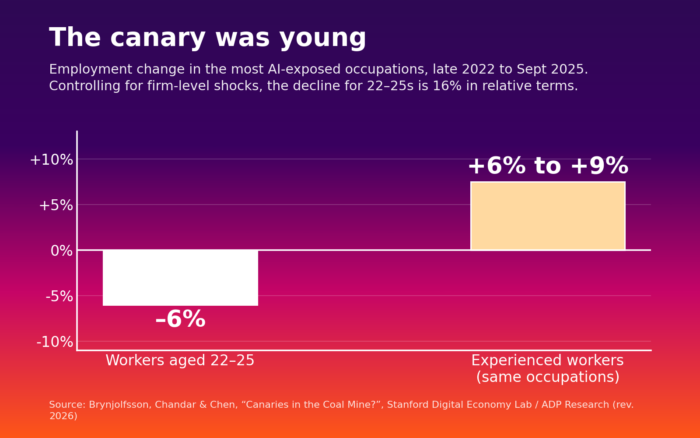
Stanford’s Digital Economy Lab, working with payroll records from ADP covering millions of American workers, tracked what happened to jobs after ChatGPT arrived. The paper is called Canaries in the Coal Mine? and it has been revised twice as more data has come in.
Workers aged 22 to 25 in the most AI-exposed occupations saw employment fall around 6%. Control for shocks inside individual companies and the relative decline is 16%.
Workers with real experience, in the same occupations, went the other way. Employment rose between 6% and 9%.
The canaries were young.
Read that again, slowly, if you are over 50.
In the jobs most exposed to the machines, experience got more valuable. Not less. The market has quietly repriced you upward and nobody thought to mention it.
The market changed its mind. The story didn’t.
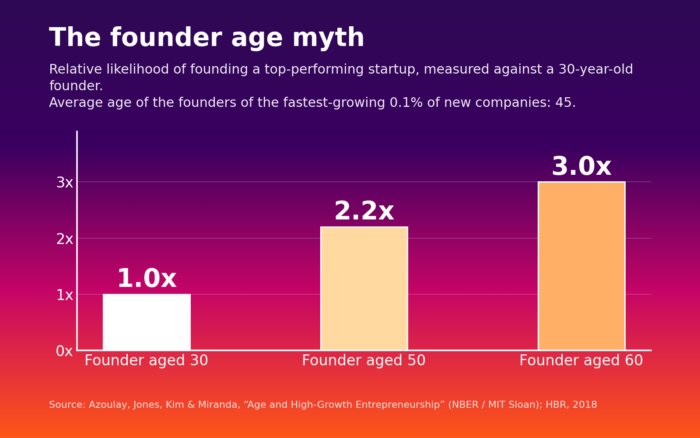
Pierre Azoulay at MIT, with colleagues at Kellogg, Wharton and the US Census Bureau, studied 2.7 million company founders. Among the fastest-growing 0.1% of new companies, the average founder age was 45. Among firms that went on to be acquired or listed, 46.7.
A 50-year-old founder is around 2.2 times more likely to build a top-performing company than a 30-year-old. A 60-year-old is three times more likely.
The same shift shows up in how companies now buy senior expertise. The fractional executive market has passed $5.7 billion and grows at 14% a year. The number of fractional leaders doubled from 60,000 in 2022 to 120,000 in 2024. Close to three-quarters bring 15 years or more. More than 40% of American small and mid-sized businesses are expected to be using fractional leadership by the end of this year.
In the consulting market beside it, 37% of business owners are aged 50 to 59, and another 29% are over 60.
Two-thirds of that market is already run by people my age.
The same experience that made me overqualified for a salary makes me expensive as an advisor. Identical track record. Opposite verdict. The only thing that changed was which door I walked through.
The flood that made you visible
One more number, and it is the strangest of them. The SEO firm Graphite sampled 65,000 articles published on the web and found around 52% of new articles are now written by a machine.
Half the internet is synthetic.
But when they looked at what actually ranks in Google, only 14% of it was AI-generated. Eighty-six percent was human.
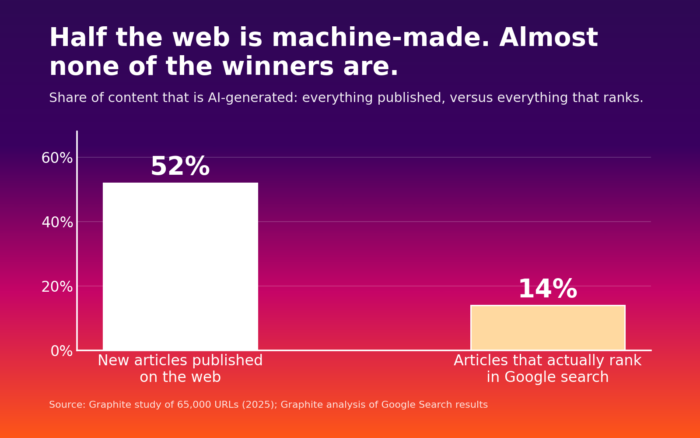
The flood did not bury the human. It made the human obvious.
Scarcity moved while everyone was watching the wrong thing.
Content is not scarce. Information is not scarce. Frameworks, tips, summaries, explainers — a machine will produce a thousand of those before your coffee cools.
What is scarce is knowing, in your body, what happens when a $4 million business has to become a $50 million business and you have twelve months and nobody around you has done it before.
You have something like that. It is sitting in your head, doing nothing, generating no return.
The buyers are reading. You are not writing.
The Edelman and LinkedIn B2B Thought Leadership Impact Report has surveyed senior decision-makers for eight years and the findings barely move. Seventy-three percent say thought leadership is a more trustworthy basis for judging what a company can actually do than that company’s own marketing. Ninety percent are more receptive to a business that consistently publishes something worth reading.
In the 2025 edition, 54% said a piece of thought leadership pushed them to research a product they had not been considering at all.
Meanwhile, on the platform where those people spend their working attention, roughly 1% of members post anything in a given week. That 1% generates around nine billion impressions.
So the decision-makers are reading.
And almost nobody carrying thirty years of scar tissue is writing.
Your experience is invisible until it is published.
Not a strategy. Not a funnel. A physical fact about how the world now works.
“I don’t want to be an influencer”
Good. Nobody is asking you to be.
It is the objection I hear most from people with grey in their hair and a serious career behind them, and it is fair. The words “personal brand” have been ruined by people selling frameworks for a life they have not lived.
So set the words aside and look at what is actually being asked.
A B2B personal brand is not a following. It is a public record of how you think. It is what a buyer finds at 9pm before a meeting when they type your name into a search bar — either a decade of considered thinking, or a profile photo and a job title.
No dancing. No morning routine. No thread of twelve tips.
One question, asked in public, over and over. Here is a problem in my industry. Here is what it cost me to learn it. Here is what I now believe.
A résumé tells people where you have been. A body of work shows them how you think. Only one of those is worth paying for.
Before you publish a word, know what you’re actually saying.
I built Zyrro to surface the identity underneath your track record. The specific thing that makes your point of view yours, not a machine’s. Takes 10-15 minutes to answer a few questions and it’s FREE. Join the waitlist to be first in.
Cicero got there first
In 44 BC, Cicero was 62 and out of power. Rome had moved on from him. He sat down and wrote a short book about growing old.
In it he argues that the great things are not done by strength, or speed, or quickness of body. They are done by judgment, standing and considered opinion. He points out that the ship’s captain does not climb the mast. He sits at the tiller, and the ship goes where he decides.
Two thousand years later a payroll database ran the numbers and agreed with him.
Five moves, and none of them is a résumé
When I started writing online I just thought I was writing a blog. But I discovered later I was creating authority. One post at a time.
But I also learned as I wrote and distilled what I learned. The art and science of writing and creating has magical powers that aren’t obvious on starting but are revealed as others affirm what you reveal from your life stories and observations.
Experience and expertise published even in a simple and honest way is far more powerful than any clever thoughts that are never revealed.
You don’t need to be a world famous author but just an honest practitioner. You don’t need to be a poet, just reveal what you learned and use plain language.
George Orwell revealed the power of simple writing in his short 14 page book titled “Politics and the English Language”
Here are the five moves.
1. Stop applying. Start publishing.
A résumé is a request. A body of work is a claim. One gets filtered by software. The other gets read by a human who then comes looking for you. Change which one you spend your Sundays on.
2. Pick one scar, not your whole CV.
Not the roles. Not the titles. One thing that went badly wrong and what it rewired in you. A machine can produce polish at zero cost. It cannot produce the Tuesday your largest client walked out, or what you did on the Wednesday.
3. Write to one person, two levels below where you were.
Not “the market.” One operator, staring right now at the problem you solved in 2011, who does not yet know it is solvable. Everything you write should be aimed at that one face.
4. Use AI for the scaffolding. Never for the signal.
Research, structure, charts, twenty headline options — hand all of it to the machine. Story, opinion, verdict, the line that makes somebody sit up — that is yours and it stays yours. The moment the machine writes your point of view, you become the thing the market is already drowning in.
5. Publish on a slow clock.
A hundred posts, not ten. The first fifty feel like shouting into a car park.
What happened when I stopped asking
After the 700, I stopped.
I had lost a business before that, a retail bed store, of all things and spent a stretch rebuilding and licking my wounds at my brother’s place near Lake Macquarie, which is a beautiful part of the world and a hard place to be at 51 with a phone that does not ring.
In March 2009, at 52, I started writing a blog. No audience. No network worth the name. No plan beyond curiosity.
I got up at 4:30 in the morning and wrote.
Nine months later there were 100,000 readers a month. Over the years that followed, 33 million people across 190 countries read something I published.
Same man. Same experience. The same $75 million on the résumé that nobody wanted.
Seven hundred applications produced nothing. Publishing produced everything that came after.
I did not get better. I stopped asking permission to be visible.
Last year I posted that I was 69 and founding an AI startup, and asked whether I was mad. The response was almost nothing. A polite trickle.
That silence taught me more than applause would have. The market does not react to your age. It reacts to whether you have given it anything to hold on to.
The container
Every life I have watched closely is a sequence of containers. A job. A company. A belief. An identity that fitted at 30 and cuts under the arms at 55.
The container is never the problem. Staying in it after you have outgrown it is.
Somewhere right now a person is sitting in a meeting room, half-listening, thinking: there has to be more to this than this.
If that is you, the numbers are finally on your side. AI came for the entry level, not for you. Buyers trust a published opinion more than a brochure. The fastest-growing companies are being founded by people your age. Two-thirds of the consulting market already is you.
The only thing missing is a record.
They called me overqualified 700 times.
It turned out they were right. Just not in the way they meant.
Stop applying. Start publishing.
You know the record. Now name the signature behind it.
Zyrro is the AI-powered platform built for exactly this moment, helping 50-plus professionals turn thirty years of judgment into a public identity nobody can replicate. The free identity report is the first step. The waitlist is open.
Further reading
- Brynjolfsson, Chandar & Chen: Canaries in the Coal Mine? Stanford Digital Economy Lab / ADP Research
- Stanford Digital Economy Lab: Canaries Dashboard (live AI labour market indicators)
- AARP: Age Bias Survey, January 2026
- AARP: Age Discrimination Senate Hearing Testimony
- Forbes: In 2026 Age Bias Will Become Impossible For Employers To Ignore
- Harvard Business Review: The Average Age of a Successful Startup Founder Is 45
- MIT Sloan: The 20-year-old entrepreneur is a lie
- Graphite study of 65,000 URLs: AI-generated share of the web
- Edelman: LinkedIn B2B Thought Leadership Impact Report 2024
- Edelman: LinkedIn B2B Thought Leadership Impact Report 2025
- Vendux: 10 Numbers That Will Reshape How You Think About Fractional Executives in 2026
- Durable Earnings: Fractional and interim roles after 50 (Consulting Success age data)
- ContentIn: LinkedIn Content Statistics 2026