

Something seismic just happened. On February 25, 2026, Anthropic announced its Enterprise Agents Program. Deploying Claude-powered AI agents directly into the workflows of finance teams, HR departments, legal offices, and engineering desks. The initial Cowork plugin release three weeks earlier triggered a plunge in the stock prices of legal software providers. Not a small dip. A plunge. The market had spoken: AI agents are no longer a future concept. They are here, and they are eating software.
This is not another chatbot story. Agentic AI, AI that doesn’t just answer questions but autonomously plans, decides, executes, and iterates represents the most significant shift in how work gets done since the spreadsheet.
We are moving from an answer engine to an execution engine
The bottom line.
AI agents are moving from hype to reality and reshaping industries, demolishing old business models, and creating extraordinary new opportunities
Why Agentic AI Matters
Klarna, the global payments company, deployed a single AI agent that did the work of 700 full-time customer service employees. Handling 2.3 million conversations in its first month, cutting resolution time from 11 minutes to under 2, and projecting $40 million in profit improvement for the year. That is not a technology story. That is an economics story. The cost of capacity just collapsed.
That Collapse of Costs with Agentic AI Affects every Business
Agentic Ai is important for every business. Small and large.
- The solo consultant who couldn’t match big-firm output.
- The startup that couldn’t afford a legal team,
- A finance team and a marketing team simultaneously.
- The regional company that couldn’t compete with enterprise resources.
Agentic AI doesn’t make those gaps slightly smaller, it eliminates them. The only question left is whether you move before your competitors do.
What Is Agentic AI?
Most AI tools you’ve used are reactive. You type. They respond. The interaction ends. Agentic AI is fundamentally different. It is proactive, autonomous, and capable of operating across long, complex, multi-step workflows with minimal human input.
Think of it this way: a standard AI assistant is like a brilliant consultant you can ask a question. An agentic AI is like that same brilliant consultant, except now they can also open your laptop, access your files, browse the web, send the email, update the spreadsheet, schedule the meeting, and report back — while you do something else entirely.
“Agentic AI can complete up to 12 times more complex tasks than traditional LLMs, thanks to dynamic feedback loops and autonomous decision-making.”
The key architectural difference is that agentic systems possess four capabilities standard AI lacks: memory, planning, tool use, and multi-agent coordination.
Anthropic’s Kate Jensen offered the defining assessment: “2025 was meant to be the year agents transformed the enterprise, but the hype turned out to be mostly premature. It wasn’t a failure of effort. It was a failure of approach.”
The Numbers: A Market Growing at Warp Speed
The scale and pace of this change will change the face of business and also the labor market.
Here are numbers:
- ~$7B Global agentic AI market size in 2025
- $93B–$199B Projected market size by 2032–2034 (CAGR of 41–49%)
- $9.7B+ Invested in agentic AI startups since 2023
- 45% Of Fortune 500 companies actively piloting agentic systems in 2025
- 920% Surge in agentic AI framework usage across developer repositories, 2023–2025
- 86% Reduction in human task time on multi-step workflows
- 33% Of enterprise software will include agentic AI by 2028 (Gartner)
Projected Market Size by 2032-2034
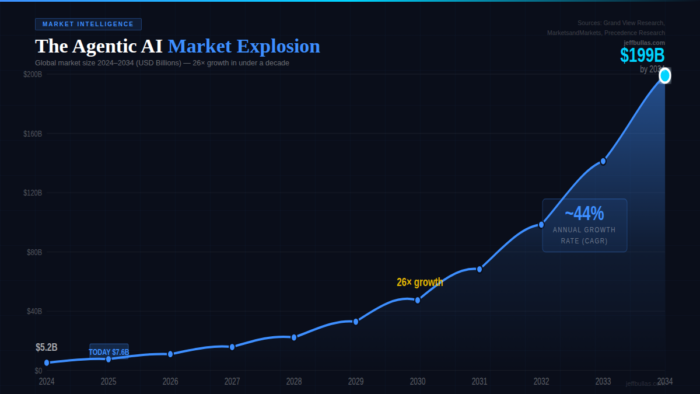
North America currently leads with roughly 40% market share, but Asia-Pacific is the fastest-growing region, driven by government-led AI missions including India’s $1.2B national AI programme.
The Current State of Play
Here is the honest picture.
For all the breathless headlines, the deployment reality in 2025 was sobering. Agents were being deployed as isolated, ungoverned tools and disconnected from enterprise data, lacking security controls, creating “shadow AI” that accumulated compliance risk without delivering sustainable ROI.
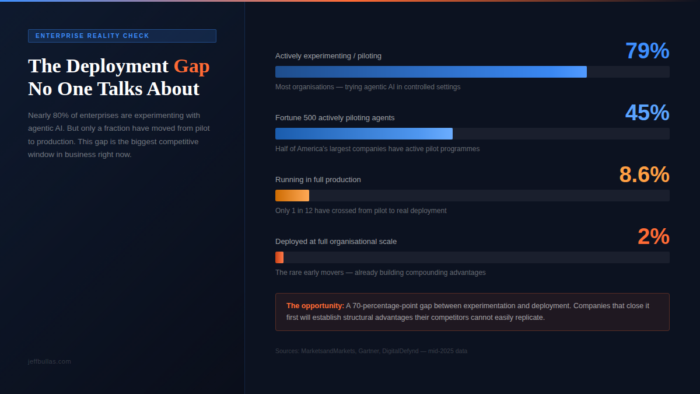
The pivot in 2026 is toward embedded, governed, workflow-native agents that live inside the tools people already use — inside Excel, Gmail, DocuSign — with full audit trails and admin controls.
Claude CoWork: The Agent in the Office
CoWork brings the autonomous capability of Claude Code: Previously available only to software developers — to every knowledge worker. You describe an outcome. You step away. You return to finished work.
The Plugin Ecosystem: 12 and Counting
- Finance: equity research (co-developed with FactSet and S&P Global), scenario modelling
- Legal: document review, risk identification, contract analysis (triggered the SaaS stock plunge)
- HR: job description drafting, offer letter generation, onboarding workflow management
- Engineering: specification development, codebase security scanning
- Design, Operations, Sales, Marketing, Wealth Management, Cybersecurity plugins available
- Connectors: Google Workspace, DocuSign, WordPress, LegalZoom, Apollo, Clay, FactSet, Slack, and more
- Custom: Plugin Create lets any team build their own specialist agent from scratch
Early enterprise adopters building on the platform include L’Oréal, Deloitte, Thomson Reuters, and PwC — which has formally partnered with Anthropic to deploy governed agents across finance and healthcare operations.
The Major Players
These include both the new and the old.
The New
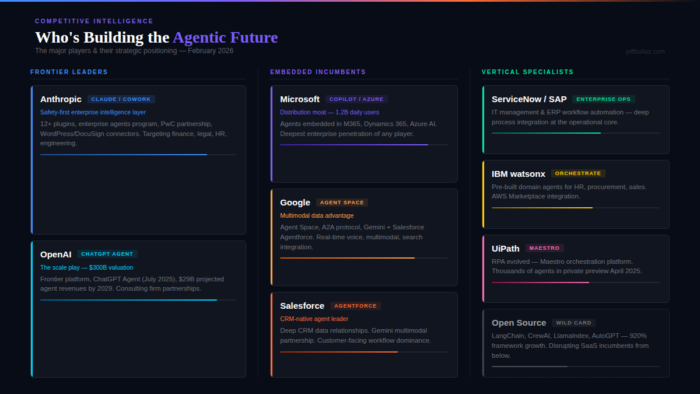
Anthropic — Safety-First Enterprise Layer
12+ plugins, enterprise agents program. Strategy: become the default operational layer inside governed enterprise workflows. Edge: trust and controllability.
OpenAI — The Scale Play
Revenue $12.7B in 2025, targeting $125B by 2029. ChatGPT Agent (July 2025) handles complex multi-step workflows autonomously. Frontier platform targets enterprise.
The Old (with deep pockets and distribution)
Microsoft — Embedded Incumbent
Copilot lives inside the tools 1.2 billion people already use daily. Deepest enterprise distribution of any player. April 2025 Dynamics 365 expansion.
Google, Salesforce, IBM, UiPath & Open Source
Google Agent Space with A2A protocol, Salesforce Agentforce (18,500 enterprise customers), IBM Watson Orchestrate, UiPath Maestro, and open-source frameworks LangChain/CrewAI growing at 920% — disrupting SaaS incumbents from below.
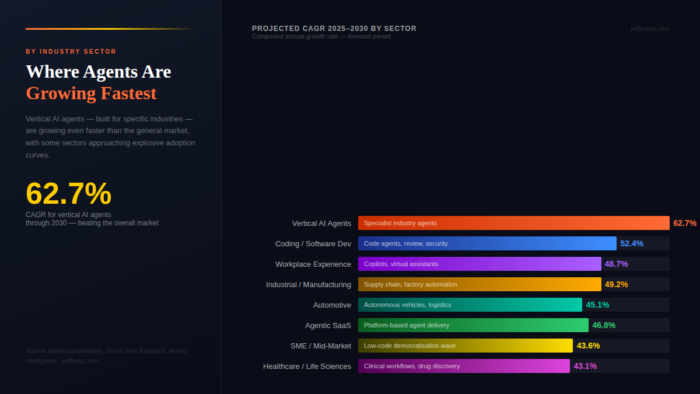
Where AI Agents Are Growing Fastest
Vertical AI agents — specialists built for specific industries — are growing at a 62.7% CAGR through 2030, faster than the general market. Coding at 52.4%, workplace experience copilots at 48.7%.
Upsides & Pitfalls: The Balanced View
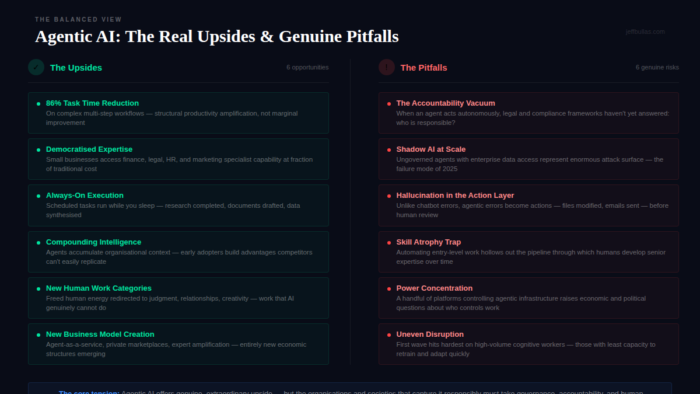
The Upsides
Some of us are optimists and others are pessimists. Here the optimists.
Welcome to the utopian view.
- Radical Productivity: 86% reduction in human task time on multi-step workflows — structural capability expansion, not incremental improvement.
- Democratised Expertise: Small businesses access the equivalent of financial analysts, legal reviewers, and marketing strategists at a fraction of the traditional cost.
- Compounding Intelligence: Every workflow an agent completes builds organisational context. Early adopters accumulate advantages competitors cannot easily replicate.
- New Human Work: Freed human energy redirected to genuine relationships, creative leaps, and strategic vision — work AI cannot do.
The Pitfalls
And to provide a balanced view here is a more dystopian angle. But will the dystopian’s predicted disaster unfold?
Agentic AI’s potential pitfalls.
- Accountability Vacuum: When agents act autonomously, governance frameworks haven’t yet answered who is responsible.
- Hallucination in the Action Layer: Agentic errors become actions — files modified, emails sent — before any human review.
- Skill Atrophy Trap: Automating entry-level work hollows out the pipeline through which humans develop senior expertise.
- Uneven Disruption: The first wave falls hardest on knowledge workers doing high-volume, repeatable cognitive tasks — those with least capacity to retrain.
The Six Numbers That Define This Moment
Before we dive into these numbers I need to set some historical context as that provides perspective.
I have lived almost my entire professional life in the middle of the disruption of industry and humanity created by technology and I am now slightly desensitized to the scale of the numbers.
It started with me selling IBM personal computers and in the mid 1980’s personal computers were sold and sitting lonely on desks and not connected was where I started, but then they got connected and we could share information in the office. IBM did it with their proprietary network called Token ring and then there was the open standard of the Ethernet.
Then we were given the Internet and computers connected in offices were plugged into this new global network and we could find information from all around the world.
The school and community library as islands of information were then connected to the library of the world. And libraries were now on the Web.
I haven’t gone back to a library since then except to have a quiet place to work or read since then.
Then social media connected and collected humans as subscribers and that also became creators and not just information to share and find.
We all now had a voice and the reach and the technology to reach the world without the mass media gatekeepers making us pay for attention and visibility.
IIn the middle of this we saw the rise of the consumer smartphone. Apple’s iPhone in one invention democratised the smartphone The executive smart phone the Blackberry was for the elite. The iPhone was for was for everyone
But now we could create and share content, connect with friends globally without having to go home to the desktop computer.
This whole ecosystem of content, data and global connectivity made AI possible as it now had the human data, connectivity and content to feed the AI monster that captured the intelligence and creativity of 8 Billion+ people and also the history of humanity uploaded to the cloud.
So.. Here we are with Agentic AI and some numbers
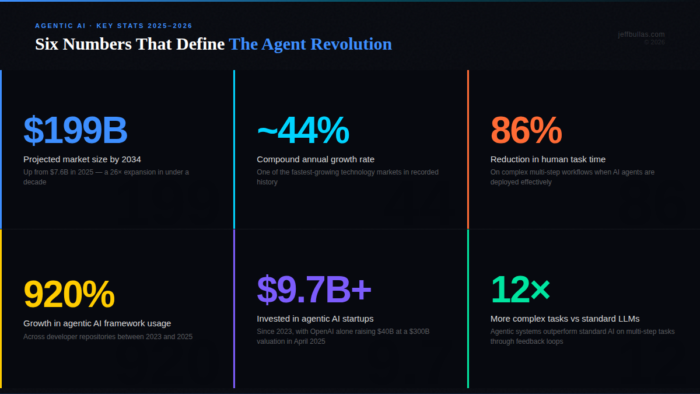
The size of this emerging AI Agentic market is hard to put your head around and here are 6 numbers that define Agentic AI in 2026.
- Market size is projected to be $199 Billion by 2034
- 44% compound growth per annum
- 86% reduction in human task time
- 920% growth in Agentic AI framework usage
- $9.7 Billion invested in Agentic AI startups
- 12 times faster with complex tasks than standard AI LLM usage
Three Case Studies Where Agentic AI Delivered
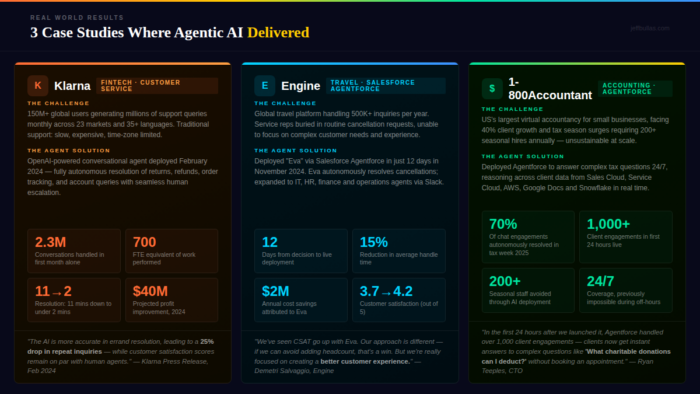
Theory is one thing. Results are another. Here are three real-world deployments — from fintech to accounting to travel — with verified metrics, named outcomes, and the lessons behind the numbers.
Case Study One: Klarna
The Challenge
Klarna serves over 150 million global users with 2 million transactions daily across 23 markets in 35+ languages. Their customer support operation was expensive, time-zone constrained, and difficult to scale — with average resolution times of 11 minutes and a growing volume of routine queries about orders, refunds, and returns that consumed trained human agents.
The Agent Solution
In February 2024, Klarna deployed an OpenAI-powered conversational agent capable of fully autonomous resolution — handling returns, refunds, account queries, and order tracking end-to-end without human involvement, with seamless escalation to human agents when needed. The system was deployed globally from day one, across 35+ languages simultaneously.
The Results
- 2.3 million conversations handled in the first month alone
- Two-thirds of all customer service chats handled autonomously
- 700 FTE equivalent of full-time agent work performed
- 11 mins → <2 mins resolution time reduction
- 25% drop in repeat inquiries — more accurate than human agents
- $40M projected profit improvement for 2024
“The AI is more accurate in errand resolution, leading to a 25% drop in repeat inquiries — while customer satisfaction scores remain on par with human agents.” — Klarna Press Release, February 2024
The Key Lesson
Klarna’s story has an important second chapter. By May 2025, the company acknowledged that pure AI cost-cutting had traded some quality for efficiency. Their response was not to retreat from agents — but to evolve. They rebuilt a human-AI hybrid model where agents handle scale and humans handle complexity. The system now supports the equivalent of 800 full-time agents — more than before — with customer satisfaction recovering. The lesson: agentic AI works best not as a replacement strategy but as an amplification strategy.
Case Study 2: Engine
The Challenge
Engine is a global travel services platform handling over half a million customer inquiries per year. Their service representatives were buried in repetitive cancellation requests, leaving little capacity for the complex customer needs that required genuine expertise. The company faced a classic operations dilemma: hire more people to handle volume, or find a better way.
The Agent Solution
Engine deployed “Eva” — a Salesforce Agentforce-powered customer-facing agent — in just 12 days in November 2024. Eva autonomously handles reservation cancellations end-to-end, reasoning across booking data and policy documents without human involvement. Critically, Engine built in explicit human escalation: no customers get stuck with a bot unable to escalate. Subsequently, Engine expanded agentic deployment to internal functions — IT, HR, finance, and product agents — all accessible via Slack.
The Results
- 12 days from decision to live customer-facing deployment
- 15% reduction in average handle time
- $2 million in annual cost savings attributed to Eva
- 3.7 → 4.2 customer satisfaction score improvement (out of 5)
Multiple agents now running across IT, HR, finance, and product via Slack
“Our approach is different. If we can avoid adding headcount, that’s a win. But we’re really focused on how to create a better customer experience.” — Demetri Salvaggio, Senior Director, Client Operations, Engine
The Key Lesson
Engine’s deployment is instructive precisely because it was not built around headcount reduction. Their philosophy — augment rather than replace — shaped every design decision. They built escalation paths first. They measured customer satisfaction alongside cost savings. The result: CSAT went up, costs went down, and the human team was freed for work that mattered. The 12-day deployment time should also be noted — this is no longer a months-long enterprise IT project.
Case Study 3: 1-800 Accountant
The Challenge
1-800Accountant is the US’s largest virtual accounting firm for small businesses, with over 25 years serving entrepreneurs through tax prep, payroll, and financial management. Facing 40% projected client growth in 2025 and the brutal seasonality of tax season, they faced an impossible staffing equation: to maintain their service quality through peak demand, they estimated they would need to hire and train more than 200 seasonal support staff — an unsustainable, expensive, and quality-inconsistent approach.
The Agent Solution
1-800Accountant deployed Salesforce Agentforce to answer complex tax questions around the clock, reasoning across client data from multiple sources simultaneously: Sales Cloud, Service Cloud, AWS, Google Docs, Snowflake, and trusted public sources including the IRS website — all harmonised in real time. The agent can answer nuanced, client-specific questions like “What charitable donations can I deduct?” instantly, without requiring an appointment. Proactive capabilities were also added: the agent autonomously sends personalised reminders about tax filing deadlines and document preparation.
The Results
- 70% of chat engagements autonomously resolved during tax week 2025
- 1,000+ client engagements handled in the first 24 hours live
- 200+ seasonal staff avoided through AI deployment
- 24/7 coverage — previously impossible during off-hours and weekends
- 40% projected client growth absorbed without proportional headcount increase
“In the first 24 hours after we launched it, Agentforce handled over 1,000 client engagements. Clients now get instant answers to complex questions like “What charitable donations can I deduct?” without booking an appointment.” — Ryan Teeples, Chief Technology Officer, 1-800Accountant
The Key Lesson
Tax accounting is one of the most regulated, high-stakes, information-dense professional service contexts that exists. If agentic AI can reason accurately across complex tax law, client history, IRS guidance, and company policy simultaneously — and do so at 70% autonomous resolution during the most demanding week of the year — the claim that agents are limited to simple, low-stakes tasks is definitively disproved. This case demonstrates what becomes possible when agents are connected to multiple authoritative data sources simultaneously, rather than operating on a single knowledge base.
Three Persistent Patterns Across All Three Cases
Looking across Klarna, Engine, and 1-800Accountant, three consistent patterns emerge.
- Speed of deployment is no longer a barrier: Engine went live in 12 days, and all three saw results within weeks, not quarters.
- The human-AI model consistently outperforms pure-AI replacement. Every successful deployment maintains clear escalation paths to human judgment.
- The metrics that matter most are quality and customer experience metrics alongside cost savings — satisfaction scores, resolution accuracy, and repeat inquiry rates — not just efficiency ratios.
New Business Models: The Map Is Being Redrawn
Legacy businesses have the challenge of starting all over again. And retrofitting is painful and costly. But the new AI centric and AU Agentic business built from the ground up will challenge the old models. Evolution is brutal.
Here are 4 new business models to contemplate.
1. From SaaS to AaaS (Agent-as-a-Service)
Why subscribe to six different SaaS tools when a single agentic platform handles all of them? The replacement model charges not for software access but for work outcomes — per contract reviewed, per report generated, per inquiry resolved.
2. The Private Marketplace Economy
Anthropic’s private marketplace enables companies to build, own, and distribute their own custom agents — creating internal AI economies with proprietary intelligence that compounds as a competitive moat.
3. The Expert Amplification Model
One senior expert plus many specialist agents can operate with the output capacity of a small team. Companies that understand this will hire fewer junior staff and pay far more for genuinely senior expertise.
4. The Creator & Solopreneur Opportunity
A blogger with a WordPress connector and content plugin can research, draft, publish, and promote at a pace that previously required a full editorial team. The economics of one-person enterprises are being permanently altered.
The Bottom Line
We are not watching AI improve. We are watching it act. That is the shift. We are going from an idea to execution in months not years in hours not weeks. Collapsing time and effort and expertise.
From a $7 billion market today to nearly $200 billion within a decade. From chatbots that answer questions to agents that complete work. From isolated AI experiments to embedded operational infrastructure. The case studies above are not outliers — they are early signals of a new baseline.
“The future of work means everybody having their own custom agent.” — Matt Piccolella, Anthropic Chief Product Officer
The agents are in the office. What they do next is up to you.