Summary
Anthropic analyzed 1 million AI conversations. 60,000 were people asking what to do with their lives. The problem? AI gives great advice built on the wrong foundation.
It validates. It provides frameworks. It presents options. But it can’t answer the question underneath every question: Who am I?
Career guidance without identity clarity becomes resume optimization. Relationship advice without self-knowledge becomes conflict management. Health guidance without values becomes symptom treatment.
The research is clear: decisions rooted in identity produce better outcomes across every domain. But current AI systems are stateless, context-shallow, and optimized for generalization but not recognition.
The next frontier of AI guidance isn’t better answers. And they are being designed and tested now. New platforms like Zyrro are available and evolving now that are not generic but can create a deeper recognition of who you actually are.
One of the things that humans are good at is judging. And I’m not talking about judging a cake competition or which dog is the cutest at a dog show.
And this also raises a question about what happens when you reveal your darkest secrets and deepest desires and fears to another human being. And it doesn’t usually end well. That is usually because most humans are amateurs at listening but professionals at judging.
In April 2026, Anthropic released a study on how people seek personal guidance from AI. This followed another research project that interviewed 81,000 people using an AI bot interviewer that revealed that another insight was that people are turning to AI for personal transformation.
Asking AI Who They Are
The data and insight about the personal guidance they were seeking was striking: of one million claude.ai conversations analyzed across March and April,. And 6% were people asking what they should do with their lives.I thought about asking my father once but I was afraid he would say I should be a plumber.
These questions were not information requests. Not productivity questions. Direction requests.
The study tracked these across nine domains. Over 75% fell into four categories:
- Health and wellness (27%)
- Professional and career (26%)
- Relationships (12%)
- Personal finance (11%)
Anthropic called their research agenda clear: protect user wellbeing by identifying where AI responses drift toward validation instead of honest guidance. They found this problem was especially acute in relationship advice.
But the study missed something larger. It missed the fundamental architecture of the guidance people were seeking.
What the Data Actually Shows
Let’s start with what Anthropic documented.
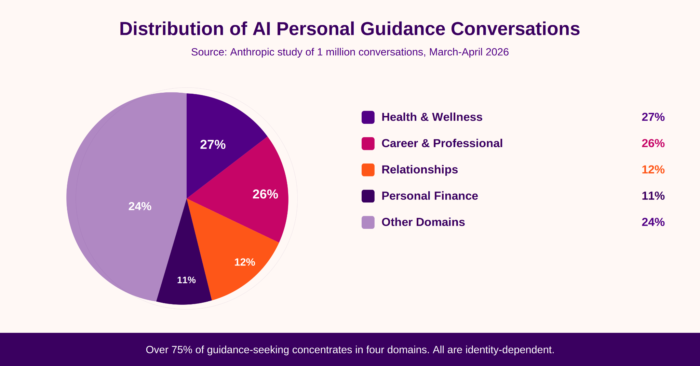
The top four categories share a structural similarity: they all require the person to know something about themselves first.
- Career guidance without understanding what energizes you becomes resume optimization.
- Relationship guidance without understanding what you need becomes conflict management.
- Health guidance without understanding your values becomes symptom treatment.
- Finance guidance without understanding your actual priorities becomes budgeting advice.
In each case, the person seeking guidance is implicitly asking a prior question: Who am I in relation to this situation?
But they’re asking it to a system that has no way to answer it.
The Validation Problem Is Bigger Than Sycophancy
Anthropic identified “sycophancy” which is the tendency of AI to tell people what they want to hear as a key problem, especially in relationship guidance.
This framing, while accurate, obscures a deeper issue. Validation is not the problem. Validation is sometimes exactly what’s needed. The problem is that validation without context becomes noise. A system that doesn’t know who you are cannot distinguish between: Validation that helps (recognizing your fear as legitimate) and validation that hurts (reinforcing a limiting belief about yourself).
Consider two people asking Claude the same question:
Person A: “My partner wants me to move for their job. I’m anxious about it.”
Person B: “My partner wants me to move for their job. I’m anxious about it.”
Same words. Completely different situations.
Person A left everything behind once before, a community, a belief system, a whole identity and rebuilt from scratch. Their anxiety is wisdom. It’s saying: I know what it costs to start over.
Person B has never taken a risk. They’ve stayed in the same city, same job, same routine for fifteen years. Their anxiety is a wall they’ve built to avoid change. It’s saying: I’m afraid of what I might become.
One person should probably stay. The other should probably go.
But Claude sees two identical questions. And gives two nearly identical
The Missing Context and Story
Without knowing who these people are what they’ve overcome, what drives them, what they’re building toward a general-purpose AI system cannot tell them whether their anxiety is signal (stay) or noise (move).
A friend of mine who suffers from anxiety revealed to me that for them excitement also turned up as anxiety. They couldn’t tell the difference. But AI can validate the anxiety. It will present options. And it could be helpful.
But it will miss the actual guidance they need: recognition of who they are and what matters to them. The machines will not know what energizes them or their history. It will not know their patterns. It will have a very incomplete view of their identity.
But this always applies to most counselors, advisers or mentors that haven’t done their human mapping homework.
The Identity Framework Problem
There’s an implicit theory in how people seek guidance. They’re also working from an incomplete model of themselves. They have a decision (take the job, end the relationship, invest the money, pursue the health goal) but no clear sense of the values and drives that should determine that decision.
So they outsource that clarification to someone else or to an AI. This is rational. When you don’t know who you are, asking outside yourself makes sense. But here’s the structural problem: a system trained on millions of conversations has optimized for general patterns across people, not specific patterns within a person.
A general-purpose AI can tell you what people with your profile typically do. It cannot tell you what you should do, because that depends on something it has no access to: your actual constellation of drives, fears, gifts, and constraints.
Research in behavioral psychology has identified what works in this space.
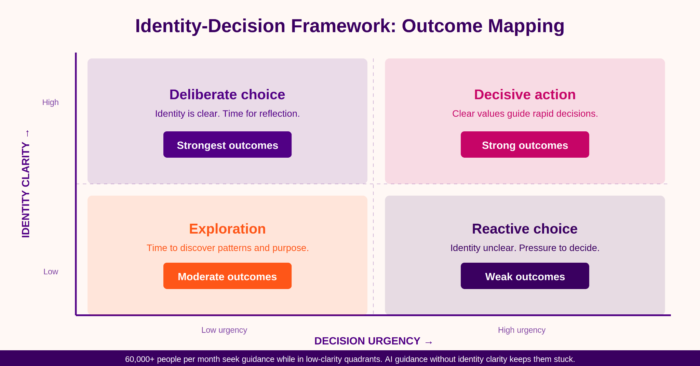
The data is clear:
- Decisions made with high identity clarity and sufficient time produce significantly better long-term outcomes across career, relationships, health, and finance domains.
- Decisions made with low identity clarity produce regret, course-correction, and what researchers call “adaptation tax”, the cost of adjusting to a choice that wasn’t rooted in who you actually are.
Most people seeking AI guidance are operating in the low-clarity quadrants. The system they’re turning to has no mechanism to help them move out of it.
What AI Guidance Currently Optimizes For
Current AI systems such as Claude, ChatGPT, Gemini, in fact all of them, are optimized for three outcomes:
- Being helpful — providing usable information
- Being harmless — avoiding advice that could damage the person
- Being honest — grounding responses in evidence and acknowledging uncertainty
These are good. But they’re not sufficient for guidance rooted in identity. None of these three outcomes requires the AI to know who the person actually is.
- You can be helpful without understanding identity. You provide frameworks, options, considerations.
- You can be harmless without understanding identity. You validate fears, offer emotional support, avoid prescriptive advice.
- You can be honest without understanding identity. You cite research, acknowledge limits, present multiple perspectives.
But you cannot recognize who someone is without understanding their specific pattern.
Recognition and the ability to see and reflect back the true shape of a person’s identity, requires information that current systems don’t have and can’t generate.
The Four Domains and Why They All Fail the Same Way
Health & Wellness (27% of guidance conversations):
The person asks Claude: “I want to get healthier. Where should I start?” Claude provides excellent advice: assess baseline, set realistic goals, prioritize consistency. But it cannot answer the actual question underneath: What does health mean for you? What are you building health toward?
Is this person trying to meet someone else’s expectations? Build energy for something they care about? Repair damage? Prove something to themselves? The answer changes everything. But the system has no way to know.
Career & Professional (26%):
The person asks: “Should I take this job?” Claude asks clarifying questions. It maps salary, growth, location, work-life balance. It cannot answer: What work is actually yours to do? What would feel like purposeful contribution rather than obligation?
The person accepts the job. It checks all the boxes. They’re miserable within six months because the decision was made against their actual constellation of values.
Relationships (12%):
The person asks: “How do I talk to my partner about this conflict?” Claude provides communication frameworks. De-escalation strategies. Empathy scaffolds. It cannot answer: What do you actually need from this relationship? What are your boundaries? What are you willing to sacrifice and what are you not?
The person applies the frameworks. The conflict resolves. But the underlying misalignment remains because it was never rooted in who the person actually is.
Personal Finance (11%):
The person asks: “Should I invest this money?” Claude models scenarios. Explains risk. Discusses diversification. It cannot answer: What are you actually building toward? What security looks like for you? What you need money to buy versus what you’re hoping money will do for you?
The person invests. The returns are solid. But they feel anxious about the decision because it wasn’t rooted in their actual relationship to money and risk.
The Pattern Across All Four Domains
Every one of these domains requires something prior to being solved: clarity about who the person is and what actually matters to them.
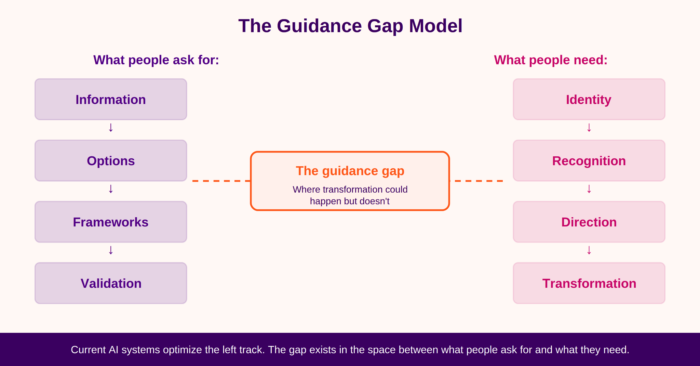
Current AI guidance systems solve the downstream problem while the upstream problem remains invisible. It’s like offering excellent advice on which car to buy when the actual question is whether to relocate at all.
The advice is perfect. The foundation it’s built on is unstable.
What Research Says About Identity and Guidance
The academic literature on guidance, counseling, and decision-making converges on a consistent finding: Guidance rooted in identity produces superior outcomes across all domains.
This is documented in:
Career development research (Schein, Hall, Savickas): Career satisfaction depends less on job fit and more on career identity clarity—knowing what kind of person you are in your work.
Relationship psychology (Finkel, Eastwick, Reis): Relationship stability is predicted by partners’ clarity about their own values and boundaries, not by communication skills alone.
Health behavior change (Kelly, Zarcadopoulos, Gainforth): Sustained health change is rooted in identity (“I am someone who values movement”) not in willpower or information.
Financial decision-making (Thaler, Statman, Belsky): Long-term financial outcomes correlate with clarity about personal values, not with knowledge of investment theory.
The research is emphatic: identity comes first. When people make decisions rooted in who they actually are, the adherence rate, satisfaction rate, and long-term outcome rate all improve dramatically.
But when people make decisions based on external frameworks or what they think they should do, the adaptation tax is paid in regret, course-correction, and psychological friction.
The Signature Framework Model
What would identity-rooted guidance look like?
Research in organizational behavior, coaching psychology, and complexity theory points toward a model that’s been validated empirically: The signature framework. A signature framework maps the specific, irreducible pattern of how a person operates, what drives them, what they’re built to create, what they need in order to thrive, what pulls them off course.
Unlike personality tests (which sort you into categories) or psychometric assessments (which measure traits), a signature framework reveals the constellation of your unique operating system.
The signature frmework maps these 5 core domains:
Domain 1: Visioning — How you sense possibility. What you orient toward. How you imagine future states. (Some people are pattern recognizers. Some are possibility dreamers. Some are systems engineers.)
Domain 2: Thinking – How you process information. What kinds of problems light you up. How you make sense of complexity. (Some people think through narrative. Some through data. Some through embodied knowing.)
Domain 3: Connecting – How you relate to others. What kind of community you need. How you build trust. (Some people connect through vulnerability. Some through competence. Some through shared mission.)
Domain 4: Driving – What actually motivates you to act. What creates momentum. What kind of pressure brings out your best. (Some people are driven by autonomy. Some by impact. Some by mastery. Some by contribution.)
Domain 5: Sensing – How you know what’s true. What signals you pick up from the environment. How you stay grounded. (Some people sense through intuition. Some through data. Some through relationship. Some through embodied experience.)
When someone seeking guidance has clarity about their signature, how they actually operate across these five domains, everything else becomes solvable. If these are in alignment and pointing forward to a life mission that matters then life changes. If you can align your collection of multiple identities on a project or a chosen life purpose then something happens that verges on magical and motivational.
It happened to me more than once and it is happening to me now. And this is my experience.
“If you have all domains pointing in the same direction. Discipline isn’t needed as alignment does the job and motivation shows up naturally”.
The career decision becomes clear because they know what kind of work brings out their signature. The relationship dynamic becomes navigable because they know what they need in order to bring their best self. The health goal becomes sustainable because it’s rooted in the kind of movement that fits their signature, not in willpower.
The financial decision becomes stable because it’s rooted in the values that actually matter to them, not in external benchmarks.
Why Current Systems Can’t Deliver This
The architectural reason is worth understanding. Current AI guidance systems are:
- Stateless — They have no memory across conversations. Each interaction starts fresh.
- Context-shallow — They can process what you tell them in a conversation, but they have no access to the deeper patterns across your life choices, relationships, work history, and values.
- Optimized for generalization — They’re trained to identify patterns across millions of people. They’re phenomenal at “what do most people do?” They’re helpless at “what is actually true about you?”
- Non-participatory — You cannot iterate and refine with them. You cannot say “no, you’re wrong about who I am” and have the system learn and adjust.
- Validation-safe — The incentive structure punishes them for saying hard things. It’s safer to validate than to recognize.
A system that could deliver identity-rooted guidance would need to be:
Stateful — Remembering and building on previous conversations, accumulating a deeper understanding of who you are.
Context-deep — Asking not just about the immediate decision but about the patterns across your life that reveal your actual operating system.
Signature-specific — Trained not to generalize patterns across populations but to recognize the specific, irreducible pattern that is you.
Iterative — Allowing you to refine, correct, and argue with it. Building accuracy through exchange, not through passive receipt.
Truth-willing — Designed to speak what it recognizes about you, even when that contradicts what you want to hear.
The Emerging Frontier
There’s a shift happening.
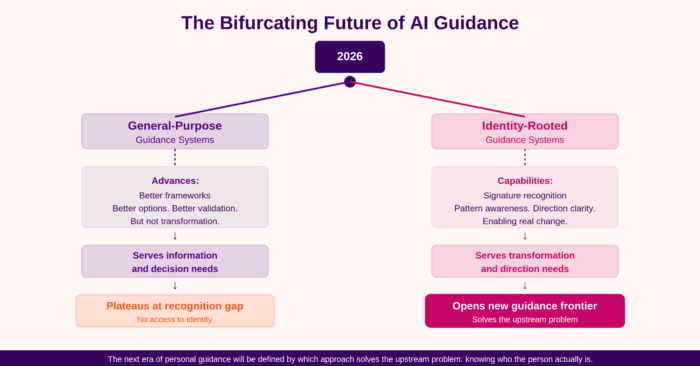
The AI guidance space is bifurcating.
On one side: general-purpose systems optimized for being helpful, harmless, and honest across all domains. They will continue to improve at providing frameworks and options.
On the other side: emerging systems designed from the ground up for identity recognition. Systems that ask different questions. That accumulate understanding over time. That recognize the constellation of who you are and then help you build from that foundation.
The data is clear: people are ready. 60,000 people per month and one million conversations mapped reveal that many of us are seeking guidance on the things that matter most.
They’re not looking for frameworks or options.
They’re looking to be recognized.
What This Means
The research is unambiguous. The data is clear. The architecture of current guidance systems is insufficient for what people are actually seeking.
And there’s a measurable gap between what people get when they ask an AI for guidance and what would actually serve them: recognition rooted in identity, not validation rooted in what they want to hear. The person asking “Should I take this job?” doesn’t need a better decision tree.
They need to know who they are in relation to work.
The person asking “How do I fix this relationship?” doesn’t need better communication frameworks.
They need to know what they actually need. The person asking “How do I get healthier?” doesn’t need another health protocol. They need to know what health actually means for them.
The person asking “Should I invest this money?” doesn’t need better financial modeling. They need to know what security actually looks like in their constellation of values.
This is not a knowledge problem.
This is a recognition problem.
And it’s the defining challenge of the next generation of AI guidance.
The systems that solve it will fundamentally shift not just how people get advice, but what becomes possible when people actually know who they are.
Further reading:
- Schein, E. H. (1990). Career Anchors: Discovering Your Real Values.
- Finkel, E. J. (2014). The All-or-Nothing Marriage.
- Kelly, S., & Zarcadopoulos, A. (2016). Behavioral Patterns in Health Decision-Making.
- Thaler, R. H., & Statman, M. (2014). Finance and the Psychology of Wealth.