Executive summary
In one week in October 2026 I asked people on X three things about AI and age. The 733 replies, from about 675 people, were each coded by stance, theme and stated age. Here is what they show.
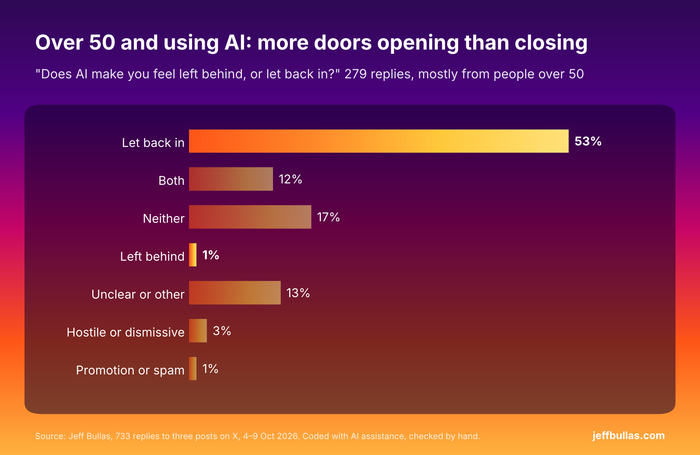
- AI is making people over 50 more capable, not obsolete. 53% of 279 people answering my over-50 question said AI had opened doors back into work and opportunities they thought had passed them by. Another 12% said both. Only 3 people (1%) felt simply left behind.
- What AI restores is capacity. The biggest theme was people doing again what age, time or missing skills had stopped them doing. Learning, judgment and ageism followed.
- The deeper fear is not being needed. Repliers rarely feared the technology. They feared being overlooked, ending up with “nobody needing you”, and thinking less without noticing.
- Those who feel “both” are often the disrupted. People whose careers or businesses AI has shaken feel capable and threatened at the same time.
- Dependence is the real tension. Almost one in five replies to my dependence question said it is already happening. Only 19% named a clear line. The most popular rule: think first, then ask AI.
- The young are more worried than the old. National surveys show under-30s are far more pessimistic about AI and creativity than over-65s. Some older repliers worried more about their children than themselves.
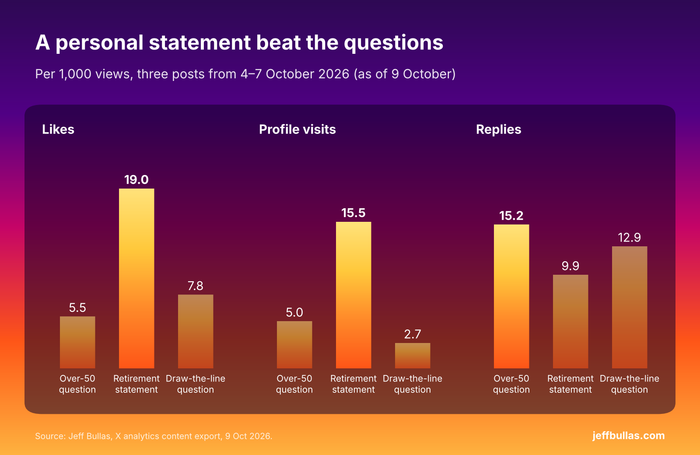
- How you ask decides who answers. Posts that named an age drew warm, personal replies. A general AI post drew almost no stated ages and around four times the hostility. A personal statement earned at least three times the profile visits of a question.
The implication: the over-50 opportunity is not teaching tools. It is helping experienced people see what their judgment is worth now, who needs it, and how to use AI without handing over the thinking that made them valuable.
A question I didn’t expect to matter
Last Sunday night I posted a simple question on X. “Honest question for anyone over 50. Does AI make you feel left behind, or let back in?” I added that I had felt both in the same week. That was true.
I expected a few dozen replies. By Thursday there were 279. The post was seen more than 18,000 times. Then I posted two more. One was a statement: “I’m 69. I’m supposed to be thinking about retirement. Instead I’m thinking about what I can build next.” The other was a worry: “At what point does assistance become dependence? Where would you draw the line?”
Together the three posts drew 733 replies from about 675 people. I read every one. Then I coded them by stance, theme and stated age, with AI doing the first pass and me checking the results. What came back challenged the story we usually tell about older people and AI. It also changed how I think about what people over 50 actually need.
Why I’m in the data
I started my blog at 52, after my business fell apart. I wrote at 4:30am because it was the only quiet time I had. Nobody was waiting for a 52-year-old to reinvent himself. The internet let me do it anyway, and the blog went on to reach millions of readers.
Now I’m 69 and building again, this time with AI. So when people talk about older workers and AI, I’m not observing from a distance. I’m one of the data points. That is why I wanted to hear from others in the same boat, in their own words, rather than in a survey’s tick boxes.
Surveys tell you what people choose from a list. Replies tell you what people say when nobody gives them a list. Both matter. This piece puts the two side by side.
Where does your experience fit now?
This research is shaping what I’m building. Zyrro is an AI mentor that helps experienced people see what their experience is worth now, and who needs it.
You answer 13 questions in your own words. You get a free report on your strengths, what energises you and the themes that keep showing up in your life. The first group of testers starts soon.
Finding 1: Most say AI is making them more capable
The headline is clear. Of 279 replies to the over-50 question, 53% said AI had let them back in. Another 12% said both, and 17% said neither. Only 3 people, about 1%, said they simply felt left behind.
That is not the story we usually hear. The usual story says older people are the ones AI will leave behind. The people who replied told a different story. A 57-year-old moved a 10-year-old game to a new platform. “Usually, this would have been a six-month task, now five hours.” Another reader put it more simply:
I am a woodsman that had a hatchet and now have a chainsaw.
Of course, this is not a random sample. People who reply to me on X are curious about AI. But the result still matters. Among people over 50 who are paying attention, fear is not the main feeling. Possibility is.
It also matters what “neither” meant. Most of the 17% were not afraid. They saw AI as “only a tool”, or said they had never felt out in the first place. Calm, not anxious.
Finding 2: What AI gave back was capacity
When I coded what people actually said, one theme stood far above the rest. AI had given back capacity they thought was gone. Not new ambitions so much as old ones they could finally act on.
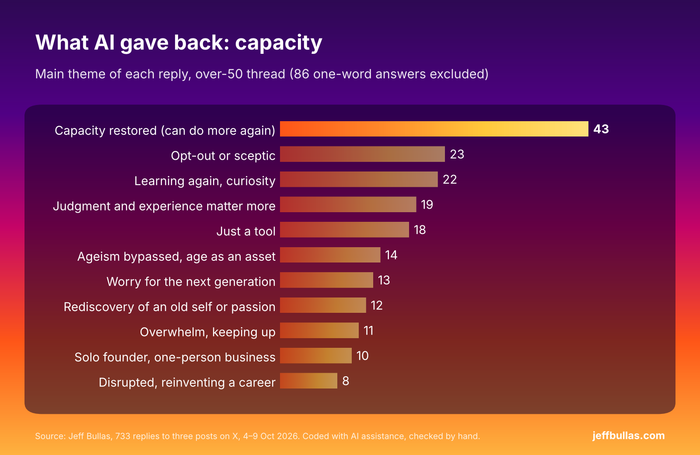
One man approaching 60 wrote that his capacity had become more limited with age. “AI is lifting that limit.” Another reader said they could no longer work at the level of their 20s and 30s. “Now, I can get more done than I did back then.” A third could finally act on thinking they had carried for years but “lacked the skills to make it real.”
Some of the most moving replies were about identity, not output. One reader described it as “picking up a part of myself I’d put down.” A writer said AI had eased the loneliness of the craft by giving her “someone to point out your errors or inspire you to new heights.” Another wrote that AI had brought coding back into their life after eye and back strain made it too hard.
Two other themes matter for anyone over 50. The first is judgment. One reply said the tool is the part a 25-year-old can buy. “Knowing which customer exception actually counts after 1,000 tickets? Not for sale.” The second is ageism. “For the most part, AI has pushed ageism off the board,” wrote a former advertising creative director. Before AI, he said, nobody would hire you with more than 15 years of experience.
There is a money side too. One founder wrote that what once would have taken “years and millions of dollars I can now execute alone for a couple of thousand dollars.” For people with decades of knowledge and limited runway, that changes the maths of starting again.
Finding 3: Those who feel “both” are the disrupted
The 33 people who said “both” are worth a closer look. They were not confused. Many were people whose careers or businesses AI had shaken.
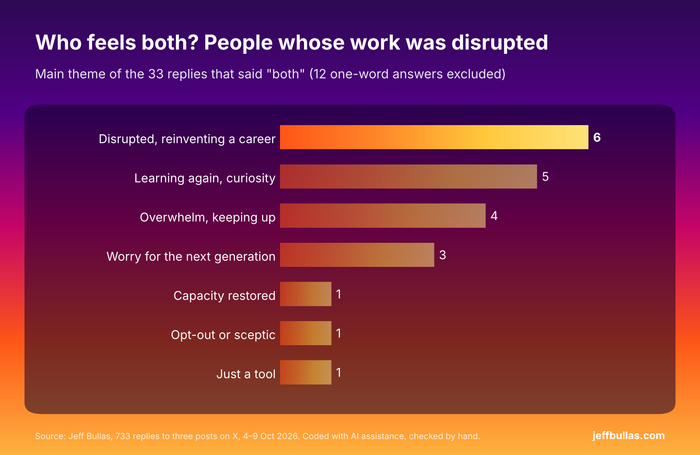
One wrote that AI had “caused disruption to my existing business model so am back to start-up mode at 53.” Others were learning fast but struggling to keep up. One reader summed it up in a single line:
AI can make you feel obsolete and capable again in the same afternoon.
This is the group that most needs help, and the group most likely to be missed. They are not sceptics and not cheerleaders. They are in the middle of a career change they did not choose.
Finding 4: The real fear is not being needed
My retirement post drew a different crowd. The middle stated age was 62, against 55 on the over-50 question. Most of them were in their 60s and 70s. The oldest was 80.
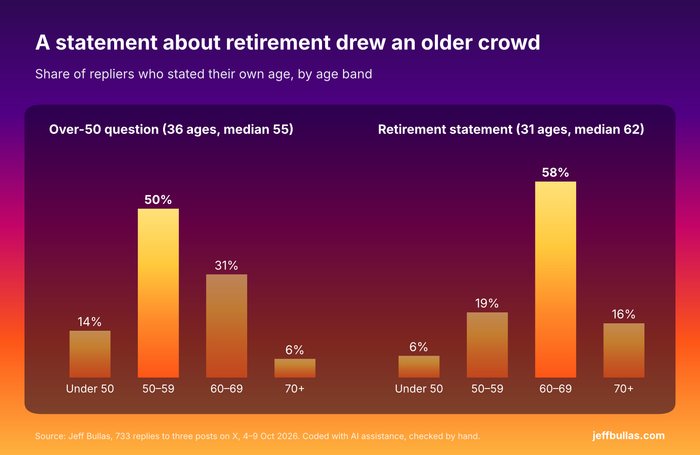
Most of these replies were celebrations. “I’m 75 and never retiring.” A 65-year-old now works as an AI enablement specialist. A 59-year-old who was called to the bar in 2023 now spends his days steeped in code and regulations, with “a 30 year work plan ahead.” A man of almost 76 is registering a new business next week. One reader’s mother, at 83, says she “hasn’t got enough time to retire anymore.”
But one reply, from a 63-year-old, named something deeper:
The script isn’t really the problem, it’s that it ends with nobody needing you.
I think he is right. The fear is not stopping work. It is stopping being needed. A 65-year-old put the same fear another way. They have the domain expertise, they wrote, “but that 65 has people not reaching out to me.” Another reader framed the opportunity: “judgment at 69 is a different asset than energy at 29.”
This lines up with wider research. In a survey of 1,505 American adults published by Elon University in September 2026, 64% agreed that by replacing humans in most tasks, AI will undermine our sense of purpose and meaning. 69% said it will weaken human bonds. Purpose, not productivity, is the deeper worry.
The tension: are we thinking less?
Not everyone was cheering. My third post asked where people would draw the line between assistance and dependence. Its 282 replies were the most divided of the three.
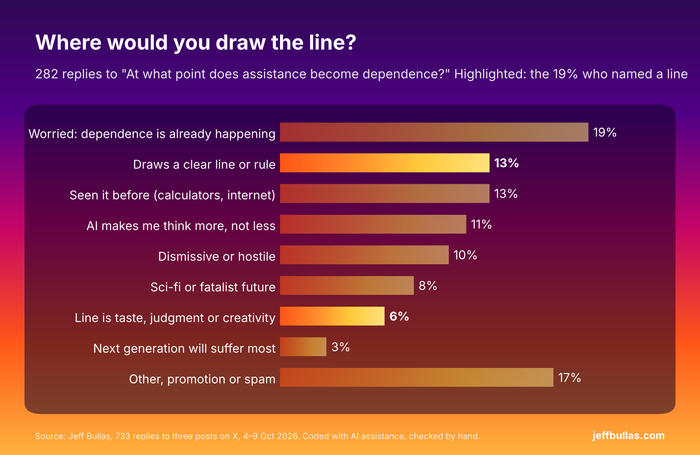
Almost one in five said dependence is already happening. One reader watched colleagues “who far outrank me in experience and education” struggle “to think even simple concepts without asking AI.” Another admitted: “Forgetting how I once did things.” Several used the GPS comparison. Use it or lose it. One reader put it bluntly: “AI is doing to thinking what social media did to attention spans.” A 56-year-old engineer said we crossed that line decades ago, when schools stopped asking students to show their working.
Others said the opposite. A retired reader wrote that he had “used more math in the last 12 months than I did in the preceding 30 years of career.” Another said he had never read so much in his life. Same tool. Opposite result.
One reply reframed the problem. Dependence, he argued, is not driven by laziness but by “impatience and anxiety”. The world moves too fast, so people reach for the fastest answer. Another offered a simple test for when you have crossed the line: when someone asks you a question and you “can’t answer it without having the urge to use AI.”
The same Elon survey captures both sides. Among people who use AI chatbots, 51% said they feel lazy or take shortcuts at least some of the time, and 39% said they are growing too dependent. Yet 52% said AI had improved their motivation to learn new skills, against 5% who said it made it worse.
The research suggests the difference is how you use it. In a study by Microsoft and Carnegie Mellon of 319 knowledge workers, more trust in AI went with less critical thinking, while more self-confidence went with more. In a small MIT Media Lab study (54 people, not yet peer reviewed), most people who wrote essays with ChatGPT could not quote their own work afterwards. The group that wrote first and used AI second stayed the most engaged.
The most-liked reply in the thread, with 21 likes, said the same thing in one line. “Formulate your own ideas first, then use AI to challenge, refine and expand.” Other readers had their own versions. One asks AI to find sources she then reads herself. Another never uses AI on a topic they don’t already know, because they couldn’t spot its mistakes. A writer never uses AI to write, because “what sells is my style.” Someone whose agency runs 90% on AI agents said the line is “taste and final accountability.”
One reader made the point with humour. He asked AI where to draw the line. “It recommended independent thinking, then offered to do it for $20 a month.”
The young are more worried than the old
Here is a twist the headlines miss. Older people are not the most worried about AI. The young are.
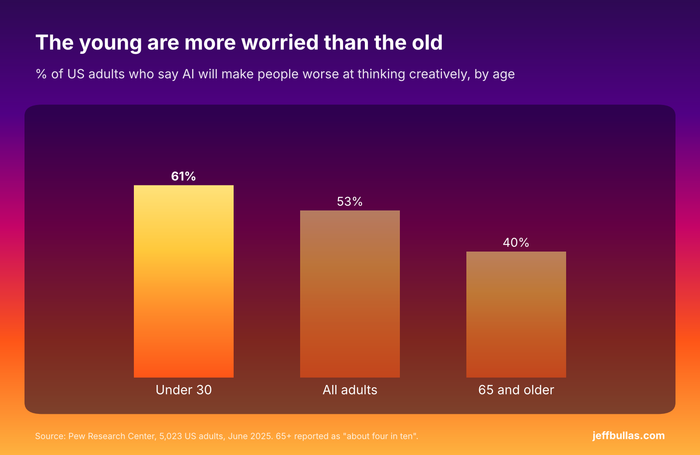
The Pew Research Center found that 61% of Americans under 30 expect AI to make people worse at thinking creatively. Among those 65 and older, it was about four in ten. Under-30s were also more likely to expect AI to damage relationships.
My replies showed the same pattern from the other side. Some of the deepest worry was not for themselves. “What actually keeps me up is my adult kids,” one parent wrote. “They’re trying to get a first job competing against agents.” Another reader turned an old joke around. Parents used to ask their kids for tech help. Now, he said, “they now come to me when they need help using it.”
There is resentment too, and it deserves honesty. One younger reply said: “Because you won’t retire, an entire generation is struggling.” That is a real tension. If experienced people now have more leverage, the question of how they make room for the next generation becomes more urgent, not less.
A surprise: how you ask decides who answers
The three posts drew three different crowds. The two posts about age drew people who shared their age and their stories. The general post about AI dependence drew almost no stated ages and around four times the hostility. One person replied with two words: “Thanks Gramps.”
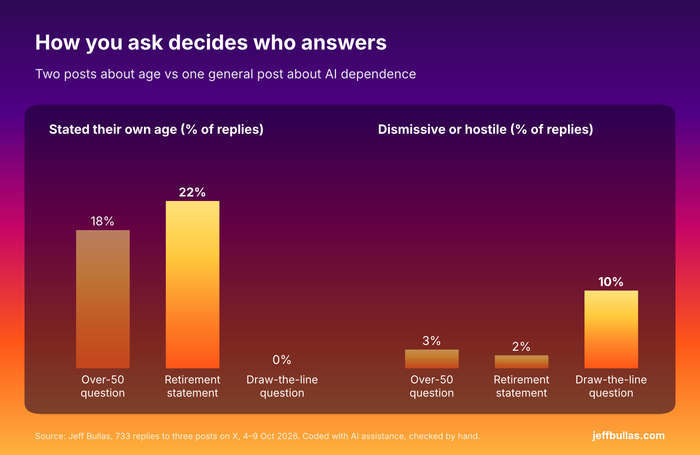
The posts also performed differently. The personal statement about retirement earned 19.6 likes and 15.6 profile visits per 1,000 views. The questions earned more replies but far fewer visits. A question starts a conversation. A personal story makes people want to know who you are.
There is a lesson here beyond social media. If you are over 50 and want to be found, lead with your story and your age. Hiding it attracts the wrong crowd. Owning it attracts your people.
What the cheerleaders miss
Not every reply was a victory lap, and the doubts deserve space. One man has been retired for 17 years and is “happily doing basically nothing.” Another wants naps, a cello and the beach. They are not wrong. As one reader put it, retirement “was designed around a world where capability faded with age and tools stayed the same.” Retirement is not the problem. Being told when to do it is.
Others warned about the cost of too much possibility. One reader took a month off after pushing himself to “near mental exhaustion.” Another warned: “Watch the burnout, this fun can quickly take over.” A third described building as “a new drug.” He said he was addicted to “building shit nobody wants because I can now.” AI makes building easy. It does not make finding the people who need it any easier.
And there are practical barriers. A 70-year-old wrote that coming out of retirement would cost him more than $80,000. For many people, the choice to keep working is shaped by tax, pensions and health, not just by mindset.
Six kinds of people in the replies
Reading 733 replies, six groups kept appearing. They are not neat boxes, and many people fit more than one. But they help explain why the same technology feels so different to different people.
1. The capacity restorers
The largest group. Age, energy or missing skills had limited them, and AI has lifted the limit. They want to do more of what they already know.
2. The rediscoverers
People picking up an old passion or an old self: music, coding, writing, a game they built a decade ago. For them AI is less a tool than a door back to who they were.
3. The solo founders
People building a business alone that once needed a team and capital. They are energised, but some are building without a clear customer.
4. The disrupted reinventors
People whose careers or businesses AI has shaken. They often answered “both”. They need direction more than tools.
5. The overlooked experts
People with deep knowledge who feel invisible. AI gives them power, but not yet an audience or a market. Their fear is not being needed.
6. The content retirees and sceptics
People who are happy as they are, or who see AI as just a tool. They are a useful check on the hype, and they deserve respect, not persuasion.
Why it matters
Put these findings together and a clear picture emerges. Most people over 50 in this sample are not afraid of AI. They are afraid of being overlooked, of no longer being needed, and of thinking less without noticing.
That is a very different problem from “learn to use the tools.” The tools are the easy part. The hard part is knowing what your experience is worth now, who needs it, and how to use AI without handing over the thinking that made you valuable in the first place.
For employers, the lesson is that experience plus AI may be the most underpriced combination in the workforce. For creators and builders, the over-50 audience is not a group to be rescued. It is a group to be served, with different needs in each of the six groups above. For the rest of us, it is a reminder that a long life of learning does not have to end with a script someone else wrote.
What to do with this
- Think first, then ask. Write your own view before you open the AI. Use AI to challenge it, not replace it.
- Name your judgment. Write down the decisions you can make that a 25-year-old with the same tools cannot. That list is your edge.
- Lead with your story. Your age and experience attract the right people. Hiding them attracts the wrong ones.
- Build for someone. Before you build, name the person who needs it. Possibility without a customer becomes a hobby.
- Find who needs you. Make a list of people your experience could help this year: a younger colleague, a small business, your own children.
- Keep one skill manual. Choose one thing you will always do yourself, whether it is writing, maths or reading a map. Treat it like exercise.
- Protect your energy. The excitement is real. So is burnout. Decide your stopping time before you start.
How this research was done
This is a small, honest study, not a poll. The replies came from three of my posts on X between 4 and 8 October 2026: the over-50 question (279 replies from 262 people), the retirement statement (172 from 165) and the dependence question (282 from 270). I collected every visible reply on 8 and 9 October.
Each reply was given one stance and one main theme. AI did the first pass and I checked the results by hand. Ages were counted only where people stated their own age, so the age figures cover 36 and 31 people respectively. Engagement figures come from my X analytics export.
The limits matter. Repliers chose to respond, so the sample leans towards people curious about AI and towards people who already follow me. About six in ten of the people who like my posts are 55 or older and about six in ten are in the US. About eight in ten are men. A survey of Facebook users or retirees offline might look very different. Quotes are from public replies, and I have left out names.
One question to leave you with
A reader who had just turned 51 told me that time usually speeds up as you get older. With AI, he wrote, “for me it feels like it is slowing down.” More gets done in a day, so the days feel bigger.
I feel that too. At 69 I have more ideas than time, and for the first time in years the tools are not what is holding me back. The real question is the one my 63-year-old reader raised.
If AI has given you back some capacity, who will you use it for?
Find out what your experience is worth now
The people in this research didn’t ask for more AI tools. They asked a harder question: what is my experience worth now, and who needs it?
That’s the question Zyrro is built to help you answer.
- Answer 13 questions in your own words. Zyrro asks before it suggests anything.
- Get your free report: your strengths, what energises and drains you, and the patterns that keep showing up.
- Explore four possible paths for your next chapter, with a seven-day plan to test one in the real world.
It’s designed so you think first and need it less over time. The first group of testers starts soon.