
I asked three different AI models the same question last week.
ChatGPT answered. Claude said the same thing. Gemini just put up its hand and said yes.
For about four seconds, I thought I’d found the truth.
Then I remembered where all three of them had intelligence but had not learned to think.
They had just agreed.
The Thing About Agreement
Three separate answers, all pointing the same way, looks like proof. That’s the instinct, and it’s wrong.
It wasn’t three minds checking each other’s work. It was three engines trained on a lot of the same internet, arriving at the same place because they’d read most of the same things.
Agreement isn’t evidence when everyone studied from the same notes.
I’ve made this mistake before, just with humans instead of machines. Ask five people in the same industry the same question and they’ll often converge too, not because anyone checked independently, but because they all read the same three books last year.
And corporate groupthink had taken hold. Instead of independent thinking, fitting in had become the way to comply. Agree first and think later is a standard modus operandi.
Consensus has always been a weaker signal than it sounds.
I wrote that observation up. Posted it on X, in a few short lines, no polish.
No one argued.
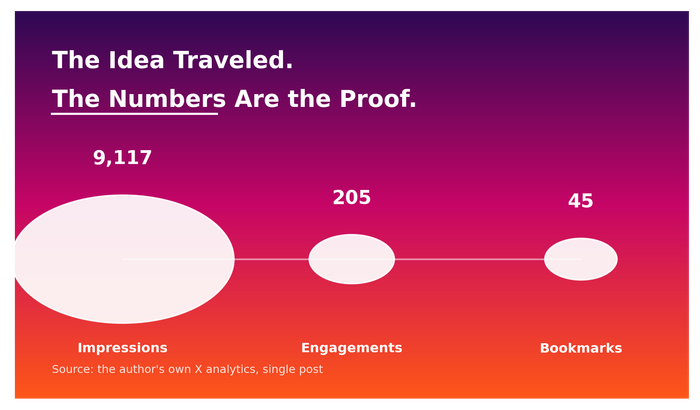
Nine thousand, one hundred and seventeen impressions. Two hundred and five engagements. Forty-five bookmarks, from people who wanted to find it again later.
Then something happened that the post itself couldn’t do alone.
I rewrote the same idea for LinkedIn, in different words, for people who never saw the original, and it broke out there too.
Nobody told me to repost a tweet. That’s not what happened.
An idea travelled because the idea was strong enough to survive the trip, not because I was clever about distribution.
That’s the actual test now, and it isn’t “can you publish.” It’s whether your idea survives being said twice, in two rooms, in two formats, by two different versions of you. Most content can’t survive that. Most content was never trying to.
The Bigger Picture
My one small post wasn’t an isolated case. Ahrefs went looking for the same pattern at scale, across 900,000 web pages published in April 2025.
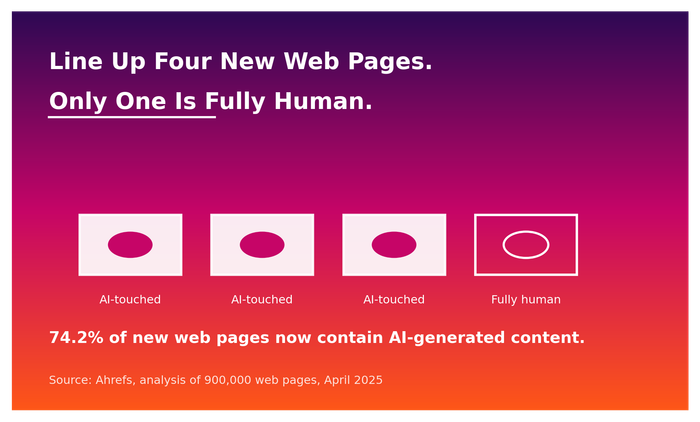
74.2% of them had a machine’s fingerprints somewhere in the wording. Only one in four pages left was written by a human alone, with nothing else touching it.
If you lined up four posts on your feed right now, three of them would fail that test.
This isn’t the first time a new tool made publishing easier and made publishing prove less.
- Blogs turned everyone into a writer.
- Podcasts turned everyone into a broadcaster.
Each wave quietly reset what counted as effort. AI is just the fastest wave yet, and the first one that hit text, images, video and code all in the same year.
Here’s the villain, if you want one. It isn’t AI.
It’s abundance.
Publishing used to prove you’d done the work. Now it mostly proves you have a subscription.
I’ll implicate myself here too. Seventeen years of my career were built partly on publishing more often than most people in my field could keep up with.
That volume strategy still moves the needle, a little.
I am experimenting on X to see if it that works.
It was never going to survive a competitor that can out-publish all of us before lunch.
Artificial Intelligence
Two Kinds Of Content
There’s content creation, and there’s thought leadership, and the flood has forced them apart, whether anyone chose that or not.
Content creation says: here’s something useful. Thought leadership says: here’s something I noticed, and it might change how you see this.
AI does the first one well. I use it for exactly that, most days.
The second one still needs a person who notices a pattern before it’s been confirmed by anyone else, who says so under their own name, and who’s willing to be wrong about it in public.
That’s not a prompt.
That’s a spine.
What The Machine Can’t Do For You
Photography didn’t end painters. It ended the job of painting things that simply looked like the thing.
AI is doing the same to expertise, at a much faster pace. It can write the report, build the deck, draft the strategy, summarise a decade of research, and do all of it competently before lunch.
So the question stops being “can you produce the work.”
It becomes “can you tell which work is worth producing,” and that’s a completely different skill.
It looks like knowing which of six fluent, well-written options is actually right for this client, this moment, this level of risk. It looks like catching the one that’s dangerous to ship, when it reads exactly as confident as the one that isn’t.
- Judgment.
- Taste.
- Reputation.
The specific, uncopyable shape of the life you’ve lived so far.
AI can amplify all of it once you already have it. It has no way to manufacture the life that built it in the first place.
None of that shows up as a line on a resume. It shows up as the pitch you didn’t take, the trend you didn’t chase, the draft you deleted because it was clever but not true.
Zoom out and it isn’t only freelancers who feel this.
A company can buy fluent, competent output from almost anywhere now, for almost nothing. What it can’t buy anywhere is a person who already sees the pattern everyone else is about to hit. And even at the top, a polished quarterly letter used to signal competence. It doesn’t anymore.
Competence is free now.
What signals it is being the person who saw the problem before there was a deck about it.
What This Is Worth
A real point of view stopped being a nice-to-have on a profile page. It’s turning into a balance sheet item.
Edelman and LinkedIn asked almost 2,000 B2B decision-makers about this in 2025. Seventy-one percent said a company’s thought leadership communicated its value better than its product marketing did.
Among the toughest audience there is, the finance and legal and procurement people who screen out cold outreach for a living, 95% said strong thought leadership made them more open to being contacted at all.
That kind of trust shows up as revenue in places people don’t expect.
- Consulting.
- Speaking.
- Coaching.
- A course
- A book
- A membership,
- A piece of software.
- A side hustle that quietly turns into the actual company.
None of that starts with more content. It starts with being known for something specific.
You don’t need thirty-three million readers for this to work on you. You need one true idea, said often enough and clearly enough that someone remembers who said it. Small audiences with real trust already outperform large ones that only ever half-believe you.
Influence chased for its own sake is hollow. Influence that shows up because you had something true to say is a business model with your name already on it.
The Part That Worries Me
AI can build thought leadership. It can also replace the person doing the thinking, and you won’t notice the swap until it’s already done.
If it finds every idea, argues every position, and picks every topic for you, you end up publishing more and meaning less. Same output. Less of you in it.
You’ve seen the result already.
Ten slides, no real author, a stock photo of a lightbulb, a caption that could belong to any company in any industry.
Nobody sat down and decided to make something that forgettable. It just happened, one convenient prompt at a time.
A rented opinion collapses the first time somebody asks a real follow-up question.
I’m not pretending to be above any of this. I use AI for research, for structure, for a second opinion at the hour when no human wants to pick up the phone.
What doesn’t get outsourced is the noticing itself, the specific, stubborn conviction that out of a thousand possible patterns, this one is the one worth saying out loud.
That is where I am reading a book or watching a video and I notice:
- A sentence or a phrase that makes me curious.
- Raises a question.
- Sounds interesting.
That part was never going to scale.
Which is exactly why it still means something.
The Observation Loop
I think about this now as a loop, not a funnel. A funnel assumes you already know the answer and you’re just moving it downstream. A loop assumes you don’t know yet, which is the more honest place to actually start from. It also means the newsletter you’re reading right now is a draft of an idea, not a verdict on it.
Observe → Think → Test → Publish → Listen → Refine → Repeat.
Notice something, from work or life or a thread you can’t leave alone.
Ask what it might actually mean, before you’re sure.
Hand it to AI and make it argue the other side. Let it go looking for the evidence that proves you wrong.
Publish it while it’s still a little rough.
Watch what people push back on. That reaction is data too, and it’s often the best kind you’ll get.
Sharpen it. Do it again tomorrow, on purpose.
This newsletter is that loop, running in public, with my name attached to every turn of it.
What Would You Want To Be Known For
I still don’t know if the three AI models were right about the question I originally asked them. That was never really the point.
The point is that I noticed something none of them could have flagged on their own: that their agreement wasn’t proof of anything.
Machines can’t catch that kind of thing about themselves. Noticing it is still, stubbornly, a human job.
That’s the whole opportunity, if you want it.
AI gives one person more reach than a small agency had ten years ago. Reach on its own is just noise at scale. Reach plus a real point of view is a business: one honest opinion, a machine that executes at speed, and an audience that already trusts you enough to keep opening the email.
That’s not a content calendar. That’s a company, quietly wearing a newsletter as a disguise.
I don’t know yet what tomorrow’s pattern will be, or which platform it shows up on first. I’ve stopped needing to know that in advance. The loop finds it, if I keep running it.
So, not “how do I create more.” A smaller question, and a harder one: what do you already know, or notice, or believe, that’s worth becoming known for.
What would you want to become known for?