
I was sent to a city for my first job as a teacher. It was clean. Tidy. Good restaurants and a lovely bay and people were well behaved. They had manners the British would be proud of but something was missing. We have all been to cities like that.
But there was a city I wanted instead. I visited it as a child. A big fun park sat beside the harbour that had been torn down and reconstructed one fun ride at a time. Ferries carried you and teeming tourists to beaches and bays. The sand was white and squeaked when you walked. It even sounded clean.
The weather was warm like a hug and winters never really arrived. And it had an Opera house and a big bridge with an arch that had the nickname “the coat hangar” the whole world knows on sight.
It had an X-factor. A city with charisma.
I arranged a transfer. I never left.
One city did everything right but the other just had the thing you cannot put on a checklist.
That thing has a name. We call it charisma. And online, it has quietly become one of the most valuable assets a human can own.
Most people think charisma is a gift. They are wrong.
You are either born with it or you are not. That is the story we are told.
Dale Carnegie spent his life proving the opposite. Charisma is not magic. It is a skill. And like any skill, it can be trained.
And it is not what you think. Charisma is not being the loudest voice in the room. The loudest room is often the emptiest. It is not slick, and it is not a performance you switch on for the camera. It is the quiet, steady signal that a real person is on the other side, worth paying attention to.
Modern research agrees. The work of Olivia Fox Cabane breaks charisma into three forces you can learn and they are presence, power, and warmth. Carnegie’s famous rules still hold: smile, use someone’s name, listen to understand, read the room.
But here is the catch nobody says out loud.
Carnegie was teaching a room skill.
When the body disappears
Smile. Eye contact. Remember names. Mirror the body. All of it assumes you are standing in front of someone, where a first impression forms in a tenth of a second, and most of the signal lives in the body.
Online, the room is gone.
There is no eye to meet. You cannot remember half a million names. The body language is on mute. So half of Carnegie’s rules quietly break the moment you step through the glass.
By rights, online charisma should be impossible. And yet some people reach through a cold pane of glass, a small screen or a big monitor and make millions of strangers feel something. They are not breaking the rules of charisma. They are using a different set.
Which raises the real question. When the body disappears, what carries the charisma?
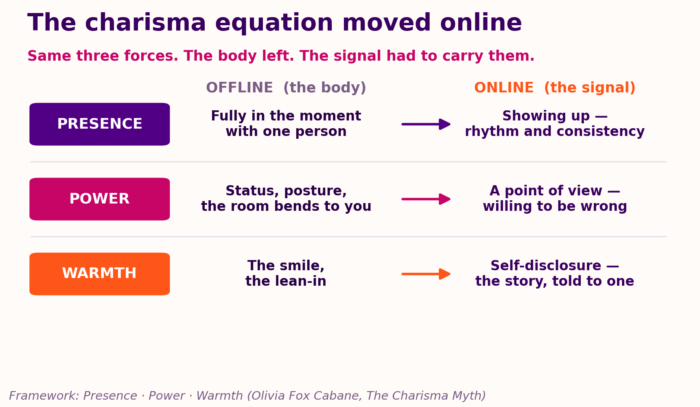
The three forces do not die. They move.
Presence stops being a moment and becomes a rhythm. You show up, again and again, until a stranger feels they know you. That is the quiet engine behind every creator who built a following.
Power stops being posture and becomes a point of view. You say the thing. You take the position. You risk being wrong in public.
Warmth stops being a smile and becomes self-disclosure. The story. The scar. One human talking to one human.
Without a body in a room and a presence across a desk we need to re-calibrate how we can feel like a friend even if we are seperated by a screen and an ocean. .
Why the X-factor now prints money
For most of history, trust lived in institutions. The brand. The bank. The broadcaster. Not anymore.
Trust has walked out of the building and gathered around individuals.
People now trust a person who feels like them more than they trust the logo. Edelman finds roughly half of people trust influencers and most of those would extend that trust to a brand they distrust, if the right person vouched for it.
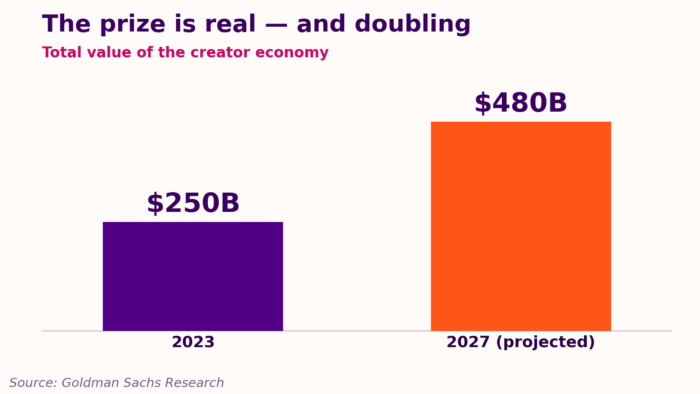
While trust moved, the money followed. The creator economy is on track to roughly double to $480 billion by 2027. Fifty million people now call themselves creators.
This is the quiet truth of the decade.
Attention is cheap. Trust is rare. And charisma is just trust you can feel.
But the middle is thin. Only about four in every hundred creators earn a full living from this. The other ninety-six blur into each other. What separates the few from the many is rarely talent, and rarely luck. It is a signal strong enough to remember.
Think about what that trust is worth. A single word from a person you believe can move you to buy from a company you would never have chosen on your own. That is not marketing. It is the oldest force in commerce and a recommendation from someone you trust wired into a screen and scaled to millions.
When I discovered social media I saw that it could reach around the world. Everyone now had a voice if they were willing to use it.
The sameness machine
But here is what is trying to kill your X-factor. Not a person. A system.
The algorithm rewards what it can predict. Templates. Best practices. The safe and the polished. Now AI floods the same pipes with content that is competent and identical to a billion posts that read like they were written by the same tired committee.
And charisma is the opposite of identical. It is difference made magnetic. The X-factor is the one thing a template cannot hold.
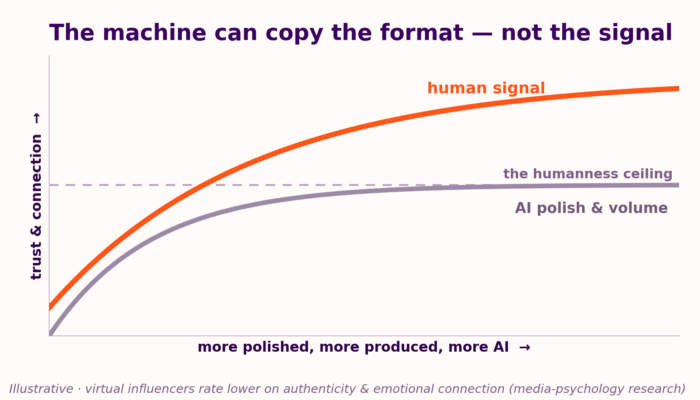
There is even proof. When researchers study virtual influencers and the flawless AI-generated faces, audiences rate them lower on authenticity and emotional connection, no matter how perfect they look.
The machine can copy the format. It cannot copy the human signal.
The trap that catches good people
Here is the seduction. The machine does not force you to be generic. It tempts you.
It pays you in small hits of reach every time you copy what already worked. Follow the trend. Use the format. Sand off the edges. Each surrender feels smart. None of them feels like a loss.
Until one day your feed is full of you and none of it sounds like you. You have been sucked into the machine and the human web starts to feel like it has been invaded and is now inhabited by an army of robots.
That is the tension every creator lives inside. Use the system, or become it. The line keeps moving, and you have to keep finding it. The test is simple: if your best post this month could carry a stranger’s name and nobody would notice, the machine has already won.
Three humans who turned charisma into cash
Theory is cheap. Look at people doing it.
Emma Chamberlain is warmth
She built her audience by refusing to be polished. Jump cuts. Bad lighting on purpose. Talking about her anxiety and her boredom like she was your friend on the couch.
Then she turned that warmth into a business. Chamberlain Coffee reportedly sold a million dollars of product in its first thirty minutes. Luxury houses came calling; she has been a Cartier ambassador since 2022. She did not sell coffee. She sold the trust, and attached coffee to it.
Remember who she was. A bored teenager who dropped out of school. Now she runs a coffee company stocked in thousands of stores and hosts the Met Gala carpet for Vogue. Same girl. Same voice. She just refused to trade it for a polished one.
Alex Hormozi is power
Most “gurus” hide their best material behind a paywall. Hormozi does the opposite. He gives the entire playbook away, the pricing, the scripts, the frameworks for free, everywhere. He takes a posture and position.
The free value builds trust at scale. The trust feeds Acquisition.com, where the real money is made taking equity in the businesses that come to him. The thing he sells is not a course. It is belief, converted into ownership. (He went from near-bankruptcy at 26 to nine figures — reinvention is the whole story.)
The lesson is uncomfortable. The more you give away, the more you are trusted with.
Ali Abdaal is presence
A Cambridge doctor who started filming study tips at night. He did not quit medicine to chase fame. He just showed up, week after week, calm and honest, building in public. Reinvention by rhythm.
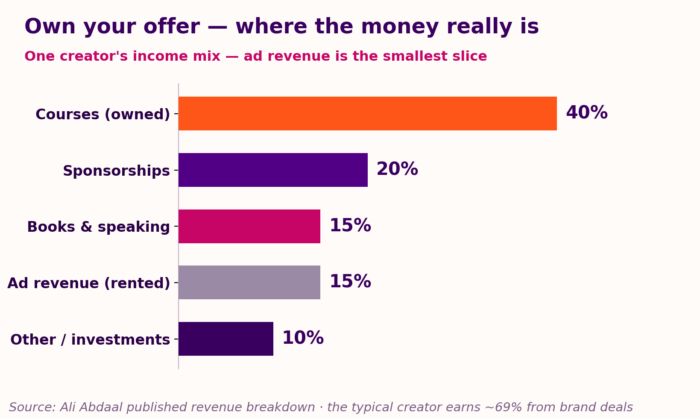
Today the courses he owns and not the ads he rents, are his biggest income line, and his book became a bestseller. Ad revenue is the smallest slice of his pie.
His early videos were ugly screen recordings made between hospital shifts. The value was huge. Production never beats a point of view.
Three different humans. Three different signals. One pattern. None of them chased the algorithm, they built a signal the algorithm was forced to carry. They were irreducibly themselves, and then they built something to own.
The tactical part: your charisma-to-cash ladder
So how do you do this on purpose? Climb in order. Skip a rung and you fall.
1: Find your signal. The part of you a machine cannot fake. Your story. Your scar. Your strange mix of obsessions. Ask one brutal question: could AI have written this? If yes, it is noise. Two thousand years ago the advice carved over the temple was the same — know thyself. The only thing that changed is that now it pays.
2: Build an audience with rhythm. Presence online is consistency. Pick one place. Show up every week for two years. Boring-but-present beats brilliant-but-absent. The rhythm is the point — a stranger cannot trust a person they meet only once.
3: Earn trust by giving value away. Be the most generous voice in your corner. Give the answer, not the tease. Hormozi hands over the whole playbook. Generosity is the fastest trust-builder there is. Give until it feels reckless and the fear that you are giving away too much is the exact feeling that builds a moat.
4 Build an offer you own. This is where most creators stop too early. Brand deals are renting your audience to someone else, the typical creator leans on them for nearly 70% of their income. Owners build the thing themselves: a product, a course, a service, a community, equity. Rent pays this month. Ownership pays for years.
5: Convert. Income is just trust, cashed in. When the signal is real and the offer fits the people who trust you, money is the natural result, not the goal you chased. Do not lead with the ask. Earn the right to make it.
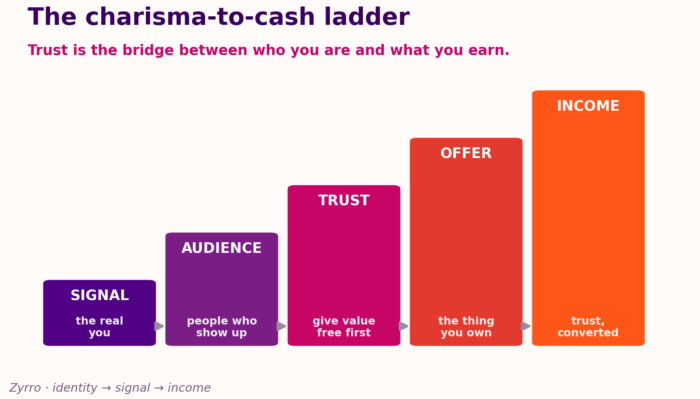
That is the whole machine. Signal becomes audience. Audience becomes trust. Trust becomes an offer. The offer becomes income.
Verdict
Charisma was never a gift handed to the lucky few. It is a skill. And in a world drowning in sameness, it has become the rarest skill of all because it is the one the machine cannot manufacture.
So stop trying to be findable. Stop writing for an algorithm that will replace you the moment it can. Be so unmistakably yourself that you become the category.
Be so interesting and unique with an opinion or a compelling story that people wait all week for your newsletter.
Sources
- The components of charisma (Cabane: presence, power, warmth) — https://richard-reid.com/the-components-of-charisma/
- The science of charisma (first impressions, non-verbal signal) — https://richard-reid.com/the-science-of-charisma-insights-and-findings/
- Parasocial trust and the creator economy — https://marlincommunications.com/blog/understanding-parasocial-relationships-in-modern-marketing/
- 2026 Edelman Trust Barometer (trust in influencers) — https://www.edelman.com/trust/2026/trust-barometer
- Goldman Sachs: creator economy to reach $480B by 2027 — https://www.goldmansachs.com/insights/articles/the-creator-economy-could-approach-half-a-trillion-dollars-by-2027
- Virtual vs human influencers: authenticity and connection — https://www.tandfonline.com/doi/full/10.1080/15213269.2025.2558029
- Chamberlain Coffee case study — https://medium.com/@itseffyphillips/a-case-study-on-chamberlain-coffee-an-influencer-brand-done-mostly-right-6627a9162b70
- Emma Chamberlain named Cartier ambassador (WWD) — https://wwd.com/fashion-news/fashion-scoops/cartier-taps-emma-chamberlain-brand-ambassador-details-1235172299/
- Alex Hormozi’s give-it-away content model — https://siliconvalleytime.com/entrepreneur/alex-hormozis-content-system-that-scaled-acquisition-com-to-9-figures/
- Ali Abdaal revenue breakdown — https://marketmakermgmt.com/blog-list2/ali-abdaal-youtube-success-story