There is a stretch of water off the coast of Iran, just 21 miles wide. Two shipping lanes run through it, each barely two miles across. And through that thin gap, every single day, flows one-fifth of the world’s oil, around 20 million barrels, about 231 every second. There is almost no way around it: a few pipelines can carry a fraction, but the rest has nowhere else to go.
Nobody planned this. No one sat down and decided the global economy should balance on a two-mile ribbon of sea. It just happened, slowly, barrel by barrel, until the world had funneled itself through its narrowest point.
And right now, as I write this, that gap keeps closing and they want to charge a toll.
The strait sits in the middle of a conflict. Ships have turned back, Brent crude has topped $106, and the agency that guards the world’s oil just made the largest emergency release in its history. One narrow passage and the cost of moving through the world jumps on every continent.
It Has Happened Before
We have seen this before, in a different narrow place. In March 2021, a single ship, the Ever Given, longer than the Eiffel Tower is tall, caught a gust of wind, turned sideways in the Suez Canal, and stuck. For six days it sat there, wedged bank to bank, with a queue of more than 400 ships building behind it.
Around 12% of all world trade runs through that canal. The blockage held up roughly $9 billion of goods a day, and the delays rippled for months, empty shelves, stalled factories, freight rates spiking.
One ship. One narrow canal. Nine billion dollars a day.
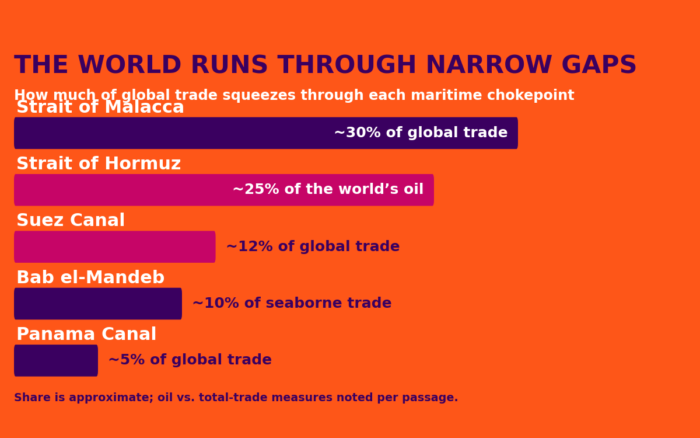
Here is what those two places teach you and it is older than the internet, older than the engine, older than money. Whoever controls the narrow passage controls the flow. And whoever controls the flow sets the toll.
Your Work Has Chokepoints Too
Now look at your own work.
Your ideas, your voice, the stories only you can tell. It has to travel too, from you to the people who need it. And somewhere in the last twenty years, that journey grew narrow passages of its own. You just can’t see them, because they aren’t made of water. They’re made of code.
They are also given the name of algorithms.
Once, the line was short: you published, a reader found you, and that was the whole trip. Now your work threads a gauntlet, a platform, then an algorithm, then a recommendation engine, then an AI summary that answers the question before anyone reaches you.
Five narrow gates where there used to be open sea.
And at every one, the same ancient rule holds: whoever controls the passage sets the toll.
The 7 Human Signal Choke Points
Let me walk you through the gates, one by one, so you can see them the next time you hit publish.
1. The Enclosure — you build on rented land
The first move was the quietest. You were invited to build your home on someone else’s property, a page here, a profile there. It felt like freedom. It was tenancy.
The platform owns the bond with your audience, not you. Your followers are theirs to show or to hide. You water the garden; they own the fence. And when the rent goes up, as it always does and you hold no deed. You hold a login.
The way through: own something they cannot evict you from. An email list. A direct line. A name people seek out by typing it, not by tripping over it.
2. The Algorithm — reach gets rationed
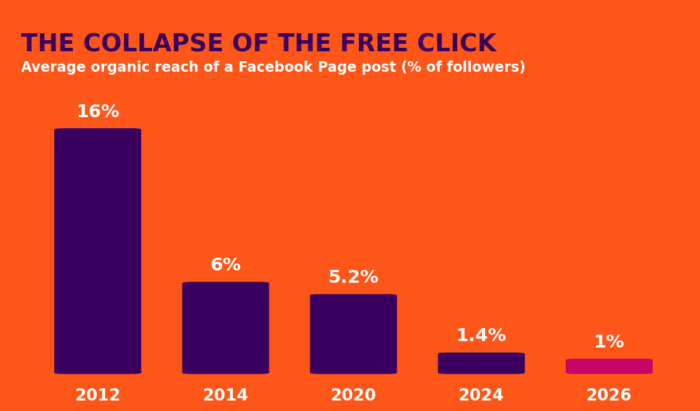
For a while, if your fans followed you, your fans saw you. Then the machine stepped in. In 2012, a Facebook Page reached about 16 in every 100 followers; by 2026, that number sits near 1 and for many, below it.
You didn’t get quieter. They turned your signal down.
The algorithm does not reward what is true, or useful, or kind. It rewards what holds the eye. Outrage travels first class. Nuance dies in the queue.
The way through: stop renting reach by the post. Build the kind of trust that makes people come looking for you by name.
3. The Recommendation Engine — discovery gets engineered
This is the gate most people never notice. It used to be that you chose what to read; now the feed chooses for you. The “For You” page is the most honest name in tech — because it decides, on your behalf, what “you” is.
A handful of unseen rules now sit between every creator and every reader — not tuned to what you went looking for, but to what keeps you here.
The way through: become a destination, not a suggestion. Be the thing people hunt for, not the thing they get served.
4. The Snippet — the answer moves onto the page
Around 2014, Google began answering questions on the results page itself. A small box at the top, your words lifted out, the reader’s question solved before they ever reached you. It looked harmless, a convenience. It was the first crack in the deal.
The click and the thing that fed every creator, began to thin.
The way through: write the thing a snippet cannot hold. A story. A stand. An argument that has to be read whole to be felt.
5. The Answer Engine — the summary eats the source
This is the gate that changed everything. When an AI summary sits at the top of search, only about 8 readers in 100 click through to a real page against 15 when there’s no summary at all. And the sources the AI quotes? Barely 1 in 100 get a click.
Sit with that.
Your work is good enough to be quoted by the machine and invisible enough that no one comes to meet you for it. One travel blog watched its traffic fall 90% and simply closed its doors.
The way through: where SEO said be findable, and GEO said be cited, the human signal says something else “be someone worth meeting and mentioning”
6. The Training Machine — your work becomes the fuel
Here is the cruelest turn in the whole Trap. The same work that built your name is now feeding the model that competes with you and scraped, absorbed, repackaged, and sold back to your reader without your fingerprints on it.
You spent years finding your voice. The machine learned a flat copy of it in an afternoon.
The way through: give it the one thing it cannot take, the living, changing, unrepeatable you. The story it cannot scrape, because you haven’t told it yet.
7. The Flood — the signal drowns in slop
And then the dam broke. More than half of new articles on the web are now written by machines that are cheap, endless, confident, and nearly all of it sounds exactly the same.
This is the final gate. Not censorship. Saturation.
You are not being silenced. You are being buried under an avalanche of beige.
The Slow Close
Here is the part that should unsettle you: none of this was sudden. There was no “Given Moment” for the web and *no single ship turned sideways, no headline the morning it happened. It closed slowly. Quietly. Over thirty years.
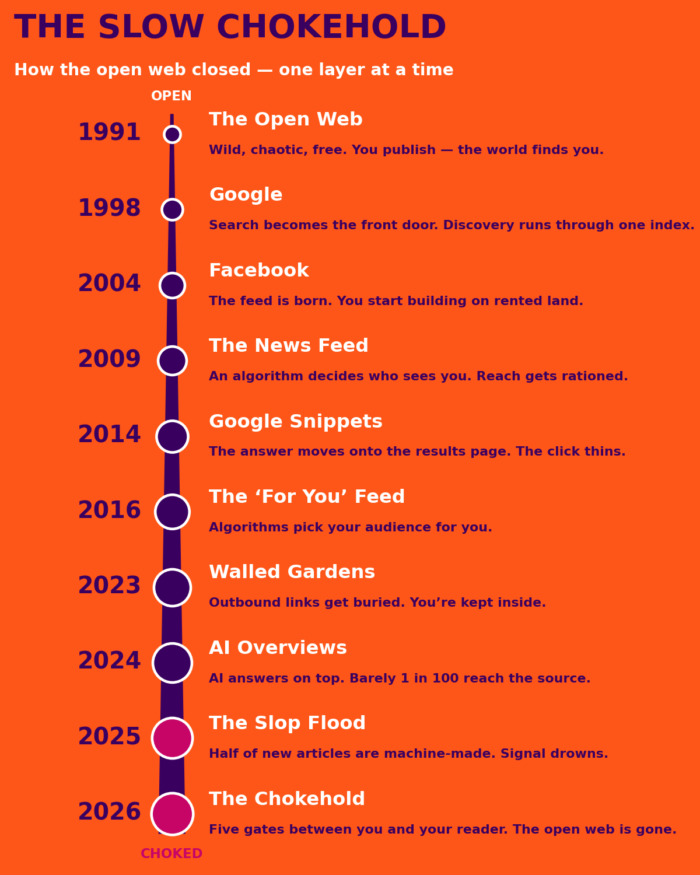
Read this chart from the top.
In the beginning the web was wild and open and you published, and the world could find you, no gate. Then, one layer at a time, the passage narrowed: search, the feed, the algorithm, the snippet, the summary.
And every new layer was added for the same reason. Not to carry your work further — but to keep it inside walls that could be sold. The summaries now send back barely 1% of the traffic they take.
That is the quiet engine under all of it. The narrower the passage, the more valuable the toll.
Your attention is the oil. Your audience is the cargo. And the gate charges by the barrel.
This Is Where We Are
The timeline ends here. So this is where we are — and these are the gatekeepers, today, in 2026.
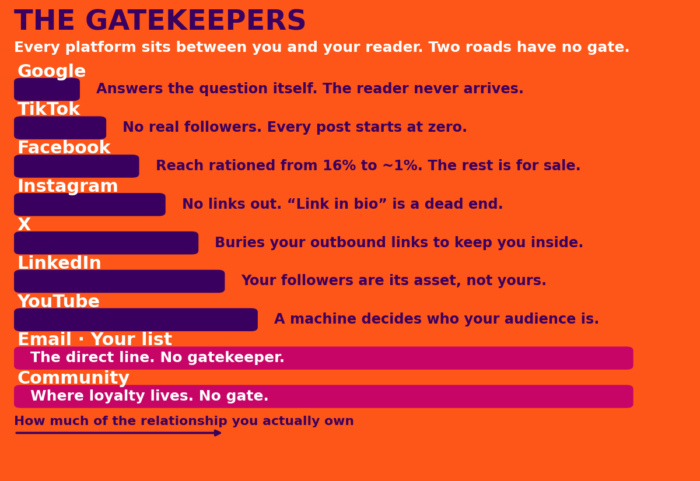
Google answers the question itself now and your work feeds the answer, and the reader never arrives. Facebook rations your reach; it has fallen from 16% of your followers to barely 1%, and the rest is for sale. LinkedIn treats your followers as its asset, not yours. X buries your outbound links to keep you inside.
YouTube hands your audience to a machine that decides who they are. TikTok gives you no real followers at all — every post starts at zero. And Instagram won’t even let you point the way out: “link in bio” is a dead end dressed as a door.
Seven gates. One toll.
And the sharp tool that does the choking? The algorithm. It isn’t a company. It’s architecture is a system built to capture, rank, and ration human attention.
The Verdict
So here is the verdict and the move.
The straits of the world have no way around them but there is no second Hormuz, and when it closes, the world simply waits. But the chokepoints of the web have a flaw the oceans never had.
They can throttle the flow. They cannot make what flows through it.
A machine can summarize information, but it cannot summarize a soul. It can copy your style, but not your stand. It can rank your words, but not the reason you wrote them at 4:30 in the morning when nobody was watching.
The gate controls distribution. It does not control you.
So here’s the key move: stop renting reach, and start owning the relationship. There are only two roads with no gatekeeper standing on them.
1. Your email list — the direct line no algorithm can sit between.
2. Your community — where loyalty lives, and no one can switch it off.
Use the platforms to be found, never to be stored. Send every borrowed visitor toward one of those two roads. Create what a machine can’t compress: a story, a stand, a point of view.
The work is human. The distribution is not.
The oil had nowhere else to go. You do.
Win the road, and you take your reader with you.
Which gate is squeezing you hardest right now? And what makes you most angry?
Coming in Part Two — The Escape. The creators who already slipped the gate, the map of where to build, and the playbook for turning your human signal into a business no passage can close.
Sources
- Strait of Hormuz oil transit — ~20M barrels/day, ~1/5 of world oil (EIA)
- Hormuz 2026 crisis — Brent past $106, record IEA reserve release (WEF)
- 2021 Suez Canal blockage — six days, ~12% of world trade (overview)
- Suez blockage held up ~$9B of trade per day (Port Economics)
- Facebook organic reach decline, 16% to ~1%
- AI Overviews and click-through rates (Search Engine Journal)
- AI summaries, source clicks, and publisher shutdowns (Pew, via NPR)
- Over half of new web articles are AI-generated (eWeek / Graphite)
- AI platforms send ~1% of publisher traffic (AdExchanger)