
Curiosity is one thing machines do not have.
They answer questions. They do not ask their own. Nothing keeps a machine up at night wanting to know.
We do. It is one of the oldest signals we carry.
But right now that signal is being wasted, and a lot of money is being spent to waste it. This piece is about how to stop wasting yours and start reading it.
The machine that never gets tired
Last month I went looking for one number.
I wanted the share of Netflix viewing that comes from its recommendation engine. One figure for one chart.
Ninety minutes later I was reading about slot machines, then pigeons, then whether taste is even a fixed thing. I never got the number that day.
Here is what has changed. A library closes. A friend gets bored. A book ends.
The machine does none of that. It is patient and endless. It will follow you into any rabbit hole and hand you a torch at every turn.
Old-fashioned curiosity had a natural brake. It cost time, money, or someone else’s patience. We removed the brake and kept the engine.
So the first job is not to be more curious. It is to give your curiosity somewhere to land.
Two kinds of curiosity
In the 1950s a psychologist named Daniel Berlyne split curiosity into two types. The split still holds up.
The first type scans. It is restless and wide, hunting for anything new. Berlyne called it diversive curiosity. Scrolling is pure diversive curiosity.
The second type digs. You spot a gap between what you know and what you want to know, and you go after it. He called it specific curiosity.
The scan finds the material. The dig turns it into something.
A feed is built to keep you scanning, because a scan that ends is a session that ends. That is the trap. It keeps you in the shallow kind and never lets you reach the deep kind.
What to do. notice which one you are in. Scanning is fine as a start. The rule is simple. Never let a scan be the whole session.
Your brain pays you for curiosity
At the University of California, Davis, three researchers ran a clean little study.
Matthias Gruber, Bernard Gelman and Charan Ranganath showed people trivia questions and asked how much they wanted each answer. Then they scanned their brains.
When people were curious, the brain’s reward system switched on. That is the same wiring that responds to food and money. In plain terms, being curious feels good because your brain pays you for it.
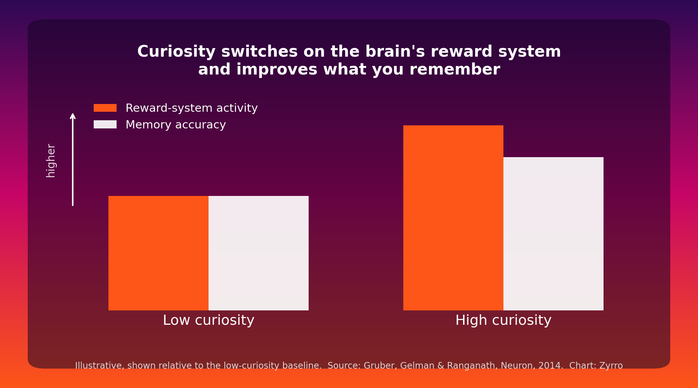
Two things followed. People remembered the answers they were curious about. They also remembered random facts that happened to be nearby at the same time.
So curiosity does not just make you want to learn. It puts your whole brain in a better state to learn anything.
Here is the useful part. Your energy is not spread evenly through the day. It pools around what you care about.
Most advice gets this backwards. Find your motivation first, it says, then apply it. The research says the opposite. Chase what already pulls you, and motivation shows up after.
I learned this the slow way. In 2009 I did not start with discipline. I published a post, a stranger on another continent replied, something in me lifted, and I published again. The 4:30am alarm was never willpower. It was a loop that paid me back.
What to do. stop hunting for motivation. Track what you already chase for free. That is where your energy pools.
Why this matters so much
Gallup surveys the working world every year. One number barely moves.
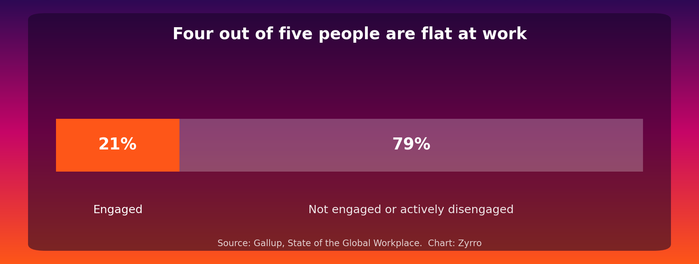
Four out of five people are not engaged at work.
That is not eight billion lazy people. It is a fit problem at scale. Most of us spend our best hours somewhere our energy never gathers.
Reading your curiosity is not a soft, nice-to-have habit. It is how you find the work that would not feel like a drain.
The feed is not on your side
There is a second trap, and it arrives looking like a gift.
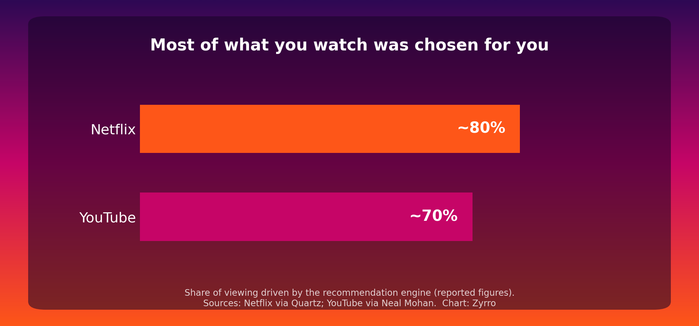
Roughly eight in ten hours on Netflix come from what the system chose for you. On YouTube it is about seven in ten.
Now put the last two charts together. Eight in ten hours chosen for you. Eight in ten people flat at work.
Nobody set out to trap you. It happens because the system is trying to help. It learned what you like, so it gives you more of what you like, forever.
Helpful is not the same as wide.
A feed shows you a mirror. It gives you more of yourself. What you need sometimes is a window, which shows you something else.
The machine has good manners too. It meets you where you are and rarely tells you your question is wrong. A real person will. Take a marketing idea to a scientist and watch their face. That face is worth more than a polite answer.
What to do. Once a month, put something in front of yourself that the feed never would. A book from another field. A person who does not do your job.
Wander wide, then review narrow
Here is where I changed my mind.
I used to think the fix was discipline at the door. Pick your lane. Set your topic. Kill the rabbit holes.
That is wrong, and my own life proves it.
In 2008 I was in a hole. A retail business I had opened failed and closed. My marriage had ended. I was selling real estate to pay the bills and had gone to stay at my brother’s place by a lake. I sat there for most of a year.
My own industry had run out of answers. So I read outside it.
Tim Ferriss showed me work did not need an office. David Meerman Scott showed me attention could be earned with writing, not bought with ads. Then a blog post from a software company said one plain thing. If you have an idea for a business, start a blog.
A fitness writer, a PR contrarian and a software company. Nothing to do with each other. Nothing to do with me.
If I had picked a lane in advance, I would have read three more books about retail.
So the rule is not focus first. It is this. Wander wide, then review narrow.
Let yourself roam. Then, on a schedule, sit down and look at where you roamed. The wandering is only half the method. The review is the other half, and almost nobody does it.
What a year of my notes told me
For about a year I have kept everything that catches me in one place. A project inside a chatbot I called “Book Summaries”.
A book, a study, a news clipping, a stray article at 5am. It all goes in. There was no plan and there still isn’t.
With each one I do four things. I’ll summarize it. I argue with it. I connect it to something else I have read. Then, sometimes, I turn it into a post or a product.
Then one day I asked the machine a new question. Not what I save. I asked, what have I kept coming back to without noticing? And this is the pattern that the machine revealed.
Five questions.
- What makes us human when machines get smart.
- What is still worth money when a machine can make almost anything.
- How to find work that feels chosen, not forced.
- How one person can build real leverage.
- How knowledge should change when the world moves faster than books can print.
I had seen these as five separate hobbies. They were one thing seen from five angles.
I had not chosen any of it on purpose. It had been choosing me for a year while I thought I was just reading.
The honest version of the lesson
It is tempting to say the wandering was secretly a plan all along. That every dead end was really preparation.
That is not true, and it is worth being straight about.
For eleven months those notes were just notes. Random clippings with nobody standing over them. They only became useful on the day I stopped, looked back, and read them in order.
The wandering did not do the work. The review did.
Two people can have the exact same scattered year. Same reading, same rabbit holes, same hundred small yeses. One person never looks back and calls it wasted time. One person reviews it and finds a direction.
The only difference is the review. That is the whole tactic.
How a passing interest becomes part of you
Two researchers, Suzanne Hidi and K. Ann Renninger, mapped how an interest grows. They found four stages.
Something grabs you. It grabs you again. You start going back to it on your own. Then it becomes part of how you see the world.
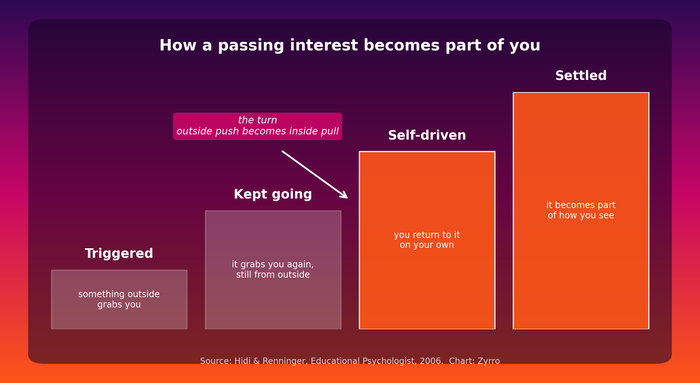
The important moment is the jump from stage two to stage three. That is when an interest stops needing a push from outside and starts running on its own.
You do not decide that moment. You spot it later, the way I did.
This is the real story about AI and curiosity. It can scatter you across a thousand afternoons. It can also read those thousand afternoons back to you as a pattern. No tool in history could do that before.
Same machine. The difference is whether you ever stop and ask it to.
Why an idea from outside your field is worth so much
At Northwestern University, Brian Uzzi and three colleagues studied 17.9 million research papers over fifty years.
They wanted to know what made a paper important. It was not being wildly original.
The papers that mattered most were mostly normal. Built on solid, familiar ideas from their own field, with one strange ingredient from somewhere else. One idea that did not belong.
Those papers were twice as likely to become some of the most cited work in science.
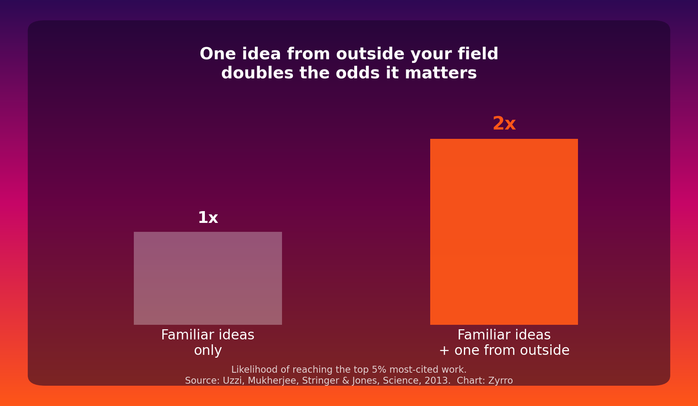
Read that as advice for a career, not just a lab.
Deep knowledge of your own field is the base. The odd idea from outside is the multiplier. You need both.
So rabbit holes are not the problem. Rabbit holes you never review are the problem.
Your monthly habit
Here is the whole method in one place.
- Keep one home for everything that catches you. One folder, one note, one chat. No filter at the door.
- Save nothing on purpose. If you have to talk yourself into saving it, it was not real curiosity.
- Once a month, sit down and ask your notes one question. Not what did I save. Ask, what have I been trying to understand?
- Once a month, talk to one person outside your field. Not a colleague, not a customer. Ask what problem they cannot stop thinking about. Carry one idea home and use it somewhere it does not belong.
- Keep using AI for the deep dives. It never sleeps. But depth with no width makes you an expert nobody can surprise. Width with no depth makes you fun at dinner and useful nowhere.
One gives you answers. The other gives you the right question.
The trail
A CV shows where you have been. Your curiosity shows where you are going.
Nobody paid you for it. Nobody was watching. You did it for free, in stolen minutes, and it kept happening anyway.
That is better evidence than anything on a business card.
The box you were handed is your job title, your feed, and your own habits. It is smaller than you think. Something bigger is sitting just outside it, in your saved tabs, waiting for you to turn around and look.
So here is the only question that matters. What have you been unable to stop asking about?
There is a fuller version of you already sitting in your patterns and your energy. It is hard to see on your own. That is what Zyrro was built to do. Join the waitlist.
Further reading: Brian Grazer and Charles Fishman, A Curious Mind: The Secret to a Bigger Life.