
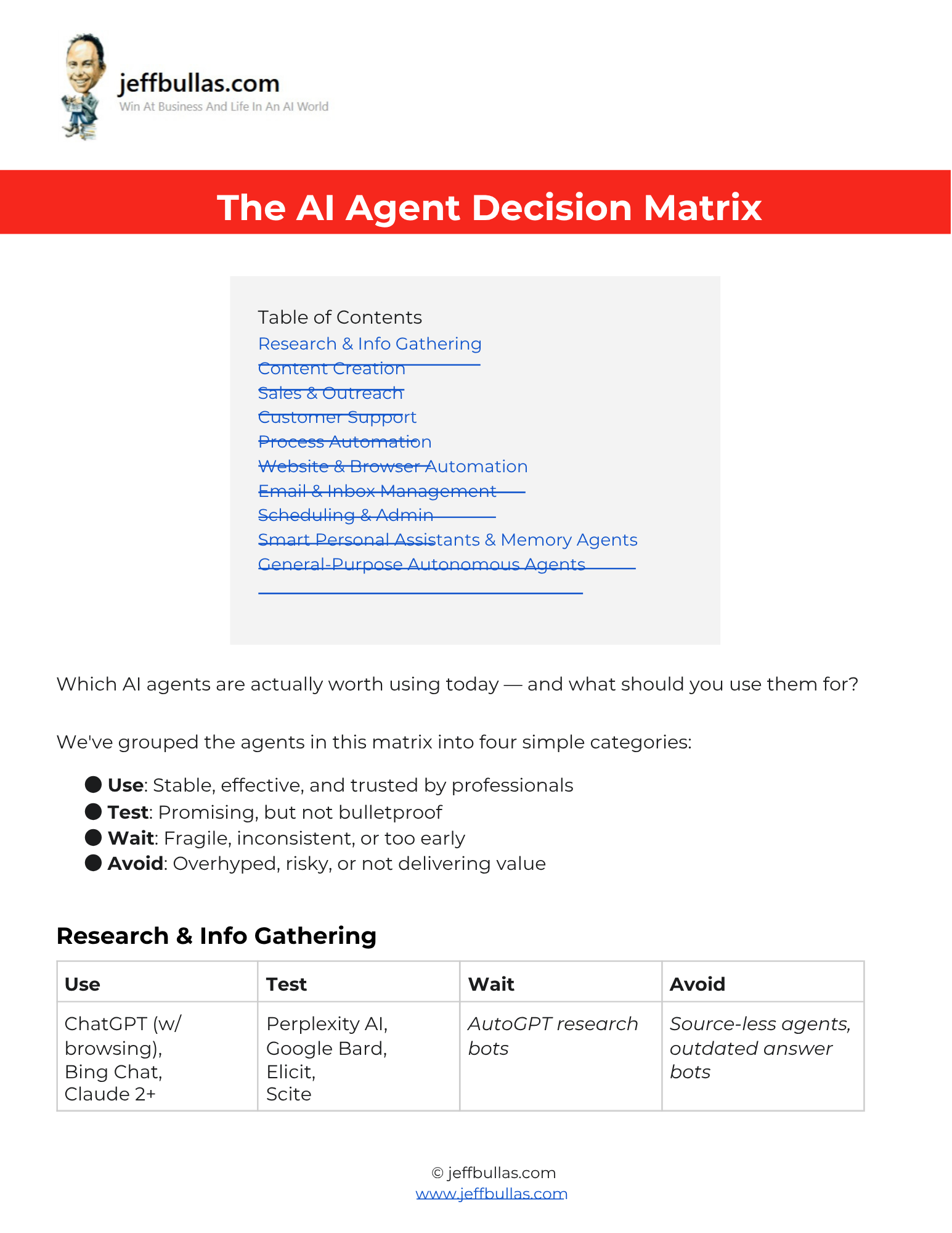

This resource helps you decide which AI tools are actually worth your time and money. It categorizes dozens of AI agents into four clear groups—Use, Test, Wait, and Avoid—so you can confidently adopt stable technologies while avoiding overhyped or risky software.
The AI Agent Decision Matrix
This document presents a comprehensive decision matrix that evaluates AI agents across ten key business categories, including research, content creation, sales, and process automation. It cuts through the market noise by classifying specific tools into four actionable tiers: Use for stable, trusted tools; Test for promising but not bulletproof options; Wait for fragile technologies; and Avoid for risky or overhyped solutions. This framework ensures you adopt the right technology at the right time while protecting your business from unreliable software and security risks.
How this helps you apply the information
This matrix acts as a cheat sheet for software selection. You can look up a specific function, such as Content Creation or Sales & Outreach, and immediately see which specific tools (like ChatGPT or Lavender) are ready for deployment and which ones (like mass content farms or autonomous SDRs) should be avoided to protect your brand reputation.
Who is this ideal for?
This resource is ideal for business owners, managers, and early adopters who want to leverage AI agents for efficiency but need a filter to separate reliable enterprise-ready tools from experimental or risky beta software.
Concluding thought
By strictly following this matrix, you can confidently integrate AI agents into your workflows where they add actual value, while steering clear of the “shiny object syndrome” that leads to wasted time and privacy issues.
How to Use This
- Make Your Own Editable Copy:
- Open the link provided to access the master Google Doc.
- Once the Google Doc is open, navigate to the menu: File > Make a copy.
- A dialog box will appear. You can rename your copy if you wish and choose where to save it in your personal Google Drive.
- Click “Make a copy.” This action saves an editable version of the document to your Google Drive.
- Using Your Matrix:
- Identify a business function you want to automate (e.g., Customer Support or Scheduling).
- Locate that category within the matrix tables.
- Review the Use column to find stable tools you can implement immediately.
- Check the Avoid column to ensure you aren’t using tools that are currently considered risky or ineffective.
Frequently Asked Questions
What do the four categories in the matrix mean?
Use means the tool is stable and trusted; Test means it is promising but not bulletproof; Wait means it is fragile or inconsistent; and Avoid means it is overhyped, risky, or not delivering value.
Which AI tools are recommended for Research?
The matrix recommends using ChatGPT (w/ browsing), Bing Chat, and Claude 2+, while suggesting you test tools like Perplexity AI.
Is it safe to use AI for Sales & Outreach?
Yes, tools like Lavender and Regie.ai are listed as safe to use, but you should wait on fully unsupervised SDR agents and avoid mass LinkedIn spammers.
What is the risk with fully autonomous customer support bots?
The matrix advises avoiding rigid rule-based bots for complex cases and suggests waiting on bots that are not trained on your specific data, as accuracy and citations are essential.
Should I let AI handle my email inbox entirely?
No, email agents are best used for summarizing and drafting. The matrix suggests avoiding fully autonomous responders and external tools that lack privacy protection.
What are the recommended tools for Content Creation?
For content creation, reliable tools include ChatGPT, Jasper, Midjourney, and Synthesia, while mass content farms should be avoided.