
In the first six months of 2026, about 560,000 new apps landed on Apple’s App Store. Most were built with AI. That’s nearly as many as in all of 2025. Downloads rose 2%.
Do the sums and it comes to about 3,000 new apps a day. If every new app were a shop, a new one would open on your street every 30 seconds, all day and all night. The number of people walking down that street barely changed.
That’s the new problem. Building has never been cheaper. Getting anyone to notice what you built has never been harder.
The flood
For most of the last decade, fewer new apps came out each year. Building software was slow, expensive and needed skills most people didn’t have. Then AI coding tools arrived. New App Store releases jumped 84% in the first quarter of 2026, and the App Store is on track for more than a million new apps this year, beating its old record from 2016.
People with ideas but no coding skills can now build things over a weekend. I think that’s wonderful. I’m one of them. I’m building an AI startup, Zyrro, and the tools have changed what one person can do.
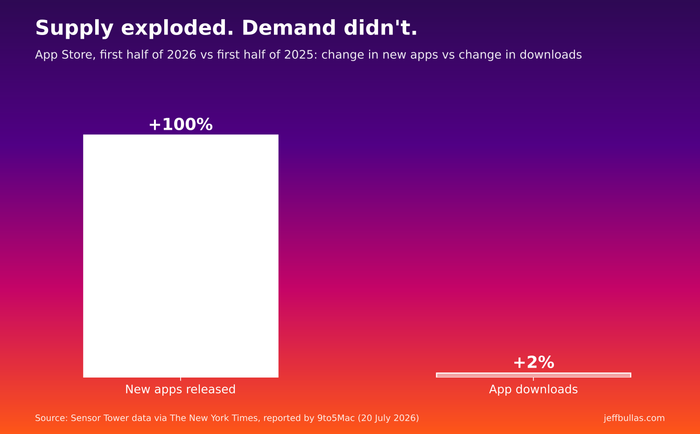
But look at that chart again. The number of apps doubled. The number of people downloading them rose 2%. The same is true of newsletters, podcasts, courses and posts. AI has turned up the supply of almost everything. It hasn’t added a single hour to anyone’s day.
So the bottleneck has moved. The hard question is no longer “Can I build it?” It’s “Will anyone see it?”
361 Impressions
I thought I had that question answered. I’ve been publishing online since 2009. I started a blog at 52 with a $10 investment, writing at 4:30am before work, and it reached 33 million readers. I built a following on X of more than 500,000 people.
Then, in June 2026, I came back to X to get attention for Zyrro. On 23 June my whole account got 361 impressions. Not per post. For the whole day. Zero people visited my profile.
It wasn’t the first time I’d been ignored. In 2007, at 50, my business collapsed. At 51 I applied for about 700 jobs, and the word I kept hearing was “overqualified.” Experience I’d spent decades building counted for nothing in the eyes of the people deciding.
That was the old gatekeeper: a hiring manager. In June 2026 the gatekeeper was a feed. Different machine, same lesson.
It stung. But it also taught me the most important lesson of the past six months. The followers I spent 17 years building didn’t carry me. Every view had to be earned again.
The rules changed while I wasn’t looking
When I started on Twitter, the feed was simple. You saw posts from the people you followed. More followers meant more reach. Big accounts won, and new accounts struggled to be heard.
That world is gone. X now runs mostly on its “For You” feed, which X has published as open code. It picks posts for each person based on what they’re likely to enjoy, from anyone, followed or not. A new post is first shown to a small group, and only spreads further if people reply and engage. And the average user sees only 20 to 30 posts a day in that feed.
Think about that. Tens of millions of posts a day, competing for 25 slots on each person’s screen.
This is the shift from the social graph, who you know, to the interest graph, what you care about. It’s brutal for big accounts that coast. It’s a gift for everyone else. Attention has been opened up to anyone.
A 21-year-old creator called Denys proved it. With no famous name and no big following, he went from nothing to his first X payout of $2,639.84. His method wasn’t a trick. He replied to people every day and posted things they wanted to answer.
If a 21-year-old with no audience can do it, and a 69-year-old with half a million followers can’t coast on them, the rules really have changed.
The new scarcity
Here’s the second-order effect most people miss. When anything can be built in a weekend, the thing you build stops being special. Your app, your newsletter, your course: someone else can copy the features by Friday.
What can’t be copied is trust. People don’t download an app because it exists. They download it because someone they’ve come to trust told them it was worth it. In a world drowning in AI-made everything, a real person with a real story becomes the rare thing.
I’ve been calling this the human signal. The more content machines make, the more people look for proof that a human is behind it. Not polish. Not volume. A voice they recognise, with scars they can see.
That changes where builders should spend their time. For years the advice was to perfect the product and the customers would come. Now the product is the easy part. The real work is earning attention, one honest post at a time, before you need it.
What 500 hours taught me
So I treated my own X account as a lab. Since June I’ve put in about 500 hours, around 3 hours a day. I posted, tested formats, read the numbers with AI, kept what worked and dropped what didn’t.
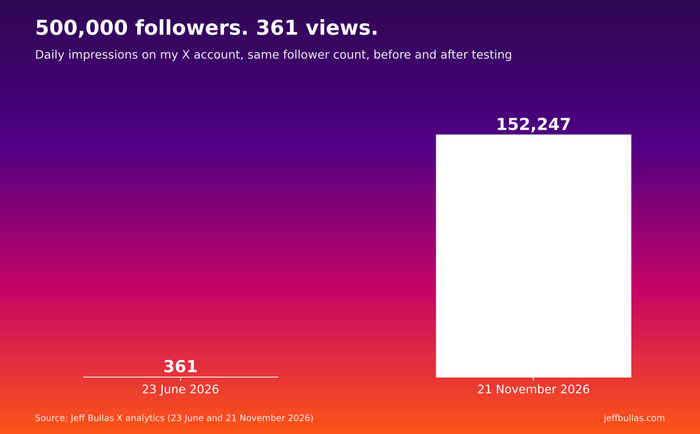
On 21 November my account got 152,247 impressions in a day. On 24 November, 623 people visited my profile and 353 followed me. For the week to 24 November, signups to the Zyrro waitlist ran at about twice their monthly average.
Here’s what I learned, in short.
- Views are not the goal. I had a post reach 31,000 people and send only 41 to my profile. Another reached 4,500 people and brought in 100. The number that matters is how many people want to know more about you after reading.
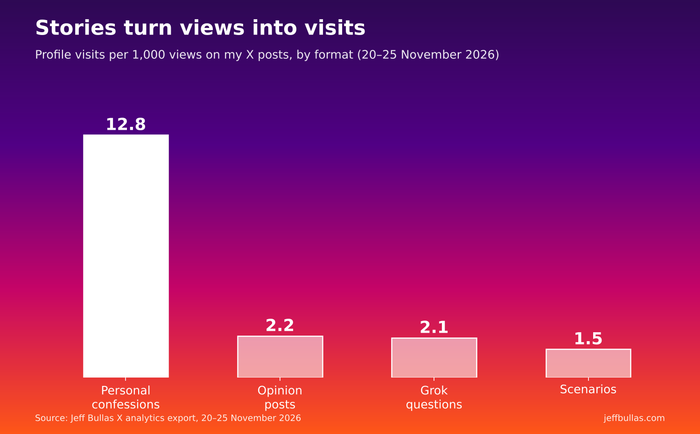
- Different posts do different jobs. Some posts are built to travel. A simple scenario like “You’re 55. You win $1 million tomorrow. Do you quit work?” gets thousands of people answering. Those posts earn reach. But they rarely make anyone curious about you.
- Stories turn strangers into visitors. The posts that brought people to my profile were personal confessions with real numbers. “In 2007, at 50, my business collapsed. I applied for about 700 jobs. At 52 I started a blog.” Those posts sent 12.8 people to my profile for every 1,000 views. Everything else sent about 2.
- One post does the selling. When people land on your profile, one pinned post should tell your story and point to one next step. Mine sent 690 people to my profile, gained 150 followers and drove 158 clicks to the waitlist in a single day.
- Your hands matter most. My best results came from things I couldn’t schedule: replying to people and writing my own take on other people’s posts. That’s where trust gets built.
Just as useful was what failed. Time-travel questions, small success stories, single statistics, opinion one-liners and posts that only pitched my product filled the schedule and moved nothing. I cut them.
That’s the other habit: keep score. Every week I look at which posts sent people to my profile, double down on what works, and drop what doesn’t after three honest tries. I wait a full day before judging anything. I once cut a format too early and watched the post nearly double after I’d given up on it.
That’s the engine. Reach posts bring strangers in. Stories make them curious. One pinned post turns curiosity into a signup.
Fighting a machine with a machine
There’s one thing I haven’t told you yet. I didn’t put in those 500 hours alone.
- The feed is a machine. It’s built to keep people scrolling, not to help you get found.
- It holds back posts with links, because links take people away.
- It changes its rules without telling anyone.
- And it reads signals you and I will never see.
So I brought my own machine. I used AI in three ways.
- It helped me draft posts and replies, and test many versions of the same idea.
- It scheduled posts to go out when my audience was awake, even while I slept in Sydney.
- And every few days it went through my analytics, more than a thousand rows of data, and showed me which posts sent people to my profile and which ones wasted my time.
That last part changed everything. Learning what works used to take me years of trial and error. This time I could see it in weeks.
But there’s a line I didn’t cross. AI never invented a story. Over months, I fed it mine: the business that collapsed, the 700 job applications, the $10 blog, the 4:30am mornings. So when it helps me draft, it starts from my life, not a blank template. That’s why the posts still sound like me. And I edit and send every post and reply myself. AI did the heavy lifting. I did the living.
If you try this, start there. The people I’ve seen struggle with AI content run out of things to say, because they never gave the AI their stories.
Feed it your life first.
That’s the twist. The same tool that’s flooding the world with apps and posts can help one person cut through the flood, if you use it to understand the system, not to fake being human.
I’ll share exactly how I set it up in another piece.
The catch
I’d be lying if I said I’ve cracked it.
- My signup jump is about a week old. I’ll know it’s real when it holds for a month.
- My top three posts still bring in about half my views, which means I still depend on the odd post that takes off.
- And the formats that work on X today will change, because the platforms always do.
It also takes time. Three hours a day is a lot. The parts that work best, the replies and the stories, are the parts no tool can do for you.
So this is not a hack. It’s a habit.
Why this matters to you
You might not be building an app. Maybe it’s a newsletter, a consulting practice, a book or a new career. It doesn’t matter. The same flood is coming for all of it, because AI makes the making easy for everyone.
What AI can’t make is your story. It can’t copy the year your business collapsed, the 700 rejection letters, or the 4:30am mornings. That’s the one asset that doesn’t get cheaper when everything else does.
If you’re over 50 and starting again, this matters even more. You’ve got decades of stories most 25-year-olds don’t have yet: the job that went wrong, the business that failed, the lesson that took ten years to learn. In the old world, your age might have counted against you. In the interest graph, a true story told well counts for more than a birth year. I’m 69 and building again. The feed didn’t care how old I was. It cared whether people stopped to read.
And here’s the good news. The interest graph doesn’t care how many followers you have. It cares whether your post is worth stopping for. That means you can start today, from zero, and still be seen.
Three things to do this week
Post one true story with one real number. An age, a year, a count, a dollar figure. Real numbers make people stop.
Reply to everyone who answers. Every reply is a small vote that tells the feed to show your post to more people. It’s also how strangers start to trust you.
Watch profile visits, not likes. Likes feel good. Profile visits tell you someone wants to know more.
Then do it again tomorrow. That’s the part most people skip.
Back to 361
I still think about that day in June. 361 impressions. Zero profile visits. Half a million followers who never saw a thing.
It was humbling. It was also the best thing that could have happened, because it made me start again with the same tools as everyone else.
Building is easy now. Attention is hard. But attention isn’t reserved for the famous any more. It goes to whoever shows up with something real to say, again and again.
So here’s my question. What’s the story you’ve been keeping to yourself that someone out there needs to hear?
I’m building Zyrro for people with long careers who can’t see what comes next. You answer 13 questions about your life and work, and it helps you find your next direction. If you’ve got a story you haven’t told yet, it might help you find it.
Sources
- 9to5Mac: App Store added nearly as many new apps in H1 2026 as in all of 2025 (Sensor Tower via The New York Times)
- AppleInsider: App Store submissions up 84% in Q1 2026
- TechSpot: App Store on track for more than one million new apps in 2026
- X’s For You feed algorithm (GitHub)
- Buffer: How the X algorithm works in 2026
- Social Media Today: X publishes its AI-powered algorithm code
- Jeff Bullas X analytics, June–November 2026 (author’s own data)