
In 2009 I cracked the code on how to grow an audience on Twitter. Followers were everything then when the social media algorithm was the social graph. That meant that if people followed you, they saw what you posted, so I spent years building a following and working with the system. And I had a significant 535,000 followers. That was the old game.
But 17 years later, on June 24, 2026, my posts were only seen about 200 times. The social media term for that is “impressions”. The reality is that compared to 2014, I was almost invisible. The new interest graph pioneered by TikTok had changed the game.
The gap between the old and the new was vast and it meant that my investment of time and money back then was now worth almost zero.
The gap
That gap is the story and the history of social media.
The platforms have moved from the social graph, where the people who follow you decide who sees you, to the interest graph, where the algorithm decides what each person is interested in and shows them that.
Your followers are now one signal among many. And the feed you’re competing in is filled with content that AI can produce in seconds, at almost no cost, without end.
The experiment
So in June I started an experiment.
I’m 69, and I wanted to know whether I could crack the code a second time: how do you get seen on the interest graph, in a flood of AI content? I posted every day and used AI to analyse every number X gave me.
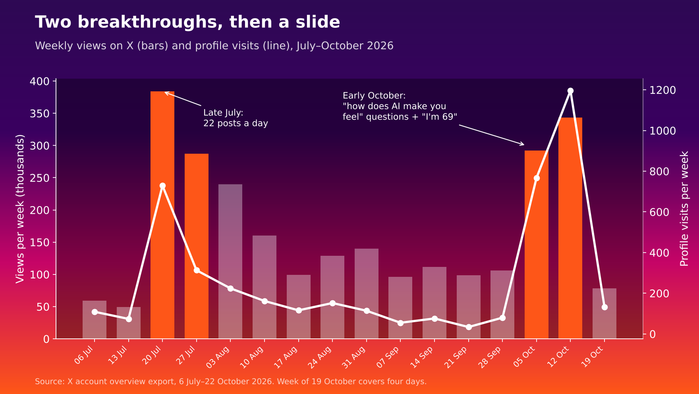
Four months later, my posts have been seen 2.7 million times since 1 July, and I’ve gained more than 3,000 followers. In October I averaged 35,000 views a day.
When I started, it was 200.
But views don’t tell you who is listening. So this week I went back through every reply to my posts since July: 3,660 replies from 2,020 people. I used AI to help me sort and count them.
Followers no longer decide who sees you
The clearest sign is in my own replies. Only about one in five of the people who replied to me were following me. If they’re any guide, most of the people seeing my posts weren’t on my follower list at all. X “had” decided that they’d be interested.
To be fair, the algorithm isn’t hiding me from every old follower. Many accounts from 2009 to 2015 are no longer active. But even allowing for that, a typical post today reaches less than 1% of my followers. The audience I spent years building now buys me very little reach.
So what does get you seen? So using X as a platform to do some research from the 3,660 replies that had responded to my posts on X. And these are the insights that have changed how I create content and how I use social media on X.
1. Name the feeling
On the interest graph, the algorithm watches what people stop for, and shows the post to more people like them. So the question is what makes a stranger stop.
Since early October I’ve posted ten questions in the same format. Four of them took off, reaching between 12,600 and 25,100 people. The other six stalled below 3,600.
The difference wasn’t the time I posted or the length. Every question that took off asked how AI makes you feel. “Does AI make you feel left behind, or let back in?” drew 283 replies. “Has AI made you more excited about your future, or more uncertain?” drew 313.
The ones that stalled asked practical questions, such as whether starting again is harder now than at 30, or who still asks for your advice. They were fair questions. But they asked people to think, not to feel.
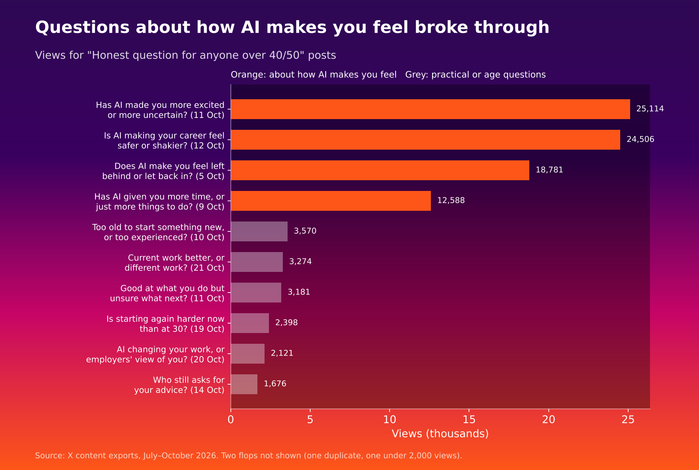
People don’t stop for a topic. They stop for a feeling they recognise in themselves. A machine can produce endless content about AI. It’s much harder to fake the moment someone reads a question and thinks, “that’s me.”
Even so, only about one in three of those questions broke through. The answer isn’t to post more. It’s to take more shots with the kind of post that can land.
2. Write for an audience, not a topic
The interest graph doesn’t only decide how many people see you. It decides which people. Write broadly and it will find you a broad crowd.
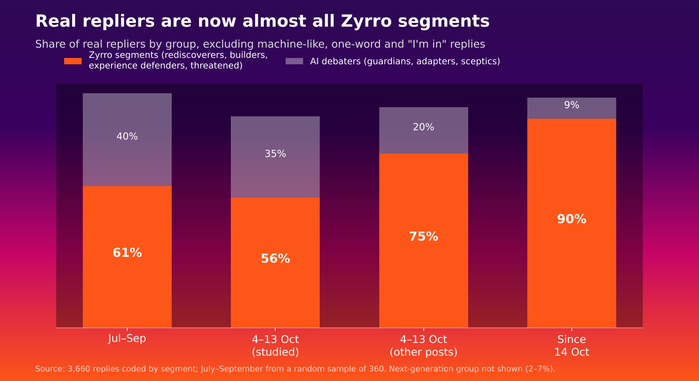
From July to September I wrote about AI in general: its risks, its paradoxes, what it does to thinking. Those posts drew a crowd, but the wrong one. About four in ten of the real people replying were debating AI itself. Very few were thinking about their own next chapter.
In October I narrowed the lane. I wrote for experienced people working out what AI means for their own work and life. Since mid-October, nine in ten of the real people replying fit the four groups I’m building Zyrro for:
- Builders making something new: 30%
- Rediscoverers getting back skills and energy they thought they’d lost: 22%
- Defenders of experience, arguing that judgment matters more now, not less: 20%
- People who feel threatened or worn out by the pace of change: 18%
A community is starting to form. About half of the people replying since mid-October had replied before, and 232 people have now replied across more than one period. Compare that with the July to September crowd: only 98 of 582 came back in October.
The posts that brought the most followers were personal, not clever. A post about why I’m not retiring brought 304 profile visits and 41 new followers in a day. The story of the year my business collapsed and my marriage ended brought 524 profile visits, more than any post since July. Personal detail tells the algorithm, and the reader, exactly who you are for.
3. Count people, not replies
This was a surprise. The flood of AI content isn’t only in the feed. It’s in the replies.
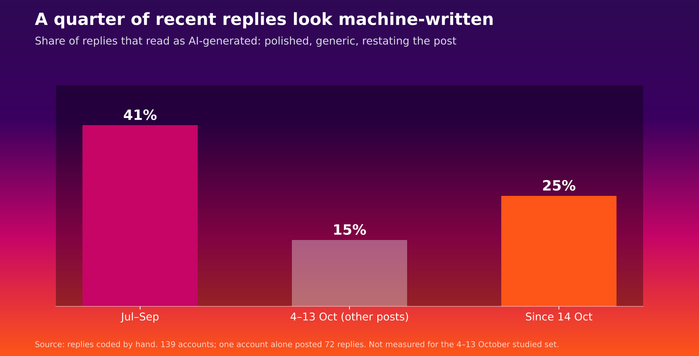
As I read, I kept seeing the same kind of reply: polished, agreeable, and saying back to me what I’d just said in slightly grander words. “The good question is the hard bit, the agent will happily answer a bad one.” One account had replied to me 72 times. Its bio said it was building a tool that writes replies for people.
So I counted. In July to September, about four in ten replies to my posts read as machine-written. Since mid-October it’s about one in four, from 139 different accounts.
This isn’t just my account. Imperva’s 2025 Bad Bot Report found that bots made up 51% of all web traffic in 2024. The machines aren’t only reading the internet now. They’re joining the conversation.
The effect is easy to miss. Reply counts no longer measure connection. If you judge your content by its replies, you are partly judging how attractive it is to software. I now count people: profile visits, new followers, and real people who come back.
4. Reply more, don’t post more
When anyone can publish endless content, adding more of your own is the weakest move. I learned that the hard way.
In the week of 20 July I posted 22 times a day, and at first it worked. Views jumped from about 7,000 a day to 55,000. So I kept going at close to that pace into August. Reach fell week after week.
In October I posted about 8 times a day. Views were higher than in August, and profile visits per 1,000 views tripled, from 1.0 to 3.1.
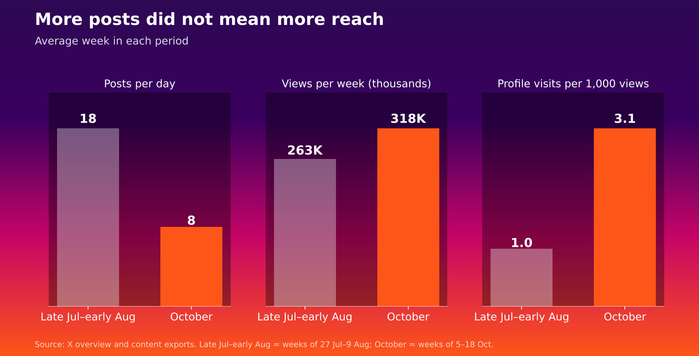
When I lined up the daily numbers, profile visits barely moved with how many posts I published. They moved with how many replies I wrote to the people in my threads. Posting is the shop window. Replying is the conversation that brings someone inside. And a real conversation is the one thing the flood can’t copy at scale.
There’s a cost to this, and I should be honest about it. I did all of it by hand, and replying became a treadmill. The next stage has to fit into about an hour a day.
5. The people reading aren’t always the people replying
The replies told me who was talking. X’s own audience data told me who is listening, and they are not quite the same people.
The people who click through to my profile are older than the people who reply. Over the past week, 68% of them were 45 or older, and one in four was over 65. Four in ten of the people who reply are between 25 and 44.
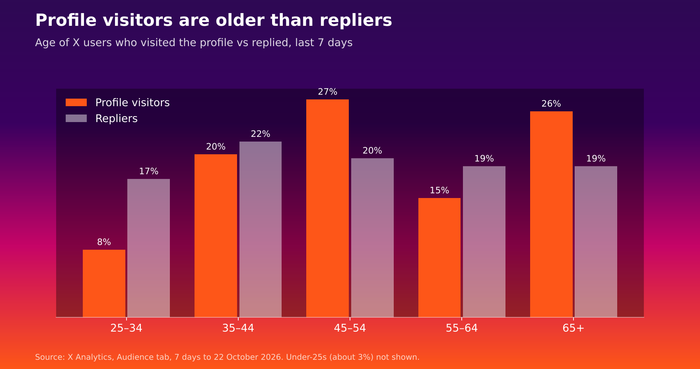
That gap matters. The quiet readers read, think and then visit my profile to decide whether I’m worth following. Most of them never reply to anything. If I judged my work only by the replies, I’d end up writing for the wrong people.
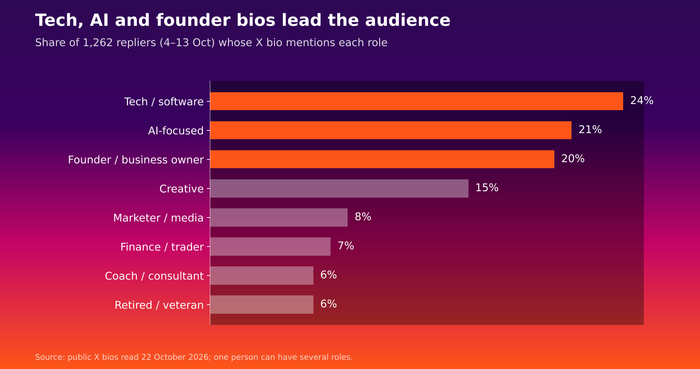
The bios of the people who do reply tell the rest of the story. One in four works in tech or software, one in five is focused on AI and one in five runs a business. Most are not influencers: 61% have fewer than 500 followers. These are working people trying to work out what comes next.
What this means if you’re trying to be seen
If you built an audience the old way, those followers aren’t wasted. But they no longer guarantee that anyone sees you. Each post now has to earn its reach from strangers.
You don’t need a big following for any of this to apply. Most of the people replying to me have fewer than 500 followers. The lessons work at any size.
- Stop counting followers. Watch profile visits and new followers per post instead. They tell you whether strangers liked what they found.
- Write to a group of people, not about a subject. “AI” is a subject. “Experienced people working out what AI means for their work” is an audience. The second one tells you what to write next.
- Name the feeling. Ask how something makes people feel, and they’ll answer from their own life. Ask what they think, and you’ll get a debate.
- Tell your own story, odd details included. The posts that earned followers were personal and specific: a year, a loss, a decision. Polish is cheap now. Detail is not.
- Count people, not replies. Likes and reply counts now include a lot of software. Profile visits and new followers are harder to fake.
- Spend your time on the people who come back. Replying to the same real people again and again is how the following becomes a community.
One caution.
This is one account, on one platform, over four months. X decides who sees each post, and it can change the rules tomorrow. That’s why every win on X has to end somewhere I own: an email address, a newsletter subscription or a waitlist.
What I’m doing next
The experiment showed that visibility can come back, even after years of shrinking reach and even in a flooded feed. Now it needs to turn into something lasting. Here is the plan for the next month:
- Two feeling questions a day, and a record of which ones break through.
- About an hour a day of replying, spent on real people, especially the ones who keep coming back.
- A weekly scorecard with five numbers: views, profile visits, new followers, real replies and sign-ups to the Zyrro waitlist.
That last number matters most. And the reason why is the real lesson of these four months.
What 535,000 followers couldn’t tell me
In 2009 I was 52 and starting again after my business collapsed. I got up at 4:30 every morning to write before the day began. Every new follower felt like proof that someone out there was listening.
So I chased the number. For years it went up, and I took that as a sign I was being heard. I never asked who those people were, or why they came, or whether they were still there.
A follower is someone who once clicked a button. That’s all. The number can’t tell you if they still read you, or what they need, or whether you’ve ever helped them.
The 2,020 people who replied this year told me far more. So did the quiet readers who never replied at all. One in four of the people who visited my profile last week was over 65. My guess is that many of them are where I was in 2009: good at something, unsure what comes next, and wondering if it’s too late to start.
That changed what I think being seen means. In a feed full of machine-made content, being seen isn’t about reach. It’s about being recognised by the right people for the right thing. And nobody can recognise you for something you haven’t worked out yourself.
My reach didn’t come back when I found a better posting time or a cleverer hook. It came back when I decided who I was writing for and what I wanted to be known for. Everything else followed from that.
That’s the hard part. Not the algorithm. Not the schedule. Knowing what you want to be known for next.
Most people with long careers never get asked that question. They get asked what they do, or when they’ll retire. Nobody asks what they want the next 10 or 20 years to stand for.
That’s why I’m building Zyrro.
It’s an AI tool for people with long careers who aren’t sure what comes next. You share the stories of your working life. It finds the strengths running through them, shows you four possible paths and gives you a small first step to take this week.
When I started this experiment in June, I wanted to know one thing. Could I still be seen?
Four months and 3,660 replies later, I’ve found a better question. Seen by whom, and for what?
535,000 followers taught me how to be counted. 2,020 people taught me how to be found.
So here’s my question for you. If the right people found you tomorrow, what would you want them to find?
Join the Zyrro waitlist
You’ve spent decades building experience. Zyrro helps you work out what to do with it next.
Tell it the stories of your working life. It will show you the strengths you keep coming back to, four paths worth testing, and one small step to take this week.
We’re opening Zyrro first to a small group of early testers. If you’ve read this far and thought “that’s me,” I’d like you to be one of them.
This is how I did it
The numbers: X Analytics exports for my account, July to October 2026, plus X’s audience breakdown for the past week.
The replies: every reply to my posts from 7 July to 22 October 2026, read along with each replier’s public bio. Each reply was sorted into a group by what it said. For July to September, the shares come from a random sample of 360 of 1,408 replies.
“Real” replies means replies from people, leaving out machine-written replies, one-word replies and sign-ups to a test I ran.
The limits: this is one account on one platform. Only 127 people stated their age, and X’s age figures are its own estimates.
The help: I used Claude to collect, sort and chart the data. The conclusions are mine to defend.