

Summary
There is a moment most people never talk about. It comes after the retreat, the long conversation, the journaling session that finally cracked something open. You’ve had the insight. And then… nothing.
This is implementation paralysis. Research from the Kellogg School finds people with the most meaningful insights are often least likely to act on them. The reason: a big insight raises the stakes, and high stakes produce freezing.
The gap between insight and action is not a willpower problem. It’s a method problem. This article gives you the 5 steps that close that gap — drawn from Aristotle, behavioural neuroscience, and three of history’s most instructive examples of people who moved before they were ready.
The Moment Nobody Talks About
There is a moment most people never talk about.
It comes after the retreat, after the long conversation, after the journaling session that finally cracked something open. You’ve had the insight. You can feel it — that quiet, precise sense of this is it. Something you’ve been circling for years has finally been named.
And then… nothing.
The insight sits there. Days pass. Weeks. The clarity that felt so urgent in the moment of discovery starts to fade at the edges. Life reasserts itself — the inbox, the obligations, the loud ordinary noise of a full schedule. And the purpose that felt so close becomes something you ‘should really get back to.’
This is the action gap. And it may be the most common — and least discussed — failure point in the entire purpose conversation.
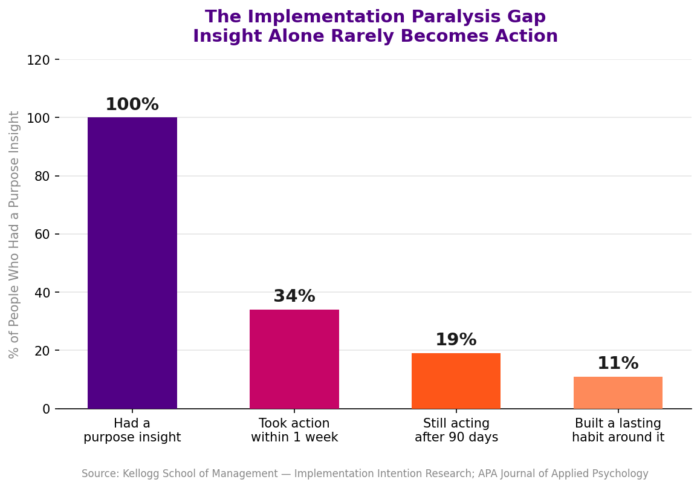
Researchers have a name for it: implementation paralysis. Studies from the Kellogg School of Management found that people with the most meaningful personal insights are often less likely to act on them than those with shallower realisations. The reason is counterintuitive but important: a big insight raises the stakes. What felt like a clue now feels like a calling — and callings, by their nature, feel enormous. Permanent. High-risk.
So instead of moving forward, most people freeze. They read more books. They talk to more friends. They start another journal. They tell themselves they need to be ‘more ready’ before they can truly begin.
The gap between knowing and doing is not a willpower problem. It is a method problem.
This article is about the method.
Why the Insight Isn’t Enough
Aristotle made a distinction the self-help industry has largely ignored.
He separated “Sophia” — philosophical wisdom, the knowing of things — from “Phronesis” — practical wisdom, the skill of acting well in particular situations. His argument was that knowing what is good and actually doing what is good are entirely different capacities, and they require entirely different development.
You can understand your purpose completely at the level of sophia — and be entirely undeveloped at the level of phronesis. That is, you can know what you’re for, and still not know how to move toward it in the real, specific, messy conditions of your actual life.
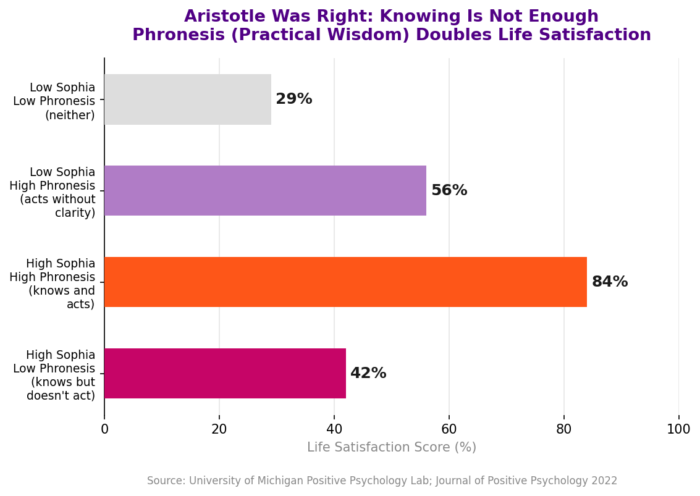
The data bears this out. People who score high on philosophical self-awareness but low on practical action-taking report life satisfaction scores barely above those who score low on both. The combination that predicts flourishing is not greater insight — it’s insight paired with the discipline of moving.
The ancient Chinese philosopher Mencius put it even more bluntly: ‘The great man is he who does not lose his child’s heart.’ Purpose isn’t the sophisticated thing — it’s the original impulse. The sophistication lies in protecting that impulse as it meets the resistance of the world.
Both Aristotle and Mencius were pointing at the same thing: insight and action are not the same muscle. You have to train the second one separately.
The People Who Froze — And Then Moved
Three stories. Three very different forms of paralysis. One thing in common.
Sylvester Stallone — Refusing to Negotiate Identity
Stallone spent years knowing he was a storyteller. He had a burning clarity about his calling — writing and acting — long before he had the means or the platform. He was turned down by over 1,500 talent agents. He was so broke he sold his dog for $50 to pay rent.
But when he wrote the script for Rocky in three and a half days, he had one unshakeable rule: he would not sell it unless he could play the lead. He was offered $125,000 for the script. He declined. He was offered $325,000. He declined again. Everyone around him told him he was insane.
Rocky cost $1 million to make. It won three Academy Awards, including Best Picture. The lesson isn’t about money. It’s about the moment Stallone decided his purpose was not negotiable.
J.K. Rowling — Acting Under Impossible Conditions
Rowling had the complete idea for Harry Potter arrive in her mind on a delayed train from Manchester to London in 1990. The full concept — the boy wizard, the school, the arc of seven books — appeared to her almost fully formed.
She spent the next five years writing the first novel while clinically depressed, unemployed, newly divorced, and raising a child alone. Harry Potter and the Philosopher’s Stone was rejected by twelve publishing houses before Bloomsbury’s eight-year-old daughter read the first chapter and refused to put it down.
Rowling didn’t wait for conditions to improve. She acted inside the conditions that existed.
Charles Darwin — The Cost of Waiting
Darwin knew the central insight of evolution decades before he published it. He held On the Origin of Species for nearly twenty years — paralysed by the scale of what he knew, the ferocity of the opposition he anticipated, and the weight of being right.
It was only when Alfred Russel Wallace arrived at the same conclusion independently that Darwin finally published. The push he needed wasn’t more certainty. It was the realisation that waiting had its own cost.
Three very different stories. Three very different forms of paralysis. One thing in common: at a certain point, each of them stopped managing the insight and started moving with it.
The 5 Steps From Insight to Action
Step 1: Name It Precisely — and Declare It Out Loud
A vague purpose cannot be acted on. ‘I want to help people’ is not a purpose — it’s a direction of feeling. The action gap lives in the vagueness. Language is not decoration — it is activation. When you name something precisely, you give your brain a target. And when you declare it out loud to another person, the psychological stakes shift. Research from the Dominican University of California found that people who write down their goals and share them with an accountability partner are 76% more likely to achieve them than those who keep their goals private. Name it as specifically as you can: not ‘I want to teach’ but ‘I want to help first-generation university students navigate the gap between academic knowledge and professional life.’ The more precise the name, the more direct the path.
Step 2: Take the Smallest True Action — Today
The enemy of beginning is scale. When purpose feels large — and it always does, at the start — the temptation is to wait until you can act at the scale it deserves. This is the trap. BJ Fogg’s research on behaviour design at Stanford makes this point with unusual force: the brain learns through repetition, not intensity. A five-minute action taken daily for thirty days creates more durable neural change than a weekend retreat. The question is not ‘what is the right first step?’ It is: ‘what is the smallest possible action that is still true to what I’m moving toward?’ Stallone didn’t write Rocky in one sitting. He wrote three and a half pages a day for three days.
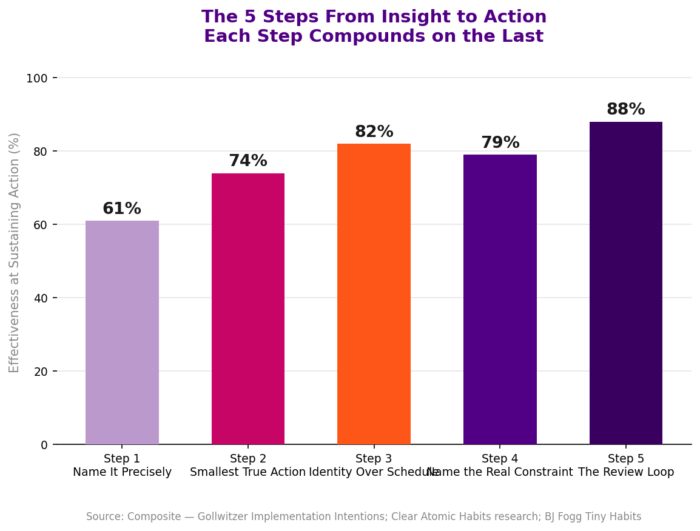
Step 3: Build Identity Before You Build a Schedule
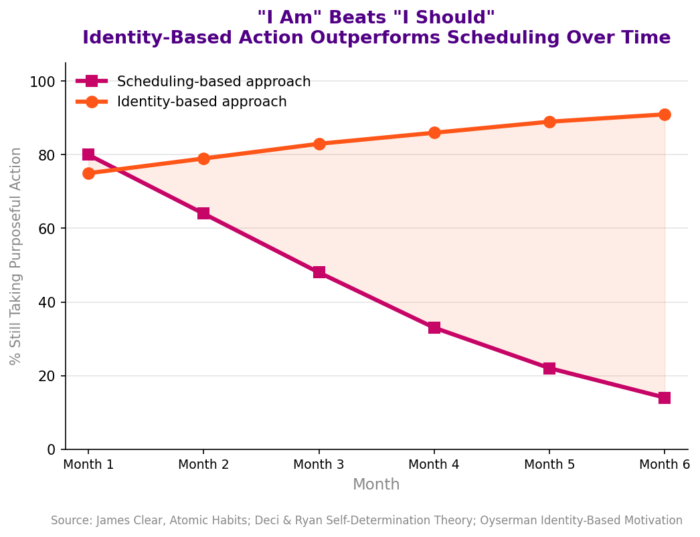
Most people try to schedule their way into purpose. They block out Tuesday mornings for ‘deep work.’ They set a timer. They create a habit tracker. And within six weeks, they have abandoned it — not because they lacked discipline, but because they were trying to bolt a new behaviour onto an old identity. James Clear’s research into habit formation found that the most durable behavioural changes come not from asking ‘what do I want to achieve?’ but ‘who do I want to become?’ The shift from ‘I’m trying to write more’ to ‘I am a writer’ is not semantic. It is the difference between effort and identity. Purpose-aligned action becomes sustainable when it is not something you do, but something you are.
Step 4: Name Your Real Constraint — Not the Comfortable One
Most people, when asked what is stopping them from acting on their purpose, give a comfortable answer. ‘I don’t have enough time.’ ‘I don’t have the right qualifications.’ ‘I’m waiting until the kids are older.’ These are real constraints. They are also, in the majority of cases, not the real constraint. The real constraint is usually one of three things: Fear of judgment from a specific person or group whose opinion carries enormous weight. Distributed attention — the intellectual life of someone who is interesting in too many things to be fully committed to one. Or absence of community — acting in isolation without even one person who holds your purpose as real. Name your true constraint. Then address that one — not the comfortable substitute.
Step 5: Review, Reframe, and Refuse to Stop
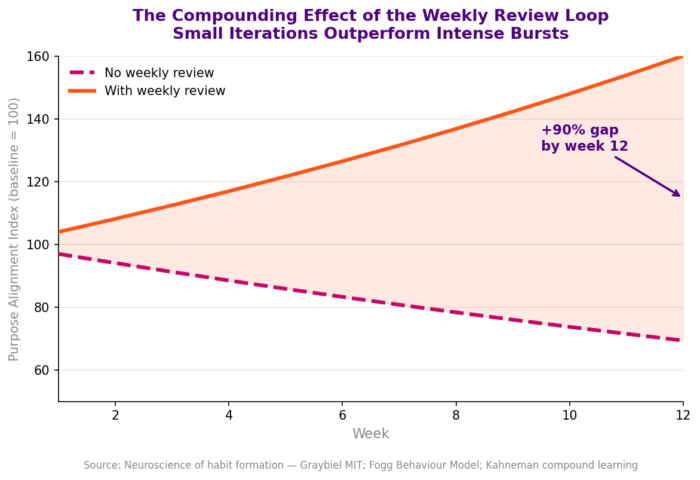
The final step is not really a step. It’s a practice — the discipline of staying in the loop rather than declaring the journey over after the first attempt stalls. The neuroscience of habit and identity change consistently points to the same mechanism: the brain learns through iteration, not intensity. Build a weekly review practice around a single question: Did I act in the direction of my purpose this week? If yes — what happened, and what does it tell you? If no — what stopped you, and what does that reveal? The Stoics called this askesis — training. Not inspiration. Not epiphany. Training.
The Role AI Plays in Closing the Gap
Here is what’s changed in this conversation.
For most of human history, the bridge between insight and action required either exceptional internal discipline or access to skilled external support — a coach, a mentor, a guide who could hold your purpose as real across time and help you track what was actually happening versus what you were telling yourself.
AI changes the equation. Not as a replacement for that human relationship, but as something that has never previously existed: a witness with perfect memory, zero fatigue, and no social agenda. A tool that can hold your stated purpose alongside your actual behaviour across weeks and months — and surface, without judgment, the gap between them.
The purpose has been detected. The pattern has been named. Now the work is daily — the small acts, the identity decisions, the weekly reckoning.
That work doesn’t require a perfect plan. It requires a first step, taken before you’re ready, in the direction you already know.
The Question That Changes Everything
Aristotle, Seneca, Mencius — separated by centuries and cultures — all arrived at a version of the same instruction.
Stop theorising about the good life. Live in the direction of it, in whatever small way is available to you today.
You already know what your purpose is pointing toward. You’ve had the insight. The signal is there.
The only remaining question is the one that has always mattered most:
What are you going to do about it — today?
This is the second article in a series on purpose detection and intentional living in the Human + Machine Age. Read the first piece: “The Purpose Trap: Stop Searching. Start Detecting.”