
In space, no one can hear you scream. In the AI economy, no one can hear you launch.
There is a new dream moving through the technology world: one person, one laptop and one idea.
No large development team. No expensive agency. No office full of engineers. Agentic AI can now help a founder research a market, shape a product, write code, design the interface, test it, build the website, create content, handle support and automate parts of the operation.
A company that once needed twenty people can increasingly be attempted by one motivated founder with a collection of AI agents beside them. That is extraordinary.
But there is a problem hiding behind the excitement. You can build the product, launch the website and switch on the payment system. Then comes the silence.
The world does not automatically arrive. You have created something in a universe already crowded with millions of other things being created at the same time. You are shouting into the vacuum.
Why this matters
If you are building the company and its easy then millions more are doing the same thing. The AI era is both creating opportunity while reducing its visibility when you launch.
This may become the defining paradox of the one-person AI company. AI is removing the bottleneck of creation while increasing the bottleneck of discovery.
For most of the software era, building was hard. Distribution was hard too, but if you could raise the money, assemble the programmers and ship something useful, you had already crossed a major barrier.
Now that barrier is collapsing. AI is making production abundant, so scarcity moves somewhere else: attention, trust, reputation and distribution.
The one-person AI company revolution is not complete when one person can build a company. It is complete when one person can reliably find the customers who need what they built.
The old internet rewarded publishing
For roughly two decades, the web operated under an informal bargain. You created useful information, search engines indexed it, social networks distributed it and people clicked.
Some became readers. Some became subscribers. A few became customers. That model helped blogs become media companies, creators become brands and tiny software businesses become global products.
I experienced that era personally. Start a blog. Publish relentlessly. Earn links. Build an email list. Grow an audience. Let search and social platforms carry your work farther than you could ever carry it yourself.
It was never easy, but there was a visible path. That path is becoming less predictable.
Pew Research Center analysed 68,879 Google searches made by 900 U.S. adults. When no AI summary appeared, 15% of search visits led to a click on a traditional result. When an AI summary appeared, that fell to 8%. Only 1% clicked a source link inside the AI summary. Read the Pew study.
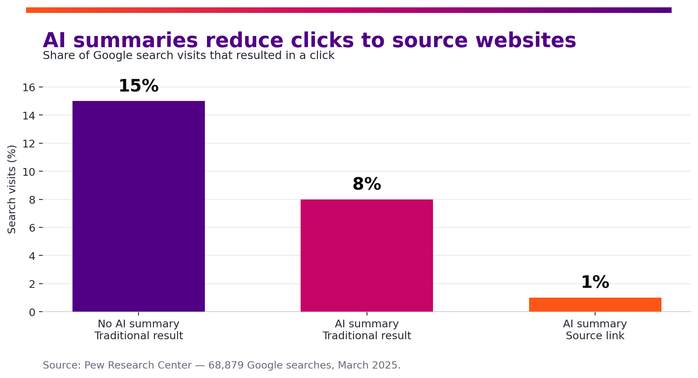
That number matters because it changes the economics of being useful.
Your article can be researched, your insight can be extracted and your answer can be summarised. The user can receive the value without ever reaching the original source.
Being used as a source is no longer the same thing as being discovered as a brand. For a one-person company, that difference can decide whether valuable work produces customers or simply disappears into someone else’s answer.
The invisible villain
There is a villain in this story, but it is not a single company. It is a system built around convenience, speed and keeping the user inside the interface.
The system wants to reduce friction. It wants to answer faster. It wants people to keep scrolling, searching or asking questions without leaving.
For the user, that can be wonderful. For the unknown founder, it can create a strange outcome: your knowledge becomes useful while your name becomes optional.
Nobody designed the entire effect from one room. Search engines, social platforms, recommendation algorithms and AI assistants are all responding to powerful incentives.
But the result is the same.
You can be valuable and invisible at exactly the same time.
The Reuters Institute reported that Google organic search referrals to more than 2,500 news sites fell 33% globally between November 2024 and November 2025, and 38% in the United States. It also notes that the figures do not prove AI Overviews caused the entire decline; algorithm changes and changing search behaviour matter too. See the 2026 Digital News Report.
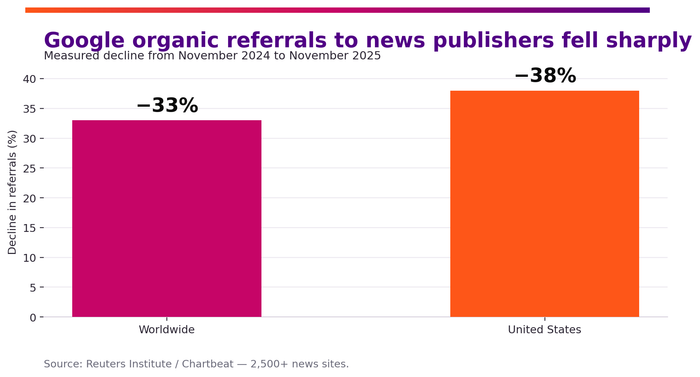
The exact numbers will vary by sector. A news publisher is not a SaaS company, a local accountant is not a creator and a niche B2B startup is not an ecommerce store.
Still, the direction is difficult to ignore. Distribution that once felt almost automatic now needs to be designed with much more intention.
For the one-person AI founder, relying on one platform or one algorithm is becoming a fragile strategy.
AI can consume more than it returns
Cloudflare looked at crawler requests compared with attributable human referrals in June 2025. Its estimate was roughly 14 crawler requests per referral for Google, about 1,700 for OpenAI and about 73,000 for Anthropic. Cloudflare cautions that referrals from native AI apps may be undercounted because they may not pass a standard referrer header. Read Cloudflare’s analysis.
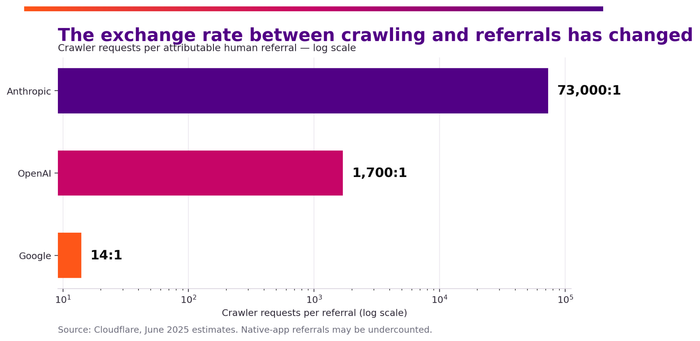
The caveat matters.
Crawling is not the same thing as citing, training is not the same thing as search retrieval, and those ratios are not a moral scorecard.
But they do reveal a structural change. The web’s old bargain “Crawl my content and send me humans” is no longer guaranteed.
For the one-person AI company, this means that “publish more” is not enough.
You need to create something the machine cannot completely absorb and deliver on your behalf.
So what becomes scarce?
Information is no longer scarce. It is exploding.
AI can generate explanations, lists, summaries, plans, landing pages, newsletters and social posts in seconds. If your entire value proposition is information, you are building on ground that is getting cheaper every month.
What becomes more valuable is what cannot be neatly compressed into an answer. That includes original evidence, lived experience, judgment, trust, relationships, implementation and transformation.
- Original evidence: data you collected, tests you ran, outcomes you measured.
- Lived experience: what happened when you actually tried the thing.
- Judgment: what matters, what does not, and what you would do next.
- Trust: the belief that you will deliver what you promise.
- Relationships: access to people who know you, reply to you and recommend you.
- Implementation: helping someone move from knowing to doing.
- Transformation: a measurable change in the customer’s life or business.
This is the part of the one-person AI company story that interests me most.
AI can help one person create at the scale of a team, but the founder still has to become a signal inside a world filled with synthetic noise.
That is not mainly a technology problem. It is a human problem: how to be noticed, believed, remembered and recommended.
The answer is not to crack the algorithm
Founders often ask the wrong question.
- How do I crack LinkedIn?
- How do I game Google?
- What is the perfect posting schedule on X?
- What is the newest SEO trick?
The problem with that strategy is simple. You do not own the algorithm. You are renting distribution from a landlord who can change the lease overnight.
The better question is more durable: how do I build a distribution system that becomes more valuable even when algorithms change?
Borrow attention. Own the relationship. Earn advocacy.
That suggests a three-part strategy.
- First, use platforms you do not own for discovery. Search, X, LinkedIn, YouTube, Reddit, podcasts, AI assistants and other people’s audiences can all introduce you to the right people.
- Second, create a direct relationship. Email, a product account, a community or a recurring service gives that person a way to find you again without asking an algorithm for permission.
- Third, deliver enough value that customers become distribution. They tell colleagues, share an output, provide a review or introduce you to a partner.
That is when distribution starts to compound.
Borrow trust before you build an audience
The other mistake is assuming every one-person founder needs to become an influencer. They do not.
Imagine you have built a remarkable AI tool for independent financial advisers. You could spend two years trying to build 100,000 followers.
Or you could find ten consultants, newsletter writers, associations, podcasts or software companies that already have the trust of financial advisers.
One trusted introduction to 500 people with the exact problem you solve may be worth more than 500,000 random impressions. This is borrowed distribution, but more importantly it is borrowed trust.
For an unknown one-person company, trust is often the missing bridge between being seen and being tried.
Build something AI cannot replace with a paragraph
There is another test I would apply to every new AI company: can the customer get most of your value by asking an AI assistant a good question?
If the answer is yes, the moat is thin. A generic career guide can be summarised, a list of marketing ideas can be generated and a startup plan can be produced.
A system that understands the customer, watches what they do, pushes them to act, measures what changes and adapts to the result is different. The value moves from information to experience.
It moves from advice to implementation, and from possibility to progress. That is much harder to steal with a summary.
There is also an unexpected opportunity
Adobe Digital Insights found something that complicates the doom story. In U.S. retail data, AI-referred traffic converted 38% worse than non-AI traffic in March 2025. By March 2026 it converted 42% better. Adobe also reported higher engagement among AI-referred visitors. See Adobe’s 2026 analysis.
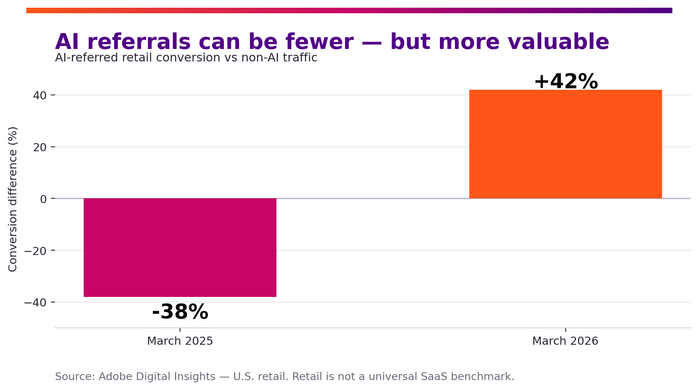
Retail is not SaaS, and one study should not be treated as a universal law. But the implication is fascinating.
AI may not simply become a wall between you and the customer. It may become a new discovery layer.
Someone asks, “What is the best tool for an experienced executive who wants to decide what to do next?” Or, “What software helps a solo consultant automate client reporting?”
If an AI assistant knows your product, understands what it does and can find independent evidence that it works, that recommendation may become extremely valuable.
The goal is no longer merely to rank in Google. The new goal may be to become recommendable by machines and trusted by humans.
The secret sauce: a one-person distribution engine
So how does the invisible one-person AI company become visible?
Not with one growth hack, a magic posting schedule or another automated content machine. It becomes visible by building a loop in which discovery, trust, experience, evidence and advocacy reinforce each other.
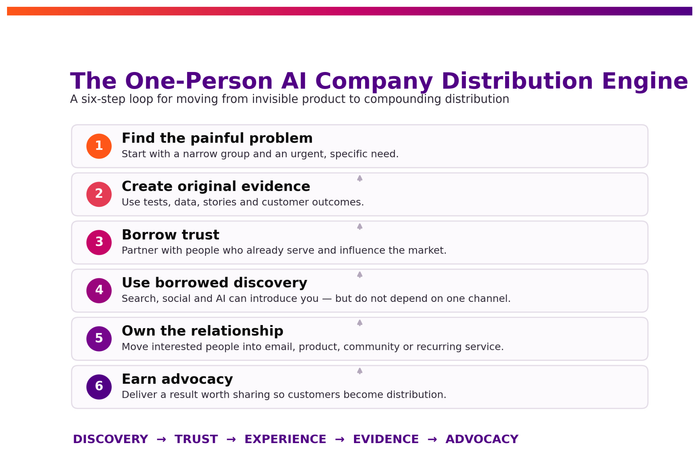
That is the shift.
The one-person AI company should not think like a miniature corporation. It should think like a network, with the founder in the middle, AI agents around them and customers, partners and communities around the outside.
Every useful interaction creates another signal. Every successful customer creates another piece of evidence. Every trusted partner creates another doorway.
Distribution stops being an event that happens after launch. It becomes part of the product architecture.
The second revolution of the one-person company
The first revolution is already underway: one person can increasingly do the work of many. But that is only half the story.
The second revolution will be about whether one person can also build a distribution system that once required a marketing department, a sales team, a PR firm and a media budget.
Agentic AI will help here too. Agents can monitor markets, identify prospects, research partners, repurpose original research, personalise onboarding, analyse conversion and reveal where customers drop away.
But automation cannot manufacture trust. It cannot fake a genuine customer outcome, create a reputation that has not been earned or save a product nobody actually needs.
Those remain human constraints. The future may belong not to the founder who automates everything, but to the founder who knows what should never be automated.
Creation is becoming abundant. Discovery is becoming scarce. Trust may become the ultimate distribution advantage.
The one-person AI company is real, but the fantasy is believing that building it is enough.
The hard part is no longer merely making the thing. The hard part is becoming visible to the right people, being credible when they arrive and delivering an outcome strong enough that they tell someone else.
That is how an invisible company becomes a business.
Because in space, no one can hear you scream. And in the emerging AI economy, no one can hear you launch unless you give the right people a reason to listen.