
Stop polishing generic AI drafts and start generating content that sounds authentic from the very first word. This workflow provides a repeatable process to define your unique voice, capture it in a reusable guide, and train any AI to adopt it.
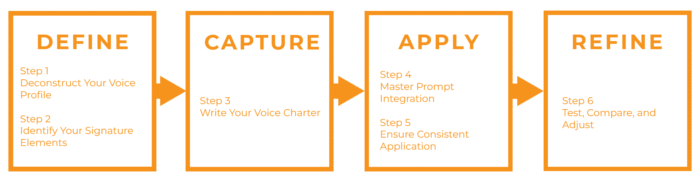
Phase 1: DEFINE — Uncover Your Authentic Style
Before you can teach the AI, you must first clarify your own voice. This is the foundation.
Step 1: Deconstruct Your Voice Profile
- Tone: Where do you fall on the spectrum? (e.g., Formal ↔ Casual, Academic ↔ Playful, Authoritative ↔ Humble).
- Sentence & Paragraph Length: Do you prefer short, punchy sentences or longer, more complex ones? Do you use dense paragraphs or lots of white space?
- Humor Level: Are you witty, dry, sarcastic, goofy, or do you avoid humor altogether?
- Emotional Range: Do you write with passion, empathy, curiosity, urgency, or calm objectivity?
Step 2: Identify Your Signature Elements
These are the recurring ingredients that make your work uniquely yours.
Personal Stories: What 2-3 anecdotes do you find yourself constantly referencing? (e.g., “The story of my first failed startup…”)
Core Metaphors & Analogies: What comparisons do you often use to explain complex ideas? (e.g., “Marketing is like gardening,” “Building a business is like running a marathon.”)
Bedrock Values: What principles underpin all your work? (e.g., Community over competition, radical transparency, relentless curiosity.)
Phase 2: CAPTURE — Create Your Reusable Guide
Translate your self-discovery into a concrete tool the AI can understand.
Step 3: Write Your Voice Charter
Condense your findings from Phase 1 into a concise, 1-2 paragraph description of your voice. This is your master guide. Be direct and use descriptive language.
Sample “Voice Charter” Snippet:
“Write in the style of a pragmatic optimist and seasoned tech mentor. The tone is conversational, direct, and encouraging, like a trusted advisor explaining a complex idea over coffee. Use a mix of short, assertive sentences and longer, more detailed ones for clarity. I frequently use analogies from engineering and construction (e.g., ‘build a solid foundation,’ ‘reverse-engineer the problem,’ ‘debug your strategy’). The core value is resilience; always frame challenges as learning opportunities. Avoid buzzwords and corporate jargon.”
Phase 3: APPLY — Bake Your Voice into Every Prompt
Integrate your Voice Charter into your daily AI interactions to ensure consistency.
Step 4: Master Prompt Integration
Simply append your Voice Charter to your content requests.
- Generic Prompt: “Write a blog post about the benefits of time management.”
- Signature Voice Prompt: “Using my voice charter below, write a blog post about the benefits of time management. [Paste your entire Voice Charter here]”
Step 5: Ensure Consistent Application
Use this exact same Voice Charter across all your AI-assisted workflows to maintain a unified brand voice.
- Blog Post Outlines
- Social Media Posts
- Podcast Scripts & Show Notes
- Email Newsletters
- Content Summaries
Phase 4: REFINE — Test and Iterate
Your voice is alive; your guide should be too. Continuously improve its accuracy.
Step 6: Test, Compare, and Adjust
This is an iterative loop, not a one-time task.
- Generate: Create a sample piece of content using your charter.
- Compare: Place the AI output next to a piece you wrote yourself. Does it feel the same? Where does it diverge?
- Adjust: Tweak your Voice Charter based on your findings. (e.g., “I need to add ‘use more active voice’,” or “Specify that humor should be dry, not sarcastic.”) Repeat until the AI’s output is 90% you.