
Last quarter, one company made fifty-five billion dollars selling ads against what you do online. That is about seven thousand dollars a second, day and night, for three months. You are not the customer. You are what they sell.
To sell to you, the machine needs to build a profile: What you like, what you click, what you buy.
Then it charges advertisers to reach that profile. The more predictable you are, the cleaner the container and category you’re in, the more they pay.
Because a person who acts the same way every day is easy to sell.
That same profile decides what fills your feed. So the feed does not reward your best work.
It rewards your most predictable work and the posts that keep you scrolling past the ads.
Why that matters
Change what you write about, and the machine is no longer sure who to show it to. So it shows it to fewer people. Your reach falls. Your online visibility is throttled. And it doesn’t matter how good your content or writing is.
Your genius is sent to the graveyard. Buried. And you get no warning and no reason. Just black box purgatory.
Most people read that fall the wrong way. They decide the new work was weak, or that they are. So they go back to the old thing and the machine gets what it was built to keep: a person who never changes.
A creator I have never met felt it.
He posted a video he was proud of about his new direction. It sank. So he posted one clip about his old topic, the thing he was trying to leave behind. It exploded. Another hundred thousand views. In the only language it has, reach, the machine told him who he was still allowed to be.
Another watched it happen in slow motion. A run of videos about a medical emergency he had survived convinced the machine that was his whole channel, and every new film after got buried. A cage his own success had built.
I know that box. Seventeen years in, this year I tried to climb out of mine.
What I found was worse than a box. It was a business.
The same machine, every feed
The trap is not a YouTube quirk. It is every feed, running the same algorithmic machine and formula under different names on the 5 platforms.
- LinkedIn: Interest Graph (360Brew). Files you as one topic; if you drift, it can’t categorise you.
- X: Cluster affinity (Phoenix / Grok). Sorts you into interest clusters read from your last ~128 posts.
- YouTube: Topic + audience model. Files you by what your existing viewers already watch.
- TikTok: ‘For You’ interest signals. Won’t push what it can’t confidently understand.
- Substack: Audience-overlap discovery. Surfaces you to people who read newsletters like yours.
It is the same formula whatever the logo
- It learns what you posted before.
- It decides that is who you are.
- It shows anything new to fewer people.
It is the black box of the platforms giving you what they think is your identity.
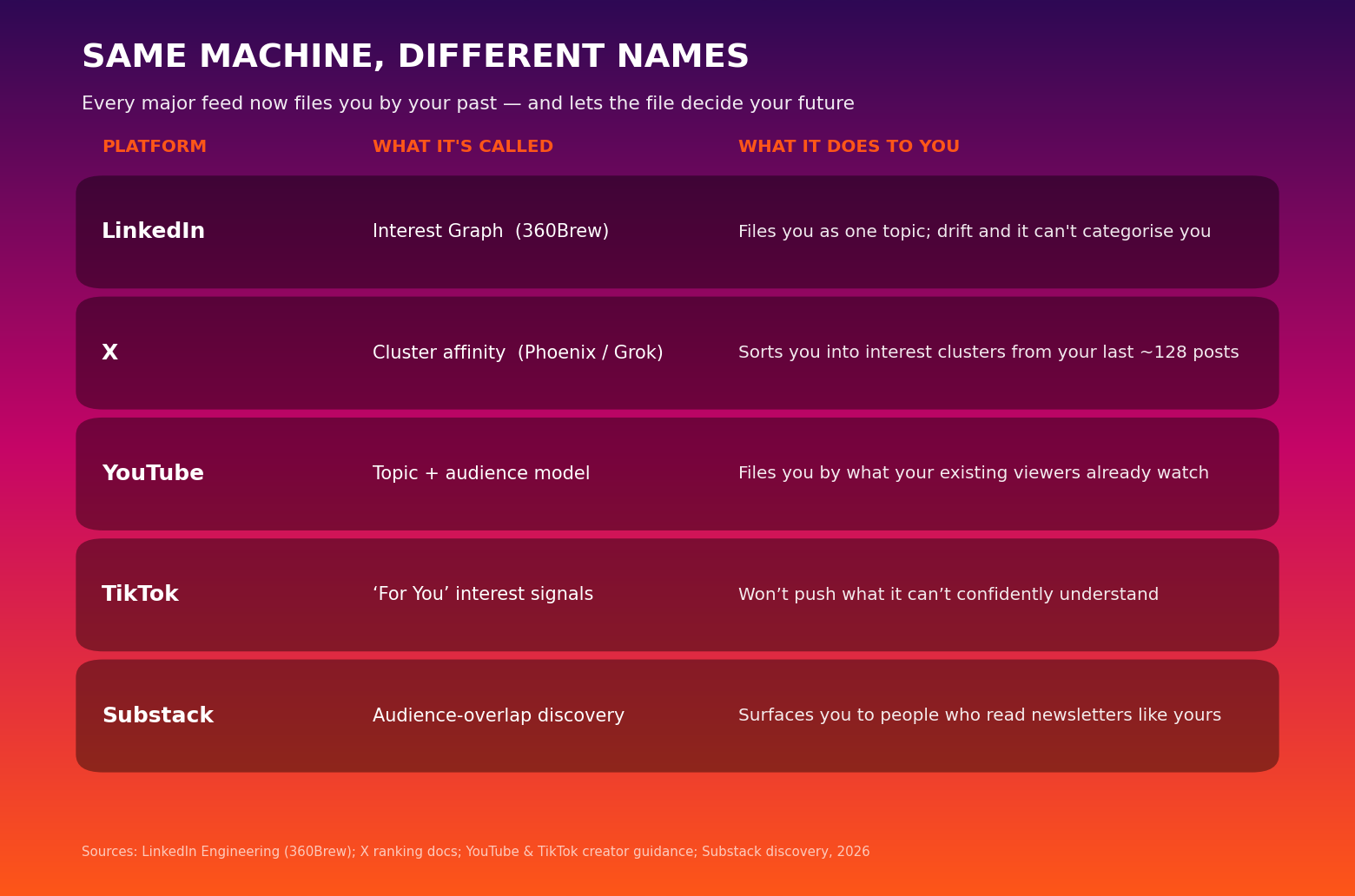
Algorithmic Identity
A scholar named it fifteen years ago. He called it your algorithmic identity.
The machine studies your trail, decides who you are, and hands you a self you never chose.
His hard line: that self is made useful not for you, but for someone else.
Useful to whom?
That is the question nobody answers on the platforms welcome screen.
So let me answer it.
You are not the customer. You never were.
The customer is the advertiser. The product is you. Here is the receipt:
- Meta told its own regulators that substantially all its money comes from advertising and built on tracking what you do, on and off its apps.
- To do it, the machine reads billions of signals about you, and that means every like, every pause, how long you hover to guess what you’ll want before you do.
- This year it passes Google to become the largest ad seller on earth — around 243 billion dollars.
- The engine that decides what you see is the same engine that decides which ad you are worth. Your feed and your price tag run on one file.
The interest graph is not a library card. It is a sales file. It sorts you so a stranger can buy the right slice of your attention.
You are not being served. You are being sold. And a person who keeps changing is hard to sell.
You built it. For free.
Now the part that should make you angry.
You built the machine that files you. You are still building it. And you are not being paid for the part that matters.
Every post you publish does three jobs, and not one of them is yours:
- It trains your cage. It teaches the machine your topic, so it can keep serving you to the same crowd and lock you in.
- It makes the inventory. Your work is the thing that keeps people scrolling — past the ads that pay for all of it.
- It sharpens the file. Every click on your post refines the profile they rent to advertisers.
You are the factory and the product. You are not on the payroll.
Look at the split.
YouTube pays a creator roughly 5 to 15 dollars for a thousand views, while charging advertisers 7 to 20 or more for the same thousand. The platform keeps the gap. Across the feeds they take 20 to 45 percent of what your work earns.
The creator economy is worth a quarter of a trillion dollars a year, and most of the people making it own nothing — not the content, not the audience, not the reach. Scholars have a flat word for the arrangement: unpaid labor.
What it cost me to change
I paid a different tax. Not in dollars. In reach.
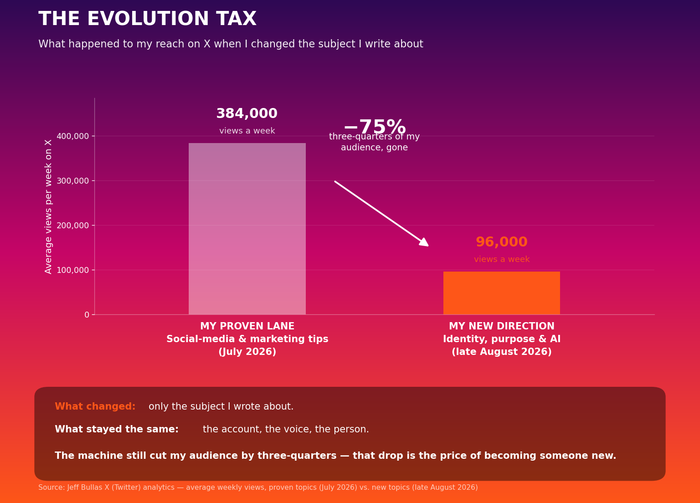
When the machine gets confused between the past and the present
- For years I fed it what it expected, social media tips, how to win at the feed and it rewarded me. A wave that reached 384,000 people in a week.
- Then I wrote as who I am now. My reach fell to 96,000. Down seventy-five percent.
Not because the work was worse. Because a shape-shifter is bad for business. Harder to file. Harder to sell.
The machine met a stranger where it expected an old friend, and it turned the lights down.
It is not just me
For a while I thought this was my private frustration. The numbers say it is a workforce.
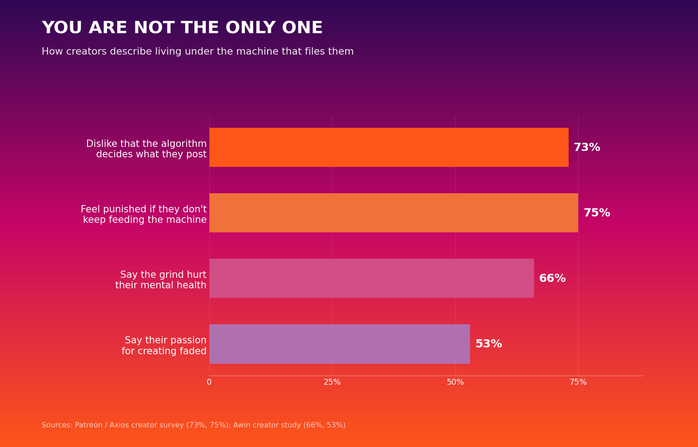
By the numbers
The impacts are not trivial and it removes motivation and joy of work for creators
- Nearly three in four creators dislike that a machine decides what they can post. Three in four feel punished the moment they stop feeding it.
- Two in three say the grind hurt their mental health.
- Half say their love of the work faded.
Here is the cold part.
No one at these companies has to sit in a room and decide to freeze you. The business model decides it for them. And the AI algorithm implements it.
Predictable pays. But evolving as a person does not. You confuse the machine. It does not know what box to put you in.
Which is worse than a conspiracy. A conspiracy you can expose. An incentive just keeps paying out.
And now they don’t even need you
Here is the last turn of the screw.
The machines have learned to eat the content and skip the creator.
Google’s AI now answers inside the search page for roughly a quarter of all searches. Publishers who spent twenty years feeding it are watching traffic fall by anywhere from a fifth to nine-tenths. The answer stays on the page. The click never comes.
They took the work. They kept the reader. They cut you out of the deal.
Feed the machine. It keeps the money. And now it does not even send the traffic back.
The way out is not what you think
Stop chasing reach. A big crowd that scrolls past does not change how the machine sees you. A smaller crowd that stops and reads does.
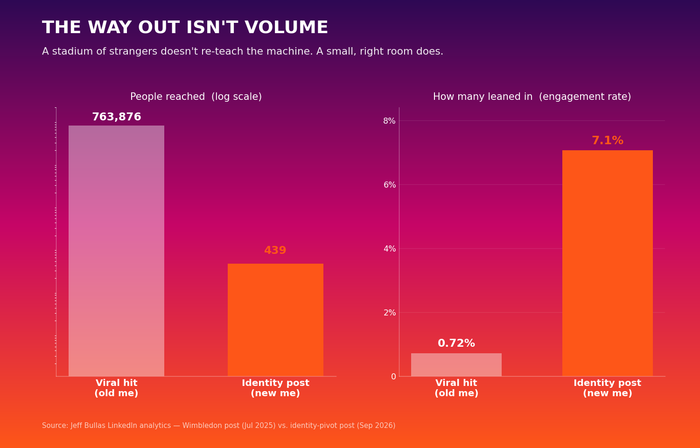
My biggest post reached 763,876 people, and almost none stayed at 0.72 percent.
The post where I wrote as the new me reached 439, and seven percent of them leaned in. The giant crowd did not change my file. It just pointed the machine back at my past.
Here are four ways to reach the right people. They work on every feed.
- Write for the people you actually want, not the biggest crowd. The machine now measures how long people spend on your post. A small, right audience that reads to the end counts for more than a huge one that skims. So write posts worth stopping for.
- Show up in your new topic before you post about it. Find the people, groups and hashtags in that space. Comment, reply and collaborate there for a few weeks first. Then, when you post, that audience already knows you — and the machine has already seen you belong there.
- Change one thing at a time. Keep your voice and style the same while you change the subject. Change everything at once and the machine treats you as a stranger, so you start from zero. Move slowly and you keep the audience you already have. (This is how you earn a new category instead of resetting.)
- Build an email list. It is the one audience no platform can throttle, delete or charge you to reach. When you have someone’s email, you reach them directly and no algorithm gets a vote. I have thirty thousand subscribers, and no interest graph decides whether they hear from me. Even Meta and Google now admit a list is one of the most valuable things a creator can own. Start collecting emails today.
One honest caveat:
This is getting easier, not harder. The newer algorithms look more at the post in front of them and less at your past, so a strong post on a new topic now travels further than it would have a year ago.
The penalty for changing is real but it is shrinking. There has never been a better time to change what you write about.
The machine could be built the other way
None of this is a law of nature. It is a choice, written in code, by companies whose business is prediction.
A feed could reward you for growing instead of fining you for it. It could read your curiosity as a direction to follow, not a pattern to lock. It could treat you as a person, not a profile to sell.
That machine is possible. We just have not been sold it — because a becoming you is harder to monetise than a predictable one.
I have left a container before
I walked out of one container at 27, when the world I was handed stopped fitting the one I could see. I started again at 52, at a keyboard, before dawn. I am building again at 69.
Every time, the hard part was never leaving. It was getting the world to stop calling me by my old name. This time the world is a machine, and the machine keeps a file — and sells it. But a tax is not a wall. You can pay it. You can climb.
Every feed files you by who you were.
Then it sells that file, pays you in reach, and cuts the reach the moment you try to become someone new.
That is the deal. You never signed it. You can still walk away from it.
You are not the inventory. You are not the unpaid factory. You are a person still becoming one.
Own your audience. Keep your voice. Change in the open, at a cost, on purpose — until the file has no choice but to catch up.
The container was built to sell who you were. You were built to outgrow it.
The feed decided who you are. Zyrro helps you decide instead — your direction, your strengths, the signal only you can send. I’m letting a small group in first.