Key Takeaways
- End-to-End Video from a Single Prompt: Manus transforms a simple text input into a fully animated, multi-scene short video — handling storyboarding, image generation, animation, and editing without manual input.
- Differentiated by Storytelling Focus: Unlike competitors that produce isolated clips, Manus generates coherent narratives with a beginning, middle, and end — ideal for explainer videos, product demos, or creative storytelling.
- Game-Changer for AI Builders & Product Leads: Teams can rapidly prototype product ideas, illustrate agent outputs visually, or replace static mockups with animated demos — cutting production time from weeks to minutes.
- No Video Skills Required: Designed for non-creatives, the tool requires zero editing experience, making high-quality video creation accessible to marketers, founders, and creators alike.
- Fast, Scalable, and Cost-Effective: Manus eliminates the cost and complexity of traditional video production, enabling A/B testing of marketing videos or generating personalized content at scale.
- Currently in Early Access: Available to paying users with broader rollout (including limited free access) expected soon; pricing is competitive with other AI content tools.
- Limited Audio Support (for now): Videos are generated without soundtracks — audio must be added manually, though future updates may include built-in voice or music features.
- Risks Require Guardrails: While powerful, teams should review AI-generated videos for factual accuracy, brand fit, and ethical considerations — especially for public-facing content.
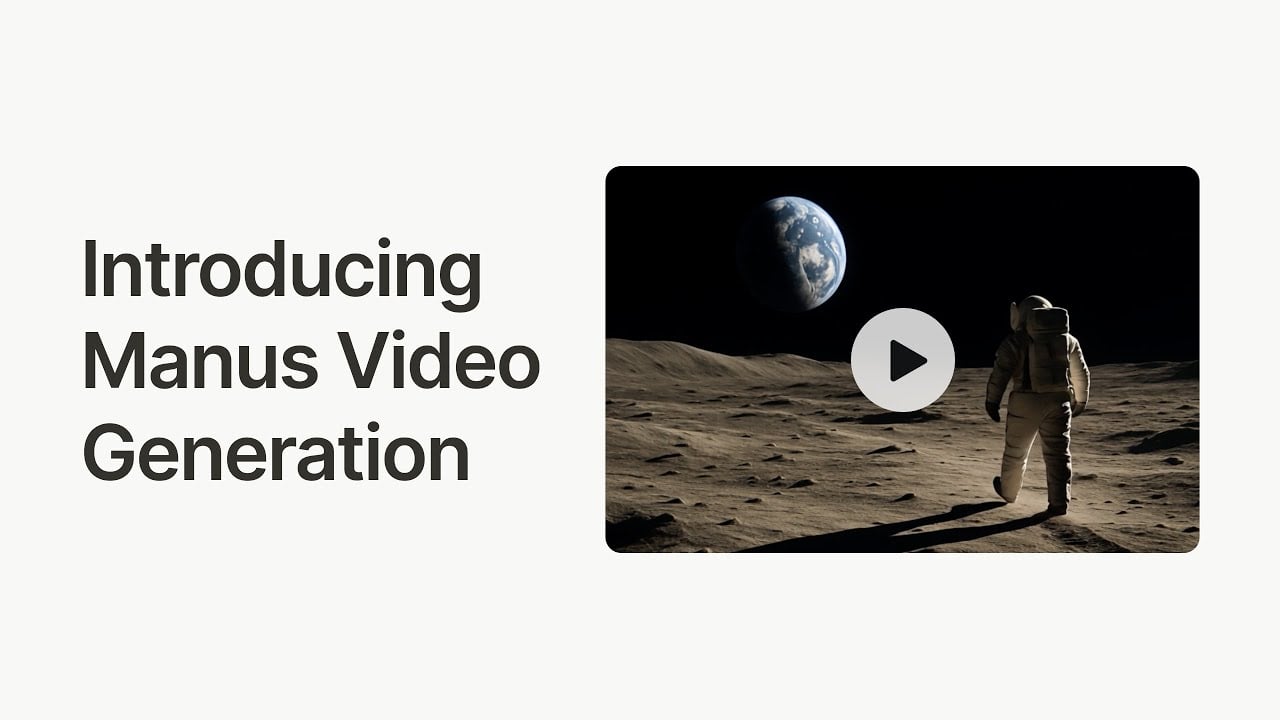
Manus – a rising AI agent platform – has launched a new text-to-video generator that can transform a written prompt into a fully animated short video story within minutes.
This AI-powered tool takes a user’s idea (entered as text) and automatically produces a “complete video story – structured, sequenced, and ready to watch,” as Manus described in its announcement. In practical terms, with a single prompt the system “plans each scene, crafts the visuals, and animates your vision,” stitching these pieces together into a coherent video narrative. The result is a polished short film that brings the user’s concept to life as an animated video, without any manual video editing.
Technical capabilities
Manus’ new generator essentially acts as a one-stop AI video production pipeline. It uses generative AI to handle storyboarding, scene planning, image generation, animation, and editing – all automatically. Unlike many text-to-video tools that might create only a single clip or require scene-by-scene prompting, Manus’ system focuses on whole-story generation.
It breaks down the input text into a series of logically sequenced scenes with a clear narrative flow, effectively creating a mini movie from the prompt. As AI analyst Jim Clyde Monge notes, “Manus creates a storyboard, performs concept visualization, generates multiple videos, and then stitches them together” – all from one prompt. In other words, the Manus AI acts like a virtual director and editor: it interprets the prompt’s theme and plot, designs a sequence of scenes, generates the visuals for each scene (using advanced generative models), and compiles the scenes into a final video file.
Differentiators
This storytelling-centric approach sets Manus apart from competitors. “Unlike most platforms that produce isolated clips, Manus tries to stand out by focusing on storytelling,” one tech journal observes. Rather than a disjointed or one-shot video, Manus outputs a cohesive story with a beginning, middle, and end.
This is a key differentiator from other text-to-video generators (such as Runway or Synthesia) which often require users to generate or assemble content scene by scene. Manus automates that assembly and ensures narrative continuity.
Another differentiator is Manus’ foundation as an autonomous agent platform – the video generator leverages Manus’ AI agent capabilities to handle multi-step tasks. For example, Manus can perform upstream work like researching a topic or retrieving images before video generation if needed, thanks to its multi-agent system for planning and knowledge retrieval. The video generation engine itself is powered by cutting-edge AI models; tech insiders report that Manus has integrated Google’s latest “Veo 3” video model into its platform.
This gives it the ability to produce high-quality, cinematic visuals with relatively natural movement of characters and objects. Early users even remarked that Manus’ AI videos “look like Disney productions” in terms of animation quality– a testament to the sophistication of the generative model under the hood. All of this is achieved through a simple interface: no video editing skills or technical knowledge are required from the user. One just types a description of the desired video, and Manus’ AI handles the rest, lowering the barrier to video content creation dramatically.
Use cases and content
Manus highlights a wide range of use cases for its AI video generator. Creators can whip up viral social media clips (e.g. “hilarious meme videos, adorable animal clips, or satisfying product showcases”) just by describing the concept.
Marketing teams can easily generate product demo videos or promotional visuals – for instance, showing a gadget in action or creating an attractive 3D visualization of a product – without contracting a film crew. The tool can also bring imaginative or educational concepts to life: everything from a “funny cat with superpowers” to a “cosmic nebulajourney”can be turned into a short film by simply typing those ideas in.
In essence, if you can think it and phrase it, Manus can likely visualize it. This opens opportunities in entertainment (e.g. indie animators prototyping story ideas), in education (quickly generating visual learning materials or storyboards), and in social/media storytelling.
Analysts believe such text-to-video technology “could transform industries ranging from marketing and education to entertainment,” by making video creation as easy as writing a document. Importantly, videos generated by Manus are owned by the user with full usage rights, so businesses can confidently use them in campaigns or product materials.
One current limitation is that these AI-generated videos come without sound – Manus focuses on the visual storytelling aspect and leaves it to users to add music or narration as needed. This design makes sense for contexts like social media, where many viewers watch muted, but it means extra steps if you require voice-overs or audio effects.
Manus may introduce built-in audio in the future – the underlying “Veo 3” model is reportedly capable of generating synchronized speech and sound – but at launch the emphasis is on visual content and letting creators overlay their own audio if desired.
Availability and access
The new video generator is currently in early access as of June 2025. Manus has rolled it out initially to its paid subscribers on the Basic, Plus, and Pro plans. These users get the first crack at using the feature on the Manus platform (which is accessible via web and an iOS app).
A broader public release is planned soon, meaning the feature should eventually become available to all Manus users including those on free tiers. In fact, Manus indicates it intends to make the feature available (at least in a limited capacity) for free to everyone down the line.
New users already get a small amount of free daily credits to experiment with Manus’ AI tools, and the video generator will likely be included once open beta begins. This approach contrasts with many Western competitors – for example, OpenAI’s forthcoming video tool “Sora” (available via a $200/month ChatGPT Pro tier) or platforms like Runway and Synthesia that charge per usage or subscription.
Manus’ more accessible pricing strategy (including free credits and relatively affordable plans) signals a bid to attract a wide user base quickly. The pricing of Manus’ paid plans is comparable to other AI services: at present a Plus subscription is about $39/month (with a few thousand generation credits included) and a Pro plan is $199/month for heavier users. Generating a typical short video might consume a few hundred credits per scene, so the included credits can cover several simple videos, while more complex or longer videos would require higher-tier plans or extra credits.
As always, costs should be weighed against the value of the time and resources saved by automating video production. Manus appears committed to improving and scaling this service – the company has strong backing (over $75 million raised in April from Benchmark Capital) and is partnered with Microsoft’s Azure AI Foundry for cloud infrastructure.
In short, Manus has rapidly evolved from a little-known startup into a well- funded player in AI content generation, and this new feature positions it as a notable competitor in the text-to-video arena alongside tech giants’ offerings.
Impact on Builders, Product Leads, and Tech Teams
Manus’ text-to-video generator arrives amid a broader race to integrate AI into content creation, and it carries significant implications for AI product builders, product leads, and tech-savvy professionals who deploy AI systems.
It has the potential to change how teams build, communicate, and market with AI agents:
New ways to present and prototype ideas
For product developers and UX designers, Manus provides a novel medium to prototype concepts or features as video without a production team. Instead of explaining a product vision with slides or static mockups, a product lead could literally show the idea with an AI-generated demo video. This could accelerate buy-in from stakeholders or help an AI product’s users visualize features. An AI agent’s output that might normally be text-only (e.g. a summary or a recommendation) could now be turned into a short illustrative video, making the outcome more compelling. In internal communications too, teams could quickly generate video snippets to demonstrate progress or illustrate user stories, adding clarity that static documents might lack.
Faster and cheaper content for marketing and communications
Manus’ tool brings high- end video production capabilities in-house for a fraction of the cost and time. This is mission- critical for startups and small businesses using AI – it levels the playing field in marketing. A product marketing manager could use Manus to generate promotional videos, social media ads, or how-to videos for their AI-driven product without hiring a videographer or animator. The turnaround time is minutes, not weeks, which means marketing campaigns can be executed or iterated much faster. For example, a growth team could A/B test different video ad concepts by prompting Manus with varied narratives, getting results the same day. This agility in content creation can be a strategic advantage in competitive markets. Analysts note that AI-generated video tools like Manus could disrupt the marketing and entertainment landscape by enabling rapid content creation at scale. For AI builders who need to explain complex technologies to non-technical audiences, an automatically generated explainer video can convey concepts more intuitively than text – improving how they communicate the value of their AI solutions to clients or executives.
Enhancing AI agent user experience
Manus’ video generator hints at a future where AI agents can create multimedia outputs as part of their task execution. Imagine an AI customer service agent not only answering a query with text, but also generating a quick personalized video tutorial for the user – all on the fly. With Manus’ feature (or similar tech), this becomes conceivable. Builders could integrate an agent with the Manus API (if/when available) to give their system the ability to produce videos as an action. This could elevate the user experience of AI products, making interactions more visual and engaging. It also opens up creative new product ideas: for instance, an educational AI tutor agent that generates short cartoon lessons, or an AI content assistant that drafts social media videos for a marketing team. In essence, text-to-video generation can become another “capability in the toolkit” of AI agents, alongside text generation and image creation, enabling more versatile and impactful autonomous agents.
Empowering creative storytelling and user engagement
For professionals in media, training, or any field that involves storytelling, an AI video generator allows for rapid experimentation and personalization. A content creator can try out many story variations by tweaking prompts, given the low cost per video, and identify which narrative resonates best. Product leads could engage their user community by automatically turning user-generated content or testimonials into short videos. Additionally, because Manus focuses on structured stories, it’s particularly useful for conveying a message with a beginning-to-end flow – something crucial in instructional design and narrative marketing. The ability for an AI to generate “familiar yet impossible” visuals (as one reviewer described the content) means audiences can be wowed with imaginative scenes that would be costly or impossible to film conventionally. This can drive higher engagement, which is key for product adoption and brand building.
Mission-critical benefits.
Adopting Manus’ video generator can yield several tangible benefits for AI- focused teams:
- Speed and agility: What used to take a video team days or weeks can now be done in hours. This acceleration can be mission-critical when responding to market opportunities or internal needs. For example, if there’s a new feature launch or a breaking industry development, a product team can quickly produce a video highlight or announcement through Manus and capitalize on the moment. Fast content turnaround can also improve iterative development – teams can get user feedback on a video demo of a feature before fully building it, then refine accordingly.
- Cost efficiency: Traditional video production is expensive (equipment, crew, software licenses). Manus dramatically lowers these costs – the only direct cost is the Manus subscription or credits. As one analyst put it, anyone can create Disney-level content using text prompts, making traditional production costs “worthless overnight”. While that may be hyperbole, it’s true that a non-artist on a small budget can now generate marketing-quality animations that previously required significant spending. This is a huge advantage for resource-strapped teams. It also means teams can produce more content with the same budget, increasing their output (e.g. generating localized or personalized variants of a video for different customer segments at minimal extra cost).
- Scalability and consistency: Because the process is AI-driven, it’s highly scalable. If a product lead wants 100 unique promo videos (say, one tailored to each of 100 target companies or each user), an AI generator can crank those out consistently – a task that would be impractical manually. The AI will also maintain a consistent style or branding if instructed, which ensures uniform quality across assets. In scenarios like training or onboarding, an AI could generate a series of standardized video modules covering different topics with the same look and feel, guaranteeing consistency in instruction.
- Unlocking creativity and experimentation: Perhaps one of the less obvious but important benefits is that AI video generation frees teams to be more creative. When the cost of trying an idea is low, teams are more likely to experiment with bold or unconventional concepts. Product marketers might attempt playful or experimental video content to see if it goes viral, without needing approval for a big production budget. AI engineers could toy with visualizing the outputs of their models in fun ways. This creative agility can lead to innovation and, ultimately, better products and marketing strategies. Manus itself encourages “unique or unusual” ideas, noting that the AI thrives on original prompts that would be hard to film in reality.
Risks and considerations
Alongside the benefits, there are risks and caveats to consider when using Manus’ video generator in mission-critical applications:
- Content accuracy and quality control: While the AI is powerful, it isn’t infallible. There’s a risk that the video might contain inaccuracies or off-target visuals – especially for prompts involving specific factual content or brand imagery. For example, if prompted with a company’s product, the AI might render it incorrectly. This means human review is essential before deploying any AI-generated video in customer-facing channels. Relying on the AI without oversight could lead to misinformation or confusing visuals in the worst case. Teams should treat the AI output as a draft that needs approval, much like they would a human-created video, especially for high-stakes communications.
- Brand and ethical risks: Any generative AI carries the risk of creating inappropriate or biased content if prompted carelessly. Product leads must enforce guidelines on what prompts are acceptable. There’s also a reputational risk: low-quality or obviously-AI content might reflect poorly on a brand if overused. Audiences are quickly becoming aware of AI-generated media; a badly done video could be seen as gimmicky. Moreover, using AI to generate certain imagery (for example, people’s likenesses or sensitive scenarios) can raise ethical concerns or IP issues. Manus does allow commercial use, but teams should avoid prompts that might inadvertently copy a real person’s image or a trademarked character, to steer clear of legal trouble. In short, governance and moderation policies should accompany the use of such a tool.
- Integration and technical constraints: At the moment, Manus’ video generator is accessed through their platform/interface – there isn’t indication of a public API yet. This could be a limitation for those who want to deeply integrate it into their own products or pipelines. One can automate some workflows (for instance, a user built a system with n8n automation to feed prompts to Manus and collect outputs), but this requires technical tinkering. If your use case demands seamless integration (e.g. your app generates videos on-demand for users), you might need to wait for Manus to offer official developer support or explore other solutions in the interim. Additionally, the speed and scalability of Manus’ service, while good for single videos, might become a bottleneck at very large scale – generating dozens of videos concurrently could be constrained by rate limits or costs. It’s wise to test those limits in non-critical scenarios first.
- Dependency and longevity: Depending heavily on a third-party AI service is a risk in itself. Manus is a startup; while it’s well-funded and growing, there’s always a possibility of service changes, price changes, or downtime. Product leaders should have a contingency plan: e.g., if Manus’ service is temporarily unavailable, ensure it doesn’t paralyze your content operations. Keep an eye on emerging open-source text-to-video models (Alibaba and Tencent have released some, like Alibaba’s “Wan” and Tencent’s “Hunyuan”), which might be alternatives you can host yourself in the future to reduce dependency. The landscape is evolving quickly, so maintain flexibility in your strategy.
Recommended Actions for Evaluation and Integration
For AI builders and tech leaders intrigued by Manus’ video generator, here are some recommended steps to make the most of this new tool:
1. Take it for a test drive
Start by experimenting with Manus’ video generation using the free credits provided. Formulate a few prompts relevant to your domain (e.g. a sample marketing blurb, a product demo scenario, or a storytelling concept) and see what videos the AI produces. Evaluate the output quality, relevance, and creative flair. This hands-on trial will help you gauge whether Manus’ current capabilities meet your bar for usage. (Note: As of now, you’ll need to sign up on the Manus platform – the feature is in early access, so if you aren’t already a subscriber you might join a waitlist or opt for a trial of the Basic plan to get access.)
2. Compare with alternative solutions
It’s wise to contextualize Manus in the broader market. Consider trying other text-to-video offerings (if accessible) like Runway’s Gen-2 or open-source projects, to see differences in output and ease of use. Manus’ strength is narrative coherence, so bring a prompt that involves multiple scenes to test this advantage. Also weigh the cost: OpenAI’s solution (once available) might be much pricier, while some open-source tools might be free but labor-intensive to use. Understanding these trade-offs will inform whether Manus is the right fit or if a combination of tools is optimal for your needs.
3. Identify high-impact use cases
Brainstorm within your team where automated video generation could provide a strategic boost. For instance, if you’re in product marketing, could this help produce promo videos for feature launches more frequently? If you run an AI-driven platform, could dynamic videos enhance your user experience or training materials? Prioritize use cases that are mission-critical yet currently bottlenecked by traditional content creation. Those are where Manus can shine – e.g., generating personalized tutorial videos for users on the fly, or spitting out dozens of variant ads for A/B testing. Start with a pilot project: integrate one or two AI-generated videos into an upcoming campaign or product update, and measure the impact (engagement, conversion, etc.).
4. Budget for scaling up
If initial experiments are promising, plan for how you’ll scale usage and what it will cost. Manus’ subscription plans offer a monthly credit allotment – ensure you choose a tier that matches your expected video volume. For example, the Plus plan (≈$39/mo) might suffice for a few short videos per month, whereas a heavy campaign with dozens of videos might push you toward the Pro plan ($199/mo). Keep an eye on credit consumption. Manus’ pricing is credit-based, so complex videos with many scenes will consume more credits; you may need to factor in purchasing extra credits for big projects. That said, compare these costs to what you’d pay for human video production – you’ll likely find Manus dramatically cheaper for the output delivered. Having a clear budget and content schedule will help avoid surprises, especially once Manus opens to all and usage might surge.
5. Establish a review and editing workflow
Integrating AI video generation doesn’t eliminate oversight. Set up a process where any video coming from Manus is reviewed by a team member (or yourself) before it goes live. Check for factual accuracy, on-brand visuals, and overall message. Minor post-editing might be needed – for example, adding a background music track, a company logo, or subtitles. Ensure you have the tools and skills in your team to do these light edits quickly. In essence, treat Manus as your “first draft” generator or creative partner, not a fully autonomous content publisher. This will mitigate risks and maintain quality. Over time, as you learn which prompt styles yield the best results, you can create a prompt library or guidelines to consistently get great videos from Manus, reducing the review burden.
6. Consider ethical and legal guidelines
Develop internal guidelines for AI-generated media. Decide what types of content are off-limits (e.g., your policy might forbid using the AI to generate realistic people or sensitive scenarios). Ensure your team is aware of Manus’ usage rights – the output is yours to use freely, but if the video accidentally resembles someone else’s work or a real person, have a policy on how to handle that. Since Manus is a cloud service, also consider data privacy: don’t input confidential information into prompts unless you’re comfortable with Manus’ data policies. For any user-facing deployment (if you integrate Manus into a product feature), be transparent that an AI is generating the content, to manage user expectations and trust.
7. Stay updated and innovate
The AI video generation field is evolving rapidly. Subscribe to Manus’ updates or AI news to know when new features roll out – for example, Manus might add audio generation or higher resolution options in the future, given the pace of innovation. Also watch for emerging competitors or open-source models that could be complementary or offer alternative approaches. Being an early adopter now could give you a strategic advantage, as you’ll develop institutional knowledge on using AI for video while others are just beginning.
Leverage that advantage – for instance, you could integrate video generation into your product’s offerings, making it more attractive to customers. But also be ready to adapt if the landscape shifts (for example, if a new model produces even better results or if costs drop significantly). In summary, treat this as a new capability that your team is learning and mastering ahead of the curve.
By thoughtfully evaluating Manus’ text-to-video tool and incorporating it where it adds value, teams can significantly boost their content creation and user engagement capabilities. The key is to combine the AI’s strengths (speed, scale, creativity) with human judgment and strategy. Done right, Manus’ video generator could become a powerful asset in your toolkit for building and promoting AI- driven products.
References
- Manus AI. “AI Video Generator: Turn Any Idea into Amazing Videos.” Manus Playbook (Company website), 2025. Accessed June 16, 2025.
- Abdullahi, Aminu. “New OpenAI Sora & Google Veo Competitor Focuses on Storytelling With Its Text-to-Video Tool.” TechRepublic, June 6, 2025.
- Roy, Dwaipayan. “ChatGPT-Rival Manus Can Now Generate Videos from Text Prompts.” NewsBytes, June 4, 2025.
- Jindal, Siddharth. “Manus AI Launches Text-to-Video Feature to Compete with OpenAI and Google.” Analytics India Magazine, June 4, 2025.
- CoinCentral Staff. “AI Agent Platform Manus Launches Text-to-Video Feature for Creative Storytelling.” CoinCentral, June 4, 2025. (Accessed via CoinCentral AI News archive)
- Beknow App (LinkedIn profile). “Introducing Manus AI’s Text-to-Video Tool for Creators” (LinkedIn post), June 2025.
- Goldie, Julian. “Why YouTubers Are Ditching Cameras for This Manus AI Video Generator Method.” Medium, June 2025.

