
In 2015, three economists sent more than 40,000 job applications to real employers in 12 American cities. The CVs were fake and almost identical. The only thing they changed was the age.
The older applicants got far fewer calls. For office admin jobs, women aged 64 to 66 were called back 47% less often than women in their early thirties. Same skills. Same experience. Different birth year.
I didn’t need a study to tell me that. I lived it.
700 doors
At 51, my business collapsed. My marriage ended in the same season. So I did what you are supposed to do. I wrote a CV and started knocking on doors.
I sent about 700 job applications. I tailored the letters and followed up. Most never replied. The few that did were polite, brief and final.
No one ever wrote “too old.” No one had to. The silence said it for them.
I remember the quiet shame of it. I had run a business. I had sold technology through the early days of the IBM PC. I had more experience than ever, and the market acted as if it counted against me.
In March 2009, at 52, I tried something else. I started a blog with about $10 on a free WordPress site. A week later, a day job finally came through. But the real door had already opened, and it wasn’t the one I had been knocking on.
My first post was a few lines about Twitter and Jennifer Aniston. It ended with three words: “Watch this space.” I had no idea I was really writing them to myself.
The front door
Let’s be clear about the villain. It isn’t a hiring manager or a recruiter. Most of them are decent people doing a hard job with too many applications on their desk.
The villain is the front door itself. It is a system built to sort strangers fast. It reads your CV, counts your years and makes a guess. For people over 50, it keeps making the same guess.
The study I opened with was run by David Neumark, Ian Burn and Patrick Button, and published by the Federal Reserve Bank of San Francisco. They tested five sets of jobs. In every one, the oldest applicants got the fewest calls.
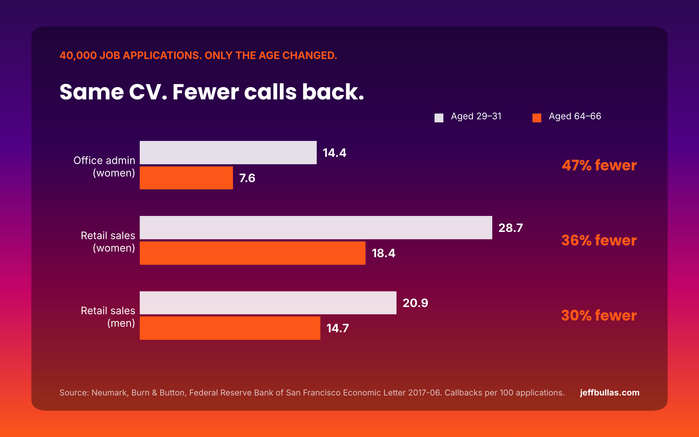
The study looked at lower-skilled jobs, and the gap was largest for women. But the direction never changed. Every time, the oldest CV lost.
This isn’t one old experiment either. In a survey published in January 2026, AARP asked 1,656 American workers over 50 about age bias. 64% said they had seen or experienced it at work. 22% said they felt they were being pushed out of their jobs. And of those who had seen it, 91% said it was common.
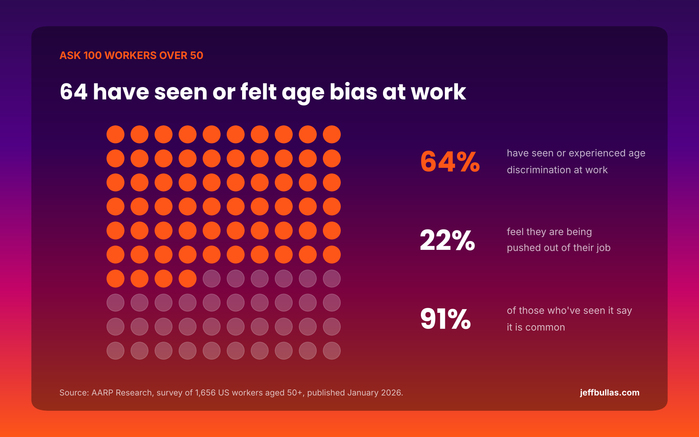
That isn’t a few bad bosses. That is a system doing what it was built to do.
A new lock on the door
Here is the part that should worry us. The front door is getting a new lock, and it is made of software.
Many large employers now use AI to score, sort and rank applicants before a person ever sees them. In 2023, a job seeker named Derek Mobley sued Workday, a company that makes these screening tools. He said he applied for more than 100 jobs at companies using its software and was rejected every time.
In May 2025, a federal judge in California allowed his age claim to go forward as a nationwide collective action for applicants aged 40 and over. Nothing has been proven yet, and Workday says the case lacks merit. But the question in that courtroom is the question of our time. What happens when an old bias is copied into a faster machine?
It stops being silence from one employer. It becomes silence at scale.
The filter doesn’t hate you
This is the sentence I wish someone had said to me at 51.
“The filter doesn’t hate you. It just counts you”.
It counts your years. It counts the gaps. It counts the keywords you forgot to use. It has no idea who you are, what you have survived or what you could build next. It was never built to know.
That changes what you should do about it. You can’t argue with a filter, and you can’t charm it. You can spend two years polishing your CV for a machine that has already decided. Or you can stop knocking on that door and find another one.
The side door
The blog was my side door. Nobody screened me. Nobody asked my age. People read what I wrote, and if it helped them, they came back.
My first big invitation didn’t come from a recruiter. It came from a reader. Jonny, who owned a golf resort in New Zealand, emailed to ask me to run a paid workshop there. The next invitation was to speak in Italy, and they flew me business class.
No CV was involved. The work was the CV.
What kept me going in those early years wasn’t confidence. It was evidence. A comment from a stranger. A reader in a country I had never visited. An email from someone who had tried what I wrote about, and it worked.
Every small reply was proof that someone could see me, even when the front door couldn’t.
Over the next decade, that blog reached 33 million readers in about 190 countries. The front door said I was finished. The side door said I was just getting started.
I’m not telling you this to boast. I’m telling you because the data says my story is less rare than it looks.
Economists Pierre Azoulay, Benjamin Jones, J. Daniel Kim and Javier Miranda studied about 2.7 million US founders. Among the fastest-growing new firms, the average founder was 45, not 25. A 50-year-old founder was about 1.8 times as likely as a 30-year-old to build one of the fastest-growing 1 in 1,000 firms.
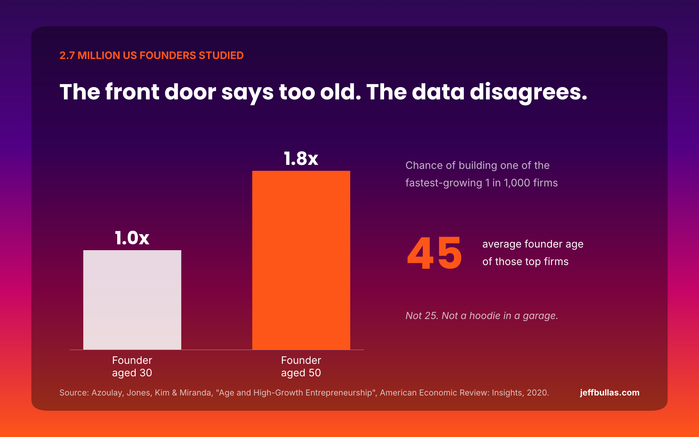
Think about that. The same market that won’t call you back is being built, quietly, by people your age.
Experience doesn’t stop being valuable at 50. It just stops being readable at the front door.
What AI changes
This is where I part ways with the gloom.
AI is putting a stronger lock on the front door. But it is also handing out keys to the side door, to anyone who wants one.
When I started in 2009, the hardest part wasn’t the writing. It was the technology. I didn’t know how to set up WordPress, and some days I wanted to throw the computer out the window. Today that wall has gone. You can ask AI to help you build a website, shape an idea, draft a plan or turn 30 years of experience into something people can see.
I’ve watched this happen in real time. Since July I have been running an experiment on X, and with AI’s help I analysed 3,660 replies from about 2,020 people. One theme kept coming back, most of all from people over 50. In their own words, they said some version of the same thing: AI had let them back in.
Back into skills they thought they had lost. Back into ideas they had shelved for years. Back into work that felt like theirs.
Last month I posted two short lines on X: “I’m 69. I’m supposed to be thinking about retirement.” It became one of my best posts of the year, with more than 18,000 views, 358 likes and 185 replies. The replies were not really about retirement. They were about being written off, and refusing to accept it.
It isn’t only my readers. A report from LinkedIn and AARP found that over five years, the number of workers over 50 listing skills like AI on LinkedIn grew by 25%. That is nearly double the growth rate for younger workers.
The story that older people can’t keep up with technology is out of date. Many are not just keeping up. They are using it to build a way around the door that shut them out.
The hard part
I want to be honest about what a side door costs.
“Just start something” can sound easy when you are not the one paying the rent. I know it isn’t. That is why I am suggesting small steps, not a leap off a cliff.
A side door isn’t a guaranteed paycheck. My blog paid nothing for a long time. I wrote at 4:30am, five days a week, with hardly any readers and no proof it would work. Most side doors look like dead ends for the first year.
And not everyone can wait. If you need income next month, keep applying. Knock on the front door, and push back on age bias where you find it.
Just don’t make the front door your only door. That is the trap. It hands a system that was never built to see you the final word on what you are worth.
Three ways to start your side door
- Make one thing people can see. Not a CV, but a piece of work. Write about a problem you have solved fifty times. Record a short video. Build a simple tool with AI. A CV tells people what you did. Visible work shows them what you can do.
- Use AI to build, not just to apply. Most people over 50 use AI to polish job applications for the filter. Flip that. Use it to help you make the thing itself: the website, the first draft, the plan. Let it handle the technology that used to stop you.
- Share it where people gather. Post it. Send it to ten people who would care. Reply to people in your field with something useful. Each small act opens a door that no filter controls.
You don’t need 700 doors. You need one that answers.
The question
At 51, I thought the front door was the only door. I knocked 700 times and blamed myself for the silence.
At 69, I see it differently. The silence wasn’t a verdict on me. It was a system doing what it was built to do: counting instead of seeing.
The front door may stay shut. That doesn’t end your story. It may be where the next chapter starts.
So here is my question for you. If no one were checking your age, what would you build?
P.S. Not sure what your side door is?
That is the question I built Zyrro to help answer. You answer 13 open questions about your life and work. Zyrro reads the patterns in your story: what energises you, what drains you and the themes that keep coming back. Then it helps you choose a path and take small steps in the real world.
Zyrro is opening soon to a small group of early testers. If you would like to be one of them, join the waiting list at zyrro.ai.
Sources
- Neumark, Burn & Button, “Age Discrimination and Hiring of Older Workers”, FRBSF Economic Letter 2017-06
- AARP Research, age bias survey of workers 50+, January 2026
- Holland & Knight, “Federal Court Allows Collective Action Lawsuit Over Alleged AI Hiring Bias” (Mobley v. Workday), May 2025
- Azoulay, Jones, Kim & Miranda, “Age and High-Growth Entrepreneurship”, NBER Working Paper 24489 / AER: Insights 2020