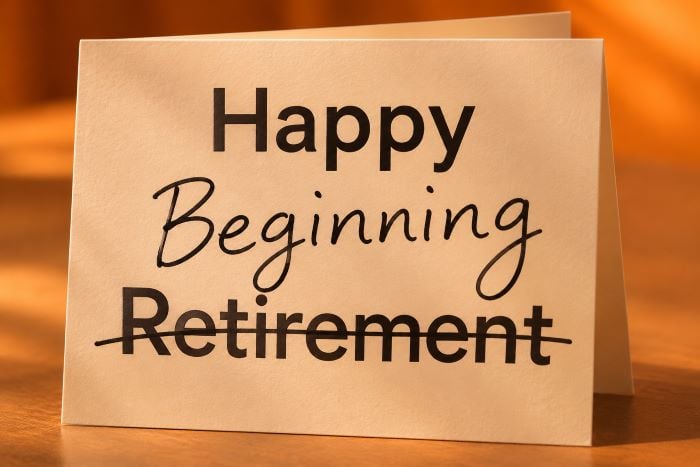
Last Wednesday night I asked a simple question on X: “Anyone over 50 starting something new right now? A business, a course, a craft, a second career. What is it?” I added my own answer. At 69, I’m building Zyrro, an AI startup.
Then I went to bed. By the next afternoon, more than 27,000 people had seen it. Nearly 100 had answered, aged from 45 to 83. More than 400 had clicked through to my profile to see who was asking.
I’ve been writing online since 2009, and I’ve learned that you can’t fake a response like that. People don’t answer a question unless it touches something real. This one did. Here’s what they told me, and what I think it means.
The replies
Some answers made me laugh. Some made me stop and read them twice.
One person wrote that at 83, they’re starting life all over again.
- A 70-year-old is working on a wind energy project.
- A 55-year-old finished a PhD last year and won a NASA contract this year.
- A 64-year-old is bootstrapping a restaurant operations platform that’s approaching $1 million in transactions in under a year.
- A 73-year-old woman is roasting specialty coffee. A 65-year-old published a first book this year and is turning it into an online workshop.
- A 60-year-old has just started writing a first novel.
- Someone else is finally starting the band they should have started years ago. On Threads, one person couldn’t find a patch for every baseball stadium, so they made all 83.
These aren’t people winding down. They’re people winding up.
What the numbers say
I sorted every real answer into groups. I left out the jokes, the ads and the “good on you” replies, which left 98 answers.
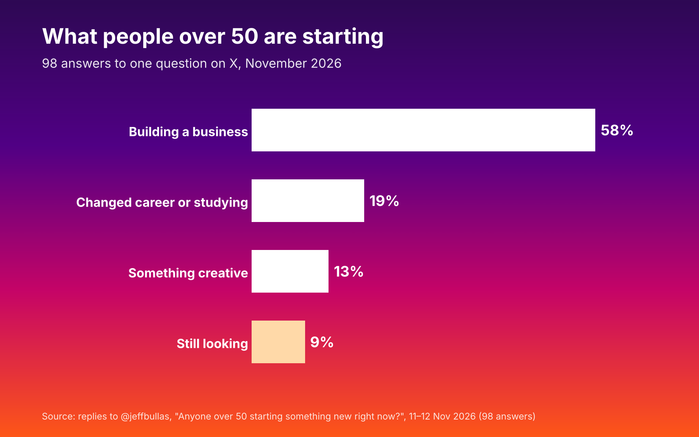
More than half are building a business. About one in five changed careers or went back to study. One in eight took up something creative. And about one in ten said they’re still looking. I’ll come back to them, because they’re the most important group in this story.
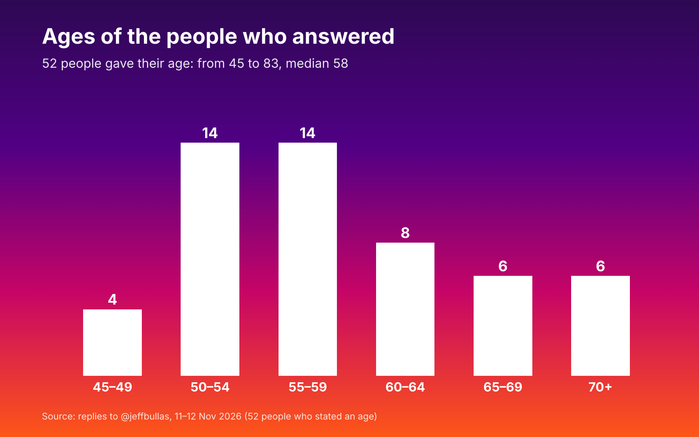
Of the 52 people who told me their age, the youngest was 45 and the oldest was 83. The median was 58.
This isn’t a scientific sample. These are people who follow me on X, and people who start things are more likely to answer a question about starting things. But the pattern matches much bigger studies.
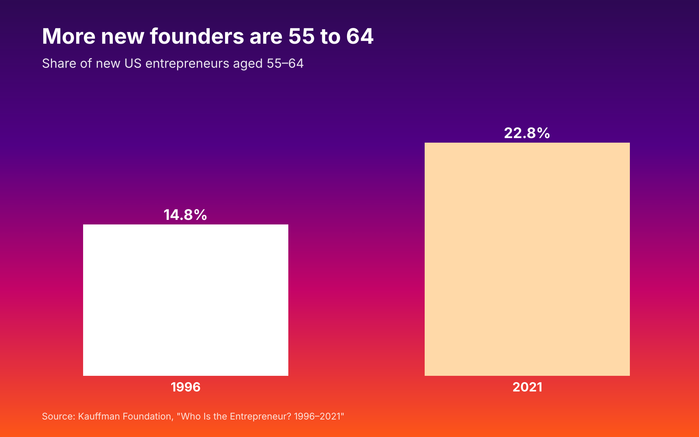
The Kauffman Foundation tracks who starts new businesses in the US. In 1996, people aged 55 to 64 made up 14.8% of new entrepreneurs. By 2021, it was 22.8%.
A study of 2.7 million US founders, by researchers from MIT, the Kellogg School of Management and the US Census Bureau, found that the average founder of the fastest-growing new companies was 45 when they started. A 50-year-old founder was 1.8 times more likely to build one of those companies than a 30-year-old.
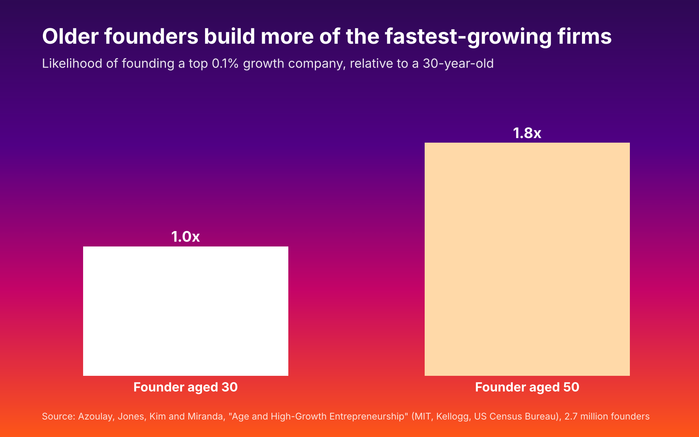
The picture of the 25-year-old founder in a hoodie is a story, not a fact. Experience counts.
The script that says stop
So why does it feel so hard to start again after 50? Because most of us were handed a script early. Work. Stop. Rest. Get the job, climb the ladder, retire at 65 and fade out quietly.
That script was written for shorter lives and safer jobs. Both are going. And when you try to step off it, the world often pushes back.
In 2009 my business collapsed and my marriage ended in the same year. I was 51. I applied for about 700 jobs, and the word I heard again and again was “overqualified”. For a lot of people over 50, that word really means “too old”.
I wasn’t alone then, and people aren’t alone now. In AARP’s 2026 survey, 64% of US workers aged 50 and over said they had seen or experienced age discrimination at work. Researchers at Boston College have also found that since ChatGPT launched, workers aged 55 and over in the jobs most exposed to AI have been leaving work at higher rates. Many of them are still looking for work, not retiring.
Then there’s the fear story. You’ve seen the headlines. AI will take your job. AI will leave you behind. If you’re over 50, the message is that the future has already moved on without you.
The fear story doesn’t match what people say
Over four months I read 3,660 replies to my posts on X, from about 2,000 people, most of them over 40. When I asked people over 50 whether AI had left them behind, only 1% said yes. Most were curious. Many were excited. I wrote about it in my AI Over 50 study.
The replies to last week’s question said the same thing. About four in ten people mentioned AI or software without being asked. They’re building apps, automating their work, making music and teaching other people over 50 how to use AI at work.
Why experience is the edge
There’s another reason people over 50 are doing well with AI, and it’s the one I find most exciting. AI is very good at producing answers. It’s poor at knowing which answer is right.
That takes judgment, and judgment takes years. If you’ve managed people, run a budget, sold to customers or raised a family, you know what good looks like. You can spot when something sounds right but isn’t. That’s the most useful AI skill there is, and you can’t learn it in an afternoon.
You can see it in the replies. One person spent 30 years writing software and now combines that experience with AI tools to build custom software for businesses. Another is building AI teaching materials for the agriculture industry, in two languages, at 72. A filmmaker who switched careers a few years ago is building AI workflows around their stop-motion and time-lapse work.
None of them threw away their experience to use AI. They put the two together. A 25-year-old can learn the tools as fast as anyone. They can’t download 30 years.
That doesn’t mean everyone is on board. In February 2026, Pew Research found that 58% of Americans aged 50 to 64, and 77% of those 65 and over, don’t use AI chatbots at all.
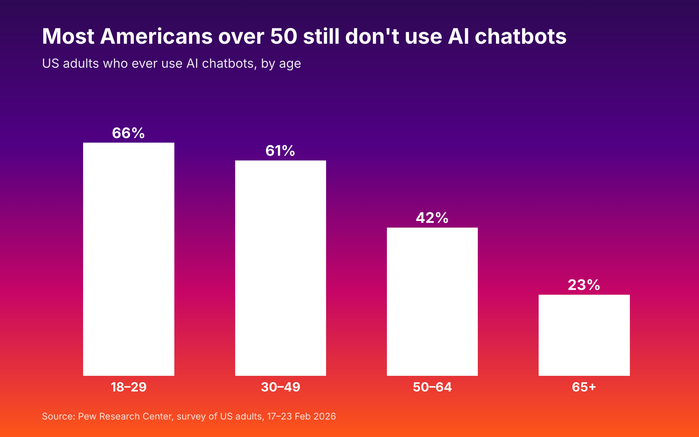
But here’s what struck me. The tools are no longer the hard part. They now work in plain English, and you can learn the basics in an afternoon. AARP found that 54% of adults over 50 feel confident they can learn and adapt to new technology.
The hard part is something no tool can do for you.
The 9% who are still looking
Read the replies from the people who are still looking, and you hear something different.
“57 here and trying to find something.” “Trying to start something else… have not found the right niche yet.” “Need help. I’m 61. Ex-CEO. Took some time for side projects and looking to resurface.” And the one I keep thinking about: “I’ve never in my life thought so much about my future as I do now at 60. It’s as exciting as it is scary.”
None of them said “I can’t learn AI.” They said, in different ways, “I don’t know what to do next.”
That’s the real gap. AI has made doing things almost free. You can build an app, write a book or start a newsletter in a weekend. But it hasn’t made choosing any easier. When you can do almost anything, it gets harder to decide what to do.
I know that feeling. In 2009 I had no plan. What I had was something I’d always done: explain new technology simply. I’d done it as a teacher and then selling IBM PCs. So at 52 I started a blog, writing at 4:30am before work. It went on to reach 33 million readers. I didn’t become someone new. I went back to something I’d buried.
If you’re over 50 and still looking
If you’re in that 9%, here’s what I’d suggest. None of it needs an app.
- Look backwards before you look forwards. Write down three times in your life when you lost track of time. What were you doing, and who were you helping? Your next chapter is often hiding in your last few.
- Ask what people always come to you for. The thing you think is ordinary is often what other people find hardest. Mine was explaining technology.
- Run a small test, not a big leap. I didn’t quit my job. I wrote before work for four years. Give yourself 30 days and one small project. Make something, and show it to someone.
- Use AI as a sparring partner, not a fortune teller. Tell it your story and ask it to point out patterns you can’t see. Then decide for yourself. The judgment is yours, and that’s where 30 years of experience pays off.
Why I’m building Zyrro
This is the problem I’m building Zyrro to solve. Two questions come back again and again after a long career: who am I now, and what should I do next?
Zyrro starts with 13 questions about your life and work. It reads the patterns in your answers and shows you your strengths, what gives you energy and directions that fit who you are now. Then it helps you take small steps, because a direction you never act on changes nothing.
It isn’t a personality test that puts you in a box. It’s closer to a mirror that shows you what’s already there.
We’re opening it first to the people on the waiting list. If you’re over 50 and wondering what comes next, you can join the waiting list here. It’s free, and all it asks for is your first name and email.
The second half is for starting
One simple question told me something the headlines miss. People over 50 aren’t being left behind by AI. Many of them are using it to build the things they always wanted to build.
What holds people back isn’t the technology. It’s the old script, and not knowing what to write in its place.
The 83-year-old starting life all over again didn’t ask permission. Neither did the 73-year-old roasting coffee, or the 55-year-old with the NASA contract.
So here’s my question for you. If the old script disappeared tomorrow, what would you start?
Sources
- Replies to @jeffbullas, “Anyone over 50 starting something new right now?”, 11–12 November 2026 (thread on X)
- Kauffman Foundation, Who Is the Entrepreneur? United States, 1996–2021
- Azoulay, Jones, Kim and Miranda, “Age and High-Growth Entrepreneurship”, summarised by Kellogg Insight
- AARP, 2026 age bias survey
- AARP, artificial intelligence survey of adults 50 and over, 2025
- Boston College Center for Retirement Research, reported by The Next Web, July 2026
- Pew Research Center, Majority of Americans 50 and older don’t use chatbots, February 2026
- Jeff Bullas, AI Over 50 study