
In 2009, I got up at 4:30am and started writing.
Not because anyone told me to. Because writing was the one thing that felt like forward motion, in a year when almost nothing else did.
Five years of that habit, and jeffbullas.com had reached 100,000 monthly readers. It eventually reached more than 33 million, across 190 countries. I built every bit of that on one skill. Content marketing.
Seventeen years later, I watched that skill quietly stop working the way it used to.
Not because I forgot how to write. Because the machinery underneath every platform I publish on changed what it rewards and almost nobody noticed the exact moment it happened. This is the story of that moment, what it cost, and what actually survives it.
The Quiet Coup
It started with an app most marketers dismissed as a place for teenagers to dance.
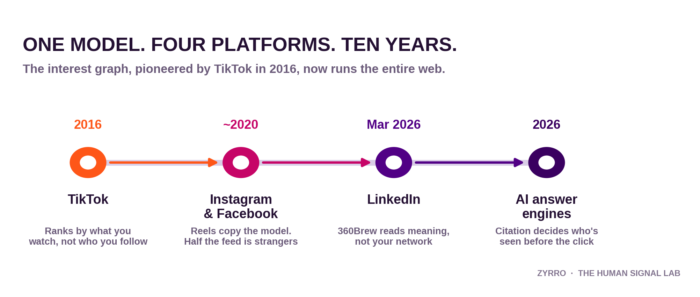
In 2016, TikTok made a decision that would eventually end content marketing as the industry understood it. It stopped ranking video by who you followed. It started ranking by what you watched, and for how long.
TikTok has said plainly that follower count is not a ranking factor. A brand-new account with zero followers can reach millions in a day, purely on how a video performs with strangers. Sprout Social’s 2026 breakdown of the algorithm confirms this has only hardened as the platform matured.
Everyone laughed at first. Then everyone copied it.
Facebook and Instagram followed. By 2026, more than half of the average Facebook feed comes from accounts a person has never followed, and AI now decides over 80% of what appears in front of users across social platforms, according to a 2026 cross-platform algorithm statistics review.
Then, on March 12, 2026, LinkedIn joined them. A new AI model called 360Brew, 150 billion parameters, built to read a post the way a human editor would, not the way a keyword-matcher does quietly replaced the patchwork of ranking systems LinkedIn had run for over a decade.
Even search followed the same road. Google’s AI Overviews and answer engines like ChatGPT now decide which brands get cited before a single click happens. Conductor’s 2026 benchmark study of 3.3 billion sessions found AI referral traffic sits at just 1.08% of web traffic, small in volume, outsized in influence, because it decides who gets seen before the click ever happens.
Four platforms. One underlying shift. Marketers built a twenty-year career on one game. The rules changed underneath us, one platform at a time and most of us are still playing by the old ones.
The Numbers Don’t Lie
Here’s what that shift did to the average LinkedIn account in twelve months, according to Richard van der Blom’s Algorithm Insights Report, built from well over a million posts.
The instinct is to blame the writing. I’ve felt that instinct myself, more than once this year.
But the honest read is simpler, and harder to accept. Distribution stopped following the network. It started following declared and demonstrated topic authority, what 360Brew infers you’re actually about, from your headline, your history, and the pattern of what you consistently publish.
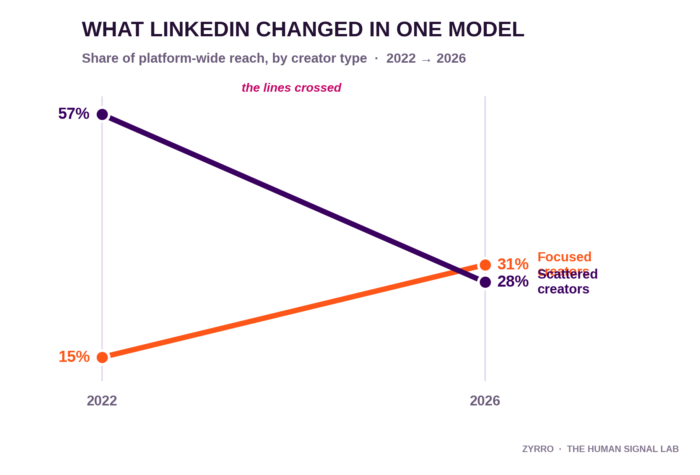
That inference is not gentle. One 2026 analysis found that creators who stayed on a small, consistent set of topics saw their share of platform-wide reach roughly double since 2022, climbing from 15% to 31%. Creators who scattered across everything watched their share collapse from 57% to 28%.
Follower count and reach are now structurally decoupled. An account with 8,000 focused followers can now out-distribute one with 80,000 unfocused ones.
That’s not a LinkedIn quirk. That’s the interest graph doing on a professional network exactly what it already does on TikTok, on Instagram, and inside every AI answer engine.
Leonardo Would Be Throttled
So the data says one thing, loud and clear. Niche down. Pick a lane. Become the topic.
Here’s who that rule would have buried.
Leonardo da Vinci.
He painted the Mona Lisa. He designed flying machines. He dissected human bodies to understand a smile.
One mind. A dozen obsessions. All feeding each other.
Post the flying machine today, right after the portrait, and the machine flags a mismatch. Reach cut. Signal lost. Interesting becomes invisible.
It wants him in one lane. It wants all of us in one lane. Because a lane is a bubble, and a bubble is easy to keep you inside.
I joined social media in 2008. Facebook first. I went looking for people humans around the world I was curious about, fascinated by. Not categories.
I followed people because they were interesting.
And that word matters more than the machine will ever understand.
An interest is a category. Interesting is a quality of a person.
A machine can index a category. It cannot index a human soul.
Yes, the shift killed some noise. Engagement bait is dying. A brilliant unknown can now beat a hollow celebrity. That’s real, and it’s good.
But the cost is bigger than anyone’s naming.
The old algorithm decided what you saw. This one decides who you’re allowed to be if you want to stay visible instead of buried.
It takes a curious human and files them under a niche.
Walt Whitman warned us about exactly this, more than 160 years ago. “I am large, I contain multitudes.” One consciousness. A dozen selves. A walking paradox.
The machine has no column for that.
Content Marketing vs the Interest Graph
For twenty years, content marketing ran on one quiet assumption. Build an audience. Publish consistently. The audience sees what you publish, because they chose to follow you.
That assumption is the thing that broke.
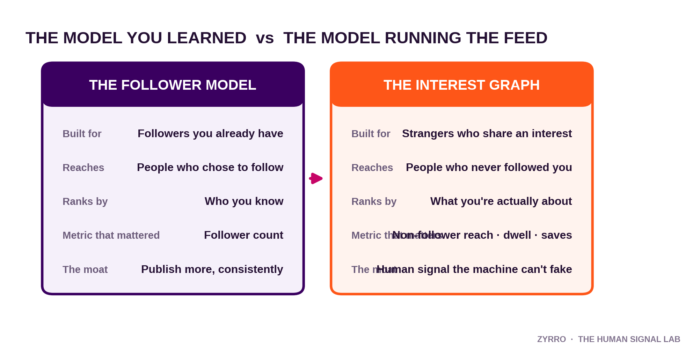
Content marketing was built for followers you already have. The interest graph is built for strangers who share an interest, matched by an AI system reading what you’re actually about, not who’s already listening.
The metric that mattered used to be follower count. The metric that matters now is non-follower reach, dwell time, and saves, because those are the only signals proving a stranger actually stayed.
This isn’t content marketing dying. It’s content marketing losing the assumption it was quietly built on.
What Actually Wins, Once You’re Found
Here’s the part most of the 2026 algorithm coverage gets half right.
Getting matched to the right stranger is necessary. It is not sufficient.
Once the algorithm hands your post to someone who’s never heard of you, something else decides whether they stay for three seconds or sixty. And that something is not the topic.
It’s the thing a machine cannot produce. The story only you carry. The opinion that costs you something. The sentence a language model would never risk, because a language model is built to predict the average — not to take a position.
I call this the human signal. It isn’t a writing style. It’s evidence that you were actually there, for the mistake, for the years nobody was watching, for the win that cost more than it looked like from outside.
The interest graph is the door. Human signal is the reason anyone stays in the room.
The Interest Architecture
So if the old playbook of publish more, post consistently, chase virality no longer works, what replaces it?
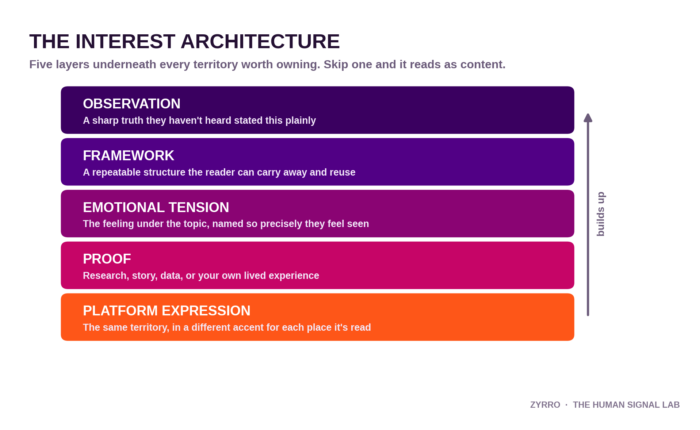
Not a hack. A structure. Five layers, underneath every topic worth owning.
A sharp observation the reader hasn’t heard stated so plainly. A repeatable framework they can carry away and reuse. The emotional tension underneath the topic, named precisely enough that they feel seen before you’ve offered a single tactic. A proof layer, of research, story, data, or your own lived experience. And a platform expression: the same territory, translated into a different accent for each place it’s read.
Skip a layer, and what you’ve made reads as content, competent, forgettable, replaceable by the next prompt. Build all five, and it becomes a territory. Something a stranger, an algorithm, and an AI answer engine can all independently arrive at the same conclusion about: that’s who talks about this.
The Territories Worth Owning
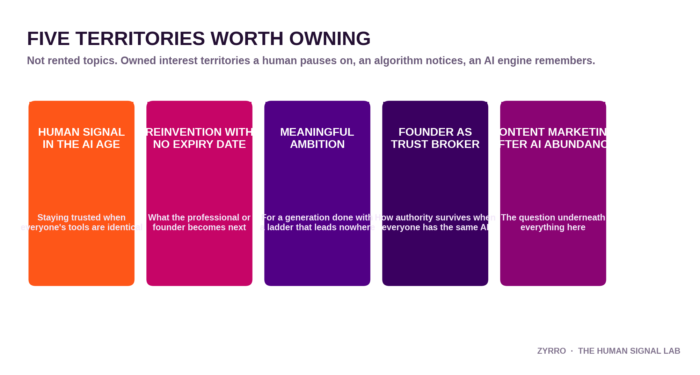
I’ve spent this year mapping five territories I believe the market already cares about deeply enough to reward for me, and for anyone building a body of work in the AI era.
Human signal in the AI age, for the person asking how to stay trusted when everyone’s tools are identical. Reinvention without an expiry date, for the professional or founder asking what they become next. Meaningful ambition, for a generation quietly done with a ladder that no longer leads anywhere certain.
Founder as trust broker, for the builder asking how authority survives when everyone has the same AI. And content marketing after AI abundance the question underneath everything in this article.
Not more content. A market that already cares, owned clearly enough that a human pauses, an algorithm notices, and an AI system remembers.
The Verdict
Here’s where I’ve landed, seventeen years into a career the interest graph just quietly rewrote.
Content marketing isn’t dead. The assumption underneath it is.
Publishing more was never the moat. It just used to work well enough that we mistook it for one.
The moat was always the human doing the publishing. And for the first time since I sat down at 4:30am in 2009, the machine agrees.
So here’s the paradox I’m choosing to live inside.
Know what you’re already, unmistakably known for. Give the machine a pattern clear enough to find you. That’s not surrender. That’s the door.
Then cross the lanes anyway.
Because focus should be a choice. Not a sentence. Curiosity is not the enemy of depth — curiosity is where depth comes from. Leonardo didn’t dissect bodies to abandon painting. He did it to paint a better smile.
The bird and the flying machine. The crossing is where I come alive.
No algorithm gets to file that away.
So before you write your next post, don’t ask what to publish.
Ask this instead.
Do you follow people for their interests? Or because they’re interesting?
Or both?
Sources
- TikTok algorithm & follower-count ranking
- Cross-platform algorithm statistics — Facebook feed composition, AI-driven recommendations
- 360Brew explained: LinkedIn’s 2026 AI ranking model
- Conductor 2026 AEO/GEO Benchmarks Report: 1.08% AI referral traffic
- Richard van der Blom: LinkedIn Algorithm Insights Report
- Topic authority & reach concentration data (15%→31%, 57%→28%)
- Relationship Graph to Interest Graph, follower/reach decouplingnterest