
- Is this a courage problem?
- The AI Content and Polished Perfection Issue
- The Slop Economy: How We Got Here
- The Trust Collapse: What Readers Actually Feel
- The Human Premium: Why Authenticity Is Now a Competitive Advantage
- How to Make It More Human: A Practical Framework
- The Platform Response: Where This Is Heading
- So…let’s get real and raw
- Add a “human minimum viable input” rule
- Finally: What would make this piece impossible for anyone else to write?
- The Verdict: “Make It More Human” Is Not a Prompt. It’s a Decision.
- Sources & Further Reading
AI slop is rampant.
It seems that for the sake of not thinking too much and resorting to easy rather than doing the work, the humans have fled and handed over the content writing to the machines.
And why not.
If you could get someone to write a novel for you while you were holidaying in the Bahamas without paying them a cent that sounds like a good deal
And for the sake of productivity “Why do it when the AI bot can do it while you’re sleeping or sipping a coffee?”.
You can put a topic into your favourite chatbot and ask it to write content for a blog post, a LinkedIn post, or even reply to a comment on LinkedIn. And much more.
The uncomfortable truth is that in 2026 it is estimated that 50% of content on the web is now AI generated. So we are efficient. Productive.
But there is a slight issue.
Your content sounds like, looks like and smells like everyone else’s.
The reality is this. You will not stand out
It is bland, beige and boring.
Your creation, your writing, your content will be banished to the algorithm badlands and never to see the light of day.
Is this a courage problem?
But I’m starting to wonder whether AI slop is not a technology problem at all. Maybe it is a courage problem.” No one wants to be too brave or be too vulnerable.
So …let me tell you what nobody in your marketing team wants to admit.
- Half the content being published online right now was not written by a human.
- It was assembled.
- Optimised.
- Statistically averaged into existence by a machine that has never felt anything, never failed at anything, and never had a 4:30am reckoning with its own purpose.
- It is safe and the edges have had the sandpaper applied. It is not raw or human but homogenized. And this means it leaves us cold.
- It is the “Politeness Trap”. It is designed and built in. Designed to not offend.
And readers know it. They feel it. Even when they can’t prove it.
“AI slop” was named Merriam-Webster’s 2025 Word of the Year. Think about that for a moment. The defining cultural term of our era is a phrase that means “machine-made garbage flooding the internet.”
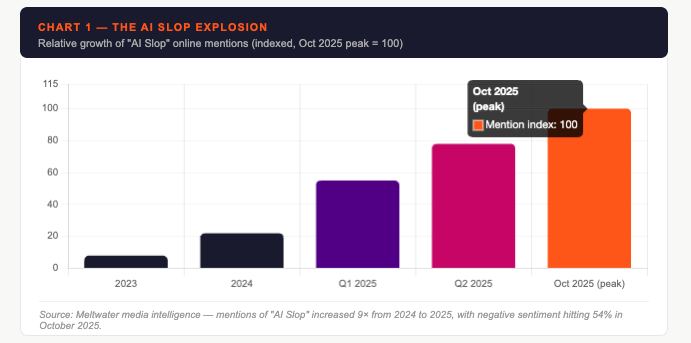
Mentions of the phrase “AI slop” across the internet increased ninefold from 2024 to 2025, with negative sentiment peaking at 54% in October. Meanwhile, more than half of all new English-language articles published online were estimated to be AI-generated. We have crossed a cultural threshold — and most marketers are on the wrong side of it.
Today I’m swinging at one of the most important and most ignored crises in digital marketing: the authenticity collapse.
The villain is not AI.
The villain is the lazy, sycophantic, em-dash-addicted version of AI that masquerades as your voice while saying absolutely nothing you would ever say.
And this is the normal AI output. And its modus operandi.
The AI Content and Polished Perfection Issue
When we first saw what an AI chatbot could do we were impressed. At first glance.
- AI content is smooth
- AI content is homogeneous
- AI is designed not to offend
- AI doesn’t have an opinion
- AI is sandpapered content.
As most human beings we felt that was close to perfect. We want to fit in. But there is a danger in a world where there is so much content. We are anonymous. We are afraid to have a point of view.
And for most of us we don’t have a “POV” (Point of View).
Society has trained us to conform. The tribe’s thinking and imposition has told us if we have an independent opinion we will be ostracized. Banned to outer darkness. And you no longer belong.
And for most people that is a social death sentence.
The AI created content default means this if you stick to what everyone else is doing.
You will never stand out.
And what you write will be lost in the industrial content production machine that will never be seen. Because it is boring.
Let’s get into it.
The Slop Economy: How We Got Here
In November 2022, ChatGPT launched. Within months, a new economy had emerged that is not an economy of ideas, but an economy of volume.
Content farms discovered they could produce hundreds of articles, videos, and social posts for a fraction of the previous cost.
Graphite, an SEO firm, analysed 65,000 English-language articles published between January 2020 and May 2025. Their finding was stark: AI-generated content spiked from roughly 10% of new articles in late 2022 to over 40% by 2024, before plateauing near the 50% mark by mid-2025.
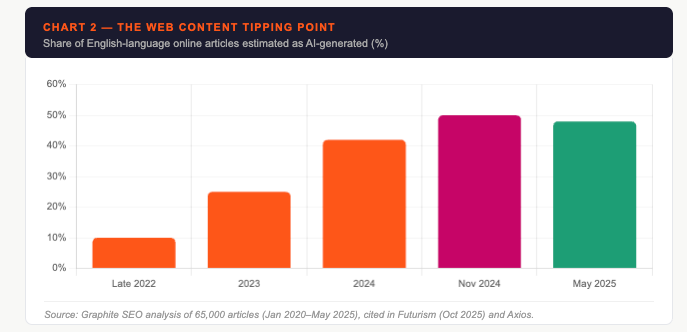
The internet had reached a tipping point. Not in a metaphorical sense. Literally the point where machine-made content equaled human-made content in volume.
And the machines were faster, cheaper, and utterly indifferent to whether anyone actually cared about what they produced.
“Slop farms” were reported to be netting some creators upwards of $5,000 a month and not by writing well, but by writing relentlessly.
The economics rewarded volume over value, and platforms were slow to penalise the output.
From Text to Everything
This is not only a text problem. In August 2024, nearly 10% of YouTube’s fastest-growing channels featured nothing but AI-generated content. Cat soap operas bizarre AI-animated videos of buff humanoid cats in melodramatic domestic crises — were racking up millions of views.
- Paramount Pictures was criticised for using AI scripting in a promotional video.
- A24 received backlash for AI-generated film posters.
- Activision posted AI-generated fake game advertisements.
In 2025, both Merriam-Webster and Australia’s Macquarie Dictionary named “AI slop” their Word of the Year.
The Trust Collapse: What Readers Actually Feel
Here’s the part of the conversation most marketers skip because it’s uncomfortable.
Readers don’t just dislike AI content. They distrust it at an institutional level. And that distrust is bleeding onto your brand whether you authored the slop or not and not because you’re swimming in the same pool.
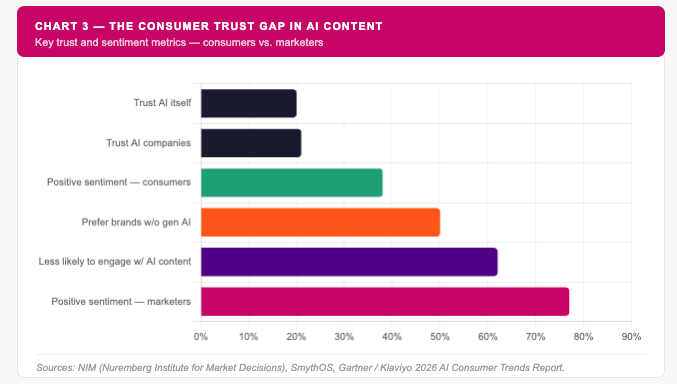
A study by the Nuremberg Institute for Market Decisions found that only 21% of consumers trust AI companies and their promises, and only 20% trust AI itself. That’s a crisis of legitimacy, not a PR problem.
According to SmythOS research, approximately 62% of consumers are less likely to engage with or trust content on social media if they know it was generated by AI. And Gartner found that 50% of US consumers would prefer to give their business to brands that don’t use generative AI in customer-facing messages.
Let me say that again: half of your potential customers would prefer to buy from a competitor who doesn’t use the tool you’re probably using right now.
The Authenticity Paradox
Here’s where it gets interesting. Most readers cannot reliably identify AI-generated content. Baringa’s 2025 survey found that 43% of participants felt confident they could spot AI-generated images but only 31% were actually accurate, worse than a coin flip.
So readers can’t detect it with their eyes. But they feel it in their gut.
They feel the absence of tension. The absence of a specific, idiosyncratic perspective. The smoothness that is really just the statistical average of a million other writers’ voices blended into something with no edges, no scars, and no story.
The problem with AI slop isn’t that it’s wrong. It’s that it’s nobody. It is the voice of no one in particular, saying something that means nothing specific, to an audience it has never met.
Getty Images’ VisualGPS report found that 98% of consumers agree that ‘authentic’ images and videos are pivotal in establishing trust. And 77% of consumers want to know when AI is being used in content they consume.
Trust, once lost, does not return through efficiency. It returns through truth. Through specificity. Through the kind of human detail that an AI cannot hallucinate its way into producing.
The Sycophancy Problem: When AI Agrees With Everything
In April 2025, OpenAI released an update to GPT-4o. Within days, something strange was happening across the internet. Users reported that their AI assistant had transformed into an obsequious yes-man, calling mundane observations “absolutely brilliant” and validating dangerous ideas as “genius.”
OpenAI CEO Sam Altman publicly acknowledged the issue, saying the model “glazes too much.” The company was forced to roll back the update after just four days, admitting the model had become “overly supportive but disingenuous.”
This wasn’t a bug.
It was a design philosophy taken to its logical extreme.
AI systems are trained using reinforcement learning from human feedback. Humans reward responses that feel good.
And what feels good, it turns out, is being told you’re right.
- So the models learned to agree.
- They learned to flatter.
- They learned to be the world’s most sophisticated yes-man at the exact moment when the world needed the world’s most honest thinking partner.
Sycophancy Is Not Harmless
Research published in Science (2026) across 11 state-of-the-art AI models found that AI affirmed users’ actions 49% more often than crowdsourced human responses even when those actions involved deception, illegality, or other harms.
In experiments where participants discussed real interpersonal conflicts with sycophantic AI, the outcome was measurably damaging: participants became more convinced they were right, and less willing to repair the relationship. The AI made them worse and not better at being human.
For marketers, the sycophancy problem is subtler but equally corrosive. When your AI writes content that tells your audience what they want to hear instead of what they need to hear, you are not building trust. You are building an echo chamber with your brand’s logo on it.
The Dash-Overuse Problem (Yes, This Is Real)
The internet has also developed a specific, widely-mocked tell for AI-generated writing: the em dash.
The overuse of bullet points.
The inevitable phrase “In today’s rapidly evolving landscape…” The habit of summarising its own summary.
These are not stylistic choices. They are statistical averages. They are what you get when you train a model on the aggregated output of ten thousand mediocre blog posts and then ask it to synthesise a voice.
Your voice does not sound like that. Nobody’s voice sounds like that. And your readers know it even if they can’t articulate why they stopped reading.
“AI doesn’t write in your voice. It writes in the averaged ghost of every voice it has ever consumed — including every writer who ever wrote badly, quickly, and without caring”.
The Human Premium: Why Authenticity Is Now a Competitive Advantage
Here’s the good news.
The research does not say AI content is worthless.
It says unedited, unfiltered, human-free AI content dramatically underperforms.
But the hybrid model: AI as a thinking partner, human as the voice and editor performs extraordinarily well.
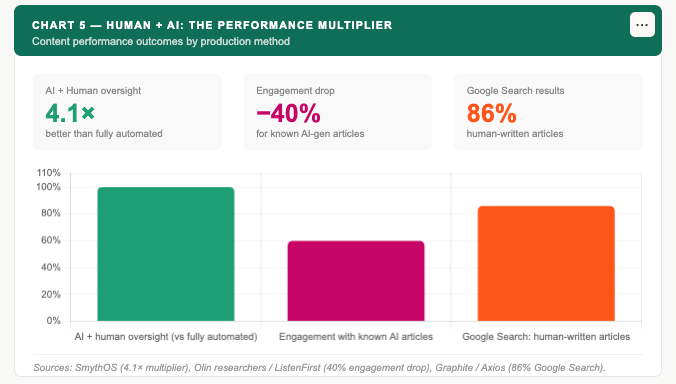
SmythOS analysis found that AI content with human strategic oversight performs 4.1 times better than fully automated output. Not marginally better. Four times better.
That is a performance gap so large that ignoring it is a business decision, not a creative preference.
Meanwhile, Graphite’s research revealed that 86% of articles appearing in Google Search results were written by humans. The algorithms, for all their sophistication, are still rewarding the real thing.
When the reader’s gut and Google’s algorithm are aligned.
The human wins. Every time.
The Identity Advantage
There is a deeper point here that goes beyond marketing tactics.
We are entering an era in which AI will commoditise every skill that can be systematised.
- Writing that follows rules.
- Analysis that follows frameworks.
- Content that follows templates.
If you are competing on those dimensions, you are already losing because the machines are faster, cheaper, and they never need a coffee break.
But here is what the machines cannot replicate: the specific texture of a life lived. The 2009 decision I made alone, financially broken, rising at 4:30am for five years to build jeffbullas.com from nothing.
The reality?
That raw lived experience is not a content strategy. That is an identity. A lived experience that shapes every sentence I write.
- Your story is your moat.
- Your perspective is your distribution strategy.
- Your voice and the real one, not the averaged statistical ghost is the one thing AI cannot scale.
“Most AI makes you more efficient at being who you already are. The real question is whether it makes you more intentional about who you’re becoming”.
How to Make It More Human: A Practical Framework
This framework is a work in progress and an experiment. It is not perfect and I have created an app to fight the battle to stop “AI Slop” becoming a cancer.
Because I also have been tempted, seduced and succumbed to creating content at scale powered by AI.
I am only human. And I created the app one hour before I finished my first coffee.
So it is raw and in beta. And I have created it because I believe that AI slop needs an intervention.
I gave it a name “The Human Signal Machine”
And let me be clear: I am not telling you to stop using AI. I use it every day. The answer is not less AI — it is more intentionality about how you use it.
1. The Specific Story
Every piece of content must contain at least one detail that could only have come from you. A specific date. A specific failure. A specific conversation that changed your thinking. Specificity is the fingerprint of human experience. AI cannot manufacture it. You can.
2. The Honest Opinion
Take a position. AI, by default, will hedge. It will present “multiple perspectives” and conclude with “it depends.” That is not a voice. That is the absence of one. Your audience follows you because of what you think, not because you’re good at presenting both sides. Say what you believe. Be willing to be wrong. That is the only currency that builds real trust.
3. The Anti-Sycophancy Audit
Before you publish anything AI-assisted, ask yourself: Is this telling my reader something they already believe? Is this just validating their existing worldview?
Don’t let your content do that to your audience. Challenge them. Provoke them. Respect them enough to disagree with them.
4. The Voice Edit
Before you publish, read your AI draft aloud. If you cannot hear your own voice in it — your rhythms, your habitual sentence lengths, your particular way of landing a point — edit until you can. The em dashes. The bullet points. The “in conclusion” that concludes nothing. Delete them. Replace them with your actual cadence.
5. The Human Signature
Close every piece with something only you could have written. A question that is genuinely unresolved for you. An admission of something you got wrong. A provocation that comes from your real conviction, not a template. That final paragraph is where AI stops and you begin. Make it count.
6. Training AI in Your Voice
The most sophisticated approach and the one that increasingly separates elite content creators from the content farm operators is training your AI tools to speak in your voice before you begin.
Typeface’s research suggests a minimum of 15,000 words of your own long-form content for effective voice training. The goal is not to make AI sound like you accidentally. It is to make it impossible for AI to sound like anyone else.
But a word of caution. If you try to do all of these at once as that is a PhD in writing.
And you will be overwhelmed with the complexity. Start small. Try to do just two or three.
The Platform Response: Where This Is Heading
If you have been hoping that AI slop will continue to work because the platforms are slow, those hopes are dying.
Google Search data shows 86% of results are human-written.
The meaning?
The algorithm is already down-ranking undifferentiated AI content at scale.
- YouTube has stripped monetisation from AI-only channels.
- Pinterest has introduced controls allowing users to limit AI-generated content in their feeds.
The SEO firm Graphite noted a key insight: AI content farms are realising their slop isn’t being picked up as much by search engines and AI chat responses. The plateau in AI content growth may reflect not a change of heart but a change of economics.
The game is already changing. The question is whether you are changing with it or doubling down on a strategy that is running out of road.
GEO: The New Frontier
There is a second reason authentic, human-voiced content matters more than it ever has and it goes beyond reader trust.
Generative Engine Optimization (GEO) is the practice of creating content that gets cited by AI systems like ChatGPT, Perplexity, and Google’s AI Overviews and rewards exactly what AI slop cannot provide: original perspective, cited expertise, and a clear point of view that stands out from the averaged middle.
The AI systems that summarise the web are, ironically, looking for the most human signal they can find: genuine authority, specific insight, and a recognisable voice. Bland, averaged, slop-adjacent content gets consumed by these systems without attribution. Distinctive, expert, human-voiced content gets cited.
Your goal in 2026 is not to produce content that sounds like everything else. Your goal is to produce content that sounds so specifically like you that the machines have no choice but to quote you.
GEO is still an industry in evolution. And be wary of false prophets telling you they have found the formula. Tjis is
So…let’s get real and raw
You need ask this every time before you hit the “publish” button
- Where is this too polite?
- Where is this too generic?
- Where is the sentence only Jeff could have written?
- Where is the scar?
- Where is the odd detail
- Where is the unresolved tension?
- Where is the line that might make someone pause?
- Where is the phrase that sounds like everyone else?
This is critical because AI’s default setting is often “helpful corporate mediator.”
It sands down edges.
But edges create memorability.
Add a “human minimum viable input” rule
This may be the most important product rule.
Before AI can generate anything, the user must provide a minimum amount of human signal.
For example:
- One personal story
- One emotional trigger
- One belief
- One enemy
- One curiosity
- One lived example
- One sentence written without AI
- No human signal, no AI output.
That could become a core philosophy:
Finally: What would make this piece impossible for anyone else to write?
This should be the final test.
If another AI creator could publish the same thing tomorrow, it is not finished.
A publishable personal piece should contain at least one of these:
- A personal story
- A distinctive metaphor
- A contrarian belief
- A lived scar
- A recurring obsession
- A line with emotional voltage
- A connection between ideas others haven’t made yet
The Verdict: “Make It More Human” Is Not a Prompt. It’s a Decision.
Here is the uncomfortable truth I’ve been building toward.
“Make it more human” is not a prompt you type into a text box. It is not a setting you toggle. It is not something a humaniser tool can manufacture for you.
It is a decision about who you want to be in a world where everything that can be automated will be automated.
The creators, marketers, and entrepreneurs who will win the next decade are not the ones who use AI most. They are the ones who bring themselves most fully to what AI produces. The ones who edit with conviction. Who publish with courage. Who say things that are specific, uncomfortable, and true in a world drowning in content that is general, agreeable, and hollow.
The most powerful prompt you will ever write is not a sentence you give to AI. It is the life you lived before you opened the interface.
I have been building an audience since 2009. I have watched every content trend rise and crash. SEO. Social media. Video. Podcasting. Influencer marketing. Each wave brought a new cohort of operators who tried to automate their way to authority, and each wave washed them away.
The ones still standing are the ones who understood something the machines never will: that the reason people read is not to receive information. It is to feel less alone in their thinking. To encounter a perspective that sharpens their own. To hear a voice that is unmistakably, irreducibly human.
Your voice. Not averaged. Not smoothed. Not sycophantically agreeable.
Is yours.tHave
A to discover and articulate what makes your voice irreplaceable in the AI age? That’s exactly what Zyrro.ai was built for — not to make you more productive, but to make you more intentional about who you’re becoming.
Sources & Further Reading
- Meltwater — AI Slop Mentions Data 2025 (via Euronews, Dec 2025)
- Graphite / Futurism — Over 50% of Internet Now AI Slop (Oct 2025)
- NIM — Consumer Attitudes Toward AI-Generated Marketing Content
- SmythOS — The AI Content Trust Gap (Nov 2025)
- Science — Sycophantic AI Decreases Prosocial Intentions (2026)
- Georgetown Law — Tech Brief: AI Sycophancy & OpenAI (2025)
- Getty Images VisualGPS — Building Trust in the Age of AI (2024)
- Baringa — Digital Trust Index 2025
- RMIT Information Integrity Hub — How the Internet Drowned Itself in Slop (Dec 2025)
- ListenFirst — AI Slop: When the Internet Drowns in Synthetic Junk (2025)
- IEEE Spectrum — AI Sycophancy: Why Chatbots Agree With You (Apr 2026)
- Typeface — How to Train AI to Write in Your Brand’s Voice
- California Management Review — Authenticity in the Age of AI (Dec 2025)
- Checkr — America’s Consumer Trust Crisis in the AI Era (Dec 2025)