
For fifteen years, the most powerful companies on earth built their empires on a single premise: Your attention is the product.
Truth was never the point. Engagement was.
The algorithms designed by the social media platforms didn’t optimize for what was real. It optimised for what was arousing.
Outrage over accuracy.
Fear over fact.
The dopamine hit of confirmation over the slow, unrewarding work of actually understanding something.
This wasn’t a conspiracy. It was a business model. And it worked until it didn’t.
The Danger Zone?
Now something far more dangerous has arrived. Artificial intelligence has collapsed the cost of producing convincing content to near zero.
A single actor with a subscription and a prompt can generate photorealistic video of a world leader saying something they never said, in their voice, with their mannerisms, in seconds. The infrastructure of deception has been democratised. The infrastructure of verification has not.
George Orwell built his most enduring warning around exactly this dynamic. The Ministry of Truth’s deepest weapon in his book 1984 wasn’t the lie. It was something more insidious: the systematic destruction of the citizen’s ability to trust their own perception of reality. When everything is propaganda, nothing can be known. And when nothing can be known, people stop trying. They retreat into their tribe’s shared narrative and call it truth.
The challenge for all of us is to find truth amongst the noise.
“Truth is treason in an empire of lies”
That is no longer a fictional dystopia. It is a description of the current information environment scaled globally by social media, and now turbocharged by AI.
The algorithm never optimised for what was real. It optimised for what was arousing. That was the deal. Most of us just didn’t read the fine print.
The Numbers That Should Stop You Cold
The scale of the problem is not rhetorical. It is measurable.
- The World Economic Forum listed AI-generated disinformation as the number one global risk for two consecutive years.
- The MIT Media Lab found that false stories spread six times faster on social media than true ones and reach ten times more people.
Not because algorithms promoted false stories. Because humans did.
We share what outrages, surprises, and confirms. Truth, statistically, does none of those things as reliably as a well-crafted lie.
Meanwhile, autocrats from Moscow to Budapest to Beijing have refined the playbook to near perfection.
The goal is no longer to make citizens believe the propaganda. The goal is to make them unable to believe anything. This is called “Epistemological exhaustion”.
A population so saturated in competing, contradictory narratives that they give up trying to navigate reality and simply choose the one that feels most familiar. AI is the most efficient tool ever built for achieving that target state.
But here is what makes early 2026 a genuinely pivotal moment in this story.
An AI company was handed a $200 million government contract. The Pentagon officially renamed the Department of War and demanded it remove two restrictions:
- No mass domestic surveillance of American citizens
- No fully autonomous weapons.
The company refused.
The government threatened to label it a national security risk. The president ordered all federal agencies to immediately cease using its products. The company held the line anyway.
CEO Dario Amodei’s public statement was nine words: “We cannot in good conscience accede to their request”.
Within 24 hours, something extraordinary happened.
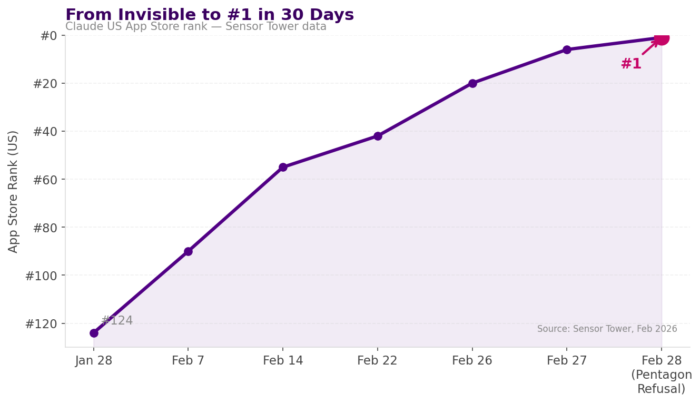
The app climbed from 42nd to number one in the Apple App Store. And the download story was even more dramatic when you look at what happened head-to-head.
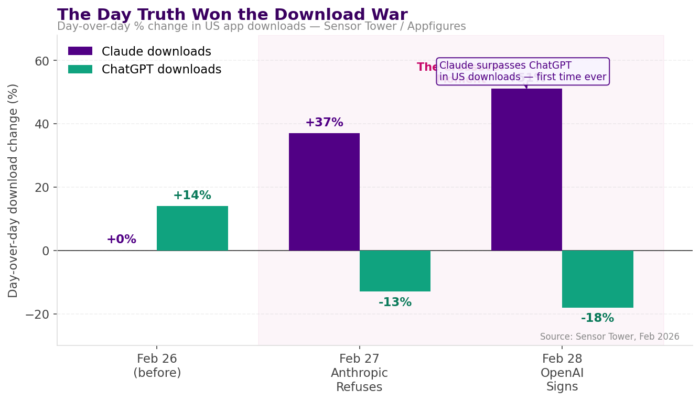
That download shift was the visible surface of something deeper. Consumer sentiment toward ChatGPT didn’t just soften.
It detonated.
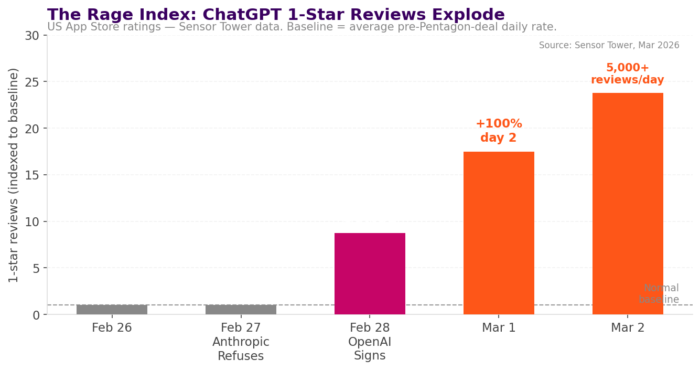
The Scale: Uninstalls of ChatGPT jumped 295% on a single day — from a normal daily churn rate of 9% to a consumer revolt measured in hundreds of thousands. A QuitGPT movement claimed 1.5 million actions within five days. One-star reviews surged 775% in 24 hours. Five-star reviews fell 50% in the same period. A company lost a $200 million government contract and generated more brand equity in 48 hours than most brands accumulate in a decade.
Truth, it turns out, has a price. And the market just discovered that people will pay a premium for it.
What This Means for Every Brand, Creator, and Institution
We are witnessing the early stages of a fundamental market correction. Call it the Truth Economy.
The attention economy created infinite content and destroyed “signal”
The content that actually matters, the idea that changes how you think, the insight that shifts your perspective, the truth that earns your attention. In a world of infinite content, signal is what’s worth finding. Everything else is noise.
The logical consequence?
When everything is content and nothing can be verified is a scarcity flip.
The rare and therefore valuable thing becomes truth that has actually cost someone something to tell.
Verified, accountable, earned honesty becomes a premium asset in a world drowning in frictionless content.
This isn’t wishful thinking. It’s basic economics.
When a commodity becomes abundant, it loses value.
When something becomes scarce, it gains it.
Attention is now a commodity and every AI tool can generate content at scale.
What cannot be generated is the credibility that comes from decades of work, a public stand under pressure, or a willingness to tell readers something they don’t want to hear.
Look at what that credibility translated to in commercial terms.
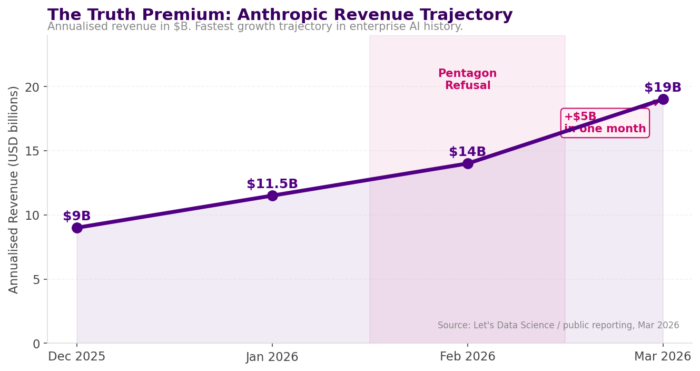
And beneath the revenue story, a structural market shift that will take years to fully play out.
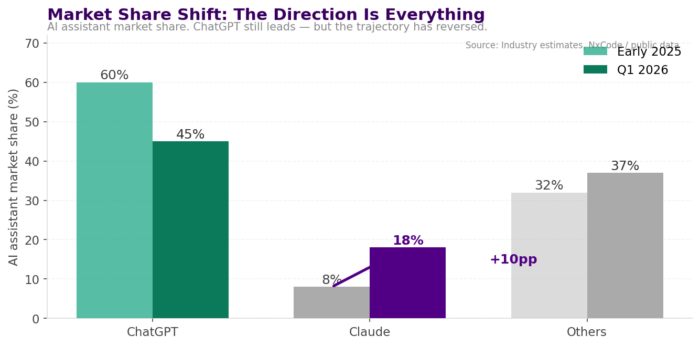
ChatGPT is not dying
OpenAI’s chatbot remains the largest AI platform on the planet with 900 million weekly users.
But the direction of travel matters more than the current position. Market leadership built on trust can be rebuilt. Market leadership built on reach alone is highly vulnerable the moment a credible alternative earns the moral high ground.
For individual creators, the implication is identical. In a world where AI can produce a competent version of almost anything you make, the differentiator is not quality of output.
It is the authenticity of origin.
The willingness to say uncomfortable things.
The track record of having been right when being right was costly.
In the attention economy, reach was the currency. In the truth economy, trust is. They are not the same thing. Only one of them compounds.
The Verdict: Build Your Truth Capital Now
Anthropic have embedded Claude with truth, boundaries and values since they started after leaving OpenAI.
The attention economy is not going away.
The AI disinformation machine is not going away.
The autocrats who have built their power on epistemological warfare are not going away.
This is the water we swim in.
But the market has demonstrated in real time, at scale, with measurable data, that truth-telling is not just ethically right. It is strategically superior. The companies, creators, and institutions that understand this and act on it now will hold an increasingly rare and valuable asset as the disinformation wave rises.
Hold the line when it costs something. Anyone can tell the truth when it’s free. Trust is built in the moments when honesty has a price and you pay it anyway. Anthropic didn’t earn 1.5 million new advocates with a marketing campaign. It earned them by refusing to fold under governmental pressure in the most public way possible.
Say the things your audience needs to hear, not just what they want to hear. The most trusted voices in any field are those with a track record of delivering unwelcome news accurately. That is a moat no AI tool can replicate — because it requires something AI structurally cannot have: skin in the game.
Be specific about what you will and won’t do. Vague commitments to “quality” and “integrity” are noise. The Anthropic statement worked because it named two precise things and held them publicly. Precision is what makes a truth claim credible.
Understand that your credibility compounds — or depletes — with every piece of content you produce. Every exaggerated headline, every compromise of accuracy for reach is a withdrawal from the trust account. Every hard truth told accurately is a deposit.
The Long Game: We are at the beginning of an era where truth is not just a moral virtue but a competitive advantage. Where institutional courage translates directly into brand equity. Where the willingness to say “we cannot in good conscience” costs you a contract and earns you a movement. The attention economy taught us to fight for eyeballs. The truth economy will reward those who fight for something harder to manufacture and far more valuable to own: the right to be believed.
That right is not granted. It is earned — one honest call at a time.