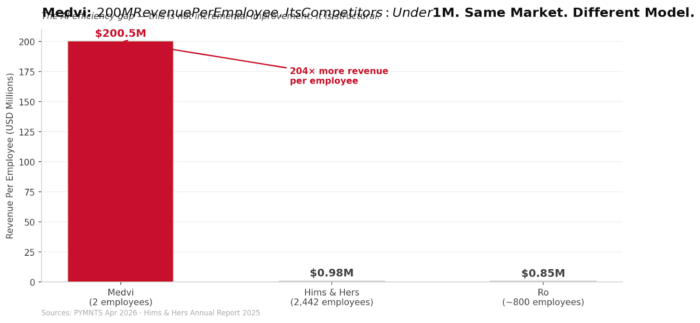
In September 2024, Matthew Gallagher launched Medvi, a GLP-1 telehealth startup, from his home in Los Angeles with no employees, no venture capital, and no traditional marketing team.
By the end of its first full year, Medvi had posted $401 million in sales, served 250,000 customers, and produced a 16.2% net profit margin, nearly triple the margin of Hims & Hers, which employed 2,442 people. Sam Altman’s prediction that AI would produce a one-person billion-dollar company took eighteen months to prove true.
But before we canonise Medvi as the AI marketing gospel, something the headlines missed matters enormously for anyone building a real, durable business. We will get to that. First, the structural picture.
The Great Marketing Reset: What Has Fundamentally Changed
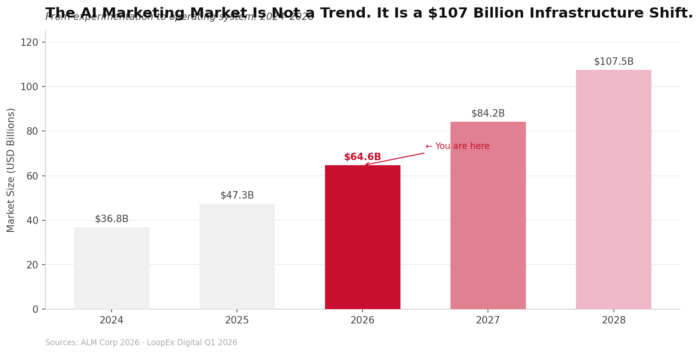
The Medvi story is a data point. What it points to is something that is more of a structural reset of the foundational economics of marketing that has been building for three years and has now arrived all at once.
For the previous thirty years, marketing operated on a stable set of assumptions.
- Scale required headcount.
- Reach required budget.
- Creative quality required agencies.
- Distribution required relationships.
Every one of those assumptions was, at some level, a cost barrier and cost barriers are also moats. The company with more people,
What Nobody Is Telling You About AI and Marketing in 2026
There is a system most marketing organisations have built over the past thirty years that nobody talks about directly, because it is too embedded in how things work to be seen clearly from the inside.
The system is built on a set of assumptions that were entirely reasonable when they were formed.
- That producing marketing content at scale requires large teams.
- That reaching a national audience requires substantial budget and agency relationships.
- That testing creative is an expensive, slow process reserved for major campaigns.
- That search visibility is a long-term project requiring months of technical work and ongoing investment.
- That personalising customer communications at scale requires enterprise software and dedicated operations staff.
These assumptions were not wrong. They were accurate descriptions of the cost structure of marketing as it existed. And like all cost structures, they produced an organisational architecture designed to manage them.
- Teams to handle production.
- Agencies to handle reach.
- Budget cycles to govern spending.
- Approval processes to protect quality.
- Org charts to coordinate the complexity.
The system worked. For decades, it worked well.
Then the cost structure changed. Not gradually. Not in one area. All at once, across every function that the system had been built to manage.
In 1995, a business owner who wanted to run a national advertising campaign needed a minimum budget of $250,000, an agency, a media buyer, a production team, and publisher relationships that took years to build. The barrier was structural. It was not laziness or lack of ambition that kept most businesses from competing at that level. It was the genuine cost of the infrastructure required.
In 2026, the same reach is available for under $500 a month. Not similar reach. The same reach. Often better targeting. Often faster creative iteration. Often higher margin.
“The danger is not that you have the wrong tools. The danger is that you have built the right organisation for a cost structure that has been retired.”
What the Data Actually Shows
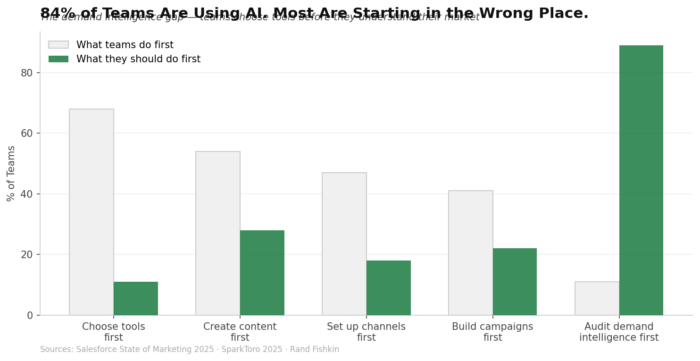
84% of marketing teams are now using AI in at least one workflow. That number sounds like a transformation.
Then you read the next one: only 17% of those professionals have received comprehensive AI training. The tools have been adopted. The thinking has not changed. The system persists inside a new interface.
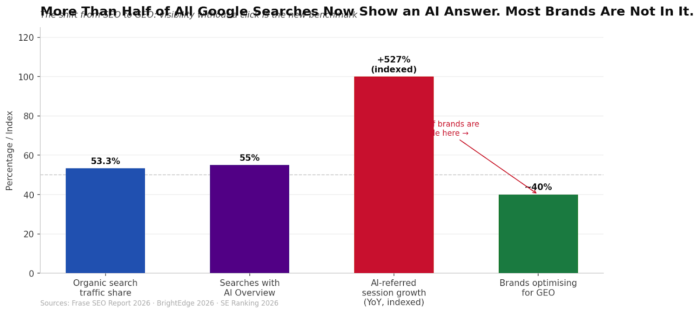
Here is the number that should stop everyone in the room: AI-referred web sessions grew 527% year-over-year in 2025. Not 5%. Not 52%. Five hundred and twenty-seven percent.
The fastest-growing source of web traffic is now AI answer engines:
ChatGPT, Perplexity, Google AI Mode, Claude and fewer than 40% of brands are doing anything to appear in those answers. The rest are investing in search optimisation for a landscape that no longer describes how the majority of information discovery happens.
And from the state of the global workforce: 21% of employees are genuinely engaged in their work. That is not an HR problem. It is a meaning problem. And it costs the global economy $8.9 trillion every year. The teams that will win in this era are not the ones who use AI to move faster inside the old system. They are the ones who use AI to ask what the system should actually be for.
The Part the Headlines Missed
Six weeks before the New York Times profile of Medvi, the FDA sent a warning letter for misbranding compounded drugs. The AI chatbot had fabricated drug prices and invented product lines. Gallagher honoured the fake prices, absorbing the cost. The story is not a clean victory lap. It is a precise map of where AI-powered marketing creates extraordinary leverage and where it generates extraordinary risk if the system it runs on has not been redesigned alongside the tools.
Three Things Most Practitioners Have Not Been Told
First: AI has made authentic human perspective more scarce, not less relevant.
The explosion of AI-generated content has flooded every channel simultaneously. Almost everything now looks polished, sounds confident, and is forgettable. The content that earns genuine attention that stops the scroll, earns the share, builds the subscriber is the content that could only have come from a specific human with specific experience. The irony of the AI era is that it has created the scarcest thing in the market: genuine, unreproducible point of view.
Second: the biggest AI marketing opportunity is not at the top of the funnel.
Most conversations about AI marketing are conversations about content production. But the measurable returns from AI are largest inside the funnel: in lead scoring that improves qualification rates by 60%, in onboarding sequences that double Day-30 retention without changing the product, in churn prediction models that identify at-risk customers four weeks before they cancel, in email send-time optimisation that lifts open rates by 35% without a single new word being written. The content story is the visible story. The funnel story is where the money is.
Third: the search game changed while most marketing departments were looking the other way.
55% of all Google searches now show an AI Overview. These systems do not return a list of blue links. They synthesise an answer and cite sources.
The brands that appear are the ones with original data, clear structure, and genuine domain authority.
The brands that do not appear are invisible to the fastest-growing traffic source in the ecosystem. Most of them have not noticed yet because their traditional SEO rankings have not changed. Visibility and traffic have been quietly decoupled.
What This Playbook Is Built to Do
This playbook does not argue that AI will replace marketers. It argues something more specific and more uncomfortable: that marketers who understand what AI is actually for, at each stage of the funnel, in the right sequence, with the right guardrails will produce outcomes that those who do not cannot match. Not because they are smarter. Because they are working with the grain of how the cost structure has changed, rather than against it.
Each of the twelve chapters/sections that follow covers one stage of the marketing system. Each is anchored by a lead expert chosen for their usefulness at that specific stage, a data chart that makes the argument visible, a real tactical example from an operator who has done the work, and live citations to the research behind the numbers.
The sequence is the argument.
- Demand intelligence before content creation.
- Visibility before distribution.
- Workflow before revenue.
- Onboarding before retention.
- Measurement throughout.
Most AI marketing advice presents these as parallel options you can adopt in any order. They are not. They are a system. A weakness at any stage compounds downstream. The organisations that understand this are building something durable.
The ones that do not are using new tools to run an old system faster.
The System at a Glance
Before Chapter One, here is the complete map. Eight stages. One system. Each one built on what came before it.
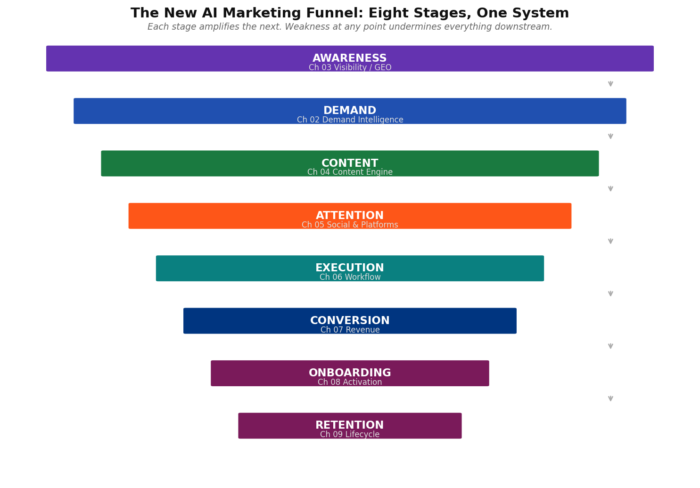
| Stage | Chapter | Lead Expert | AI Leverage Point | Core Metric |
|---|---|---|---|---|
| Awareness & Visibility | 03 | Aleyda Solis | Structure content for AI citation (GEO) | 55% of searches show AI Overview |
| Demand Intelligence | 02 | Rand Fishkin | Research before tool selection | 84% use AI; 17% trained |
| Content Engine | 04 | Ross Simmonds | One idea → 7 assets via AI | 58% higher engagement |
| Attention & Social | 05 | Gary Vaynerchuk | Platform-native AI creative iteration | TikTok: +200% follower growth |
| Workflow Execution | 06 | Kieran Flanagan | AI agents: research → publish | 16 hrs saved/marketer/week |
| Revenue & Conversion | 07 | Kipp Bodnar | AI lead scoring + CRM enrichment | 1.5× revenue growth vs peers |
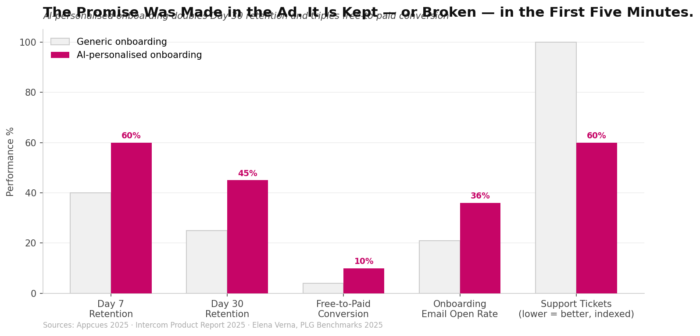
| Onboarding | 08 | Elena Verna | Personalised time-to-first-value path | Day-30 retention +60% |
| Retention & Lifecycle | 09 | Elena Verna | Churn signal detection 3-4 wks early | Expansion revenue +60-90% |
The stack is the infrastructure. The moat is what you build with the time the stack gives back to you. Everything that follows is about building the right moat, at the right stage, in the right order.
CHAPTER 01
AI Has Changed the Shape of Marketing
LEAD EXPERT: Paul Roetzer, Founder, Marketing AI Institute
Why Paul: He built the institution that trained more marketers on AI strategy than anyone else on the planet. His framework for thinking about AI as a spectrum of adoption from assisted tasks to autonomous workflows is the clearest mental model available for understanding where any organisation actually sits in this transition.Founded the Marketing AI Institute in 2016, before most marketers had heard of GPT. Author of Marketing Artificial Intelligence (2022), the defining book on AI marketing strategy. Host of the Marketing AI Show podcast with 400+ episodes. His 2025 finding that only 17% of marketing professionals have received comprehensive AI training is one of the most cited statistics in this playbook.
The most important mental model shift of this era is also the simplest: AI is not a tool. It is a new operating layer that sits underneath every function in a modern marketing organisation. Teams that treat it as a productivity add-on will continue to operate on the same model as before, only faster. Teams that understand what has structurally changed will build a different kind of system entirely.
The Three Structural Shifts
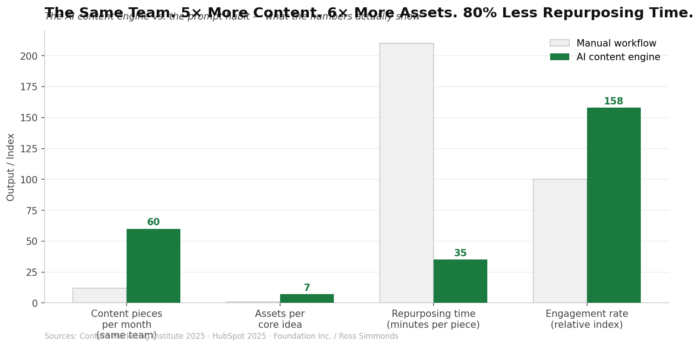
First: the marginal cost of content has fallen toward zero. A marketing team that could produce twelve pieces of high-quality content per month in 2021 can now produce sixty or more with the same headcount. The constraint has moved from production capacity to audience attention.
Second: the cost of iteration in paid creative has collapsed. An AI-equipped operator can now generate, test, and iterate on thirty creative variants in the time it used to take to produce three. You no longer need to guess which message or visual resonates.
Third: the search landscape has been restructured from below. AI-referred web sessions grew 527% year-over-year in 2025. The question is no longer just “do I rank on page one of Google?” It is “am I the source that AI systems cite when someone asks the question my content answers?”
“Stop thinking about AI as a tool. Start thinking about it as part of the operating system of modern growth.”
REAL AI EXAMPLE: Redesigning from the OS up
A B2B SaaS company ran a 90-day AI audit. They mapped every recurring marketing task against three questions: can AI do this as well? Can it do it faster? Does human judgment at this step change the outcome? Result: 14 of 22 recurring tasks were fully automated, 6 were AI-assisted with human review, and only 2 required human-first execution. Weekly marketing output tripled. The CMO’s role shifted from task management to strategic direction within one quarter.
CHAPTER 02
Start With Demand, Not Tools
LEAD EXPERT: Rand Fishkin, Founder, SparkToro (former CEO, Moz)
Why Rand: In an era where AI makes it trivially easy to produce content at scale, Fishkin is the most important voice arguing that starting with tools is the wrong order of operations. His work on audience intelligence — who your buyers actually are, what they actually read, and which sources actually influence them — is the pre-condition that most AI marketing frameworks skip entirely.
Co-founded Moz in 2004 and grew it to the leading SEO software company in the world. Founded SparkToro in 2018 to solve the problem he saw most clearly: marketers do not know enough about their audiences before they produce. His 2024 analysis showing that dark social and unmeasured channels account for the majority of B2B influence is cited in this chapter.
Rand Fishkin built his reputation by telling marketers things they did not want to hear. His core argument is that most marketing investment is wasted not because of poor execution but because of poor demand intelligence. Teams build content before understanding what their audiences actually care about. They target keywords before verifying that real intent exists behind them.
AI makes this problem worse before it makes it better. A team with strong demand intelligence can use AI to execute faster and at greater scale. A team with weak demand intelligence can now produce AI-generated content, AI-distributed posts, and AI-personalised emails at ten times the volume — pointed at the wrong audience, in the wrong channel, with the wrong message. At ten times the speed.
The Demand-First Framework
- Map real attention. Before creating anything, understand where your audience actually spends time. SparkToro’s audience research tools reveal the publications, podcasts, and social accounts that your specific buyers actually consume.
- Identify buyer language, not marketer language. The words your buyers use to describe their problems are almost never the words your product team uses to describe their solutions. Ground your content in the actual language of your audience before generating anything at scale.
- Verify category momentum before investing. Producing excellent content in a declining category is a losing investment regardless of quality. Confirm that real buying momentum exists before building.
- Find the trust signals your audience relies on. Identifying which voices, publications, and communities carry authority with your specific audience is the demand intelligence that most AI tools cannot provide — and most teams never gather.
REAL AI EXAMPLE: Demand-first before content creation
SparkToro analysis of a fintech brand’s target audience revealed their buyers spent 3× more time reading niche accounting software review sites than LinkedIn or Twitter. The brand had invested 80% of its content budget on LinkedIn and Twitter. After redirecting to sponsored content on the review platforms their buyers actually read, qualified inbound leads increased 140% in 60 days. Zero new content was created. Only the distribution changed.
CHAPTER 03
Visibility Is the New Traffic
LEAD EXPERT: Aleyda Solis, International SEO Consultant, Founder at Orainti
Why Aleyda: She is the practitioner who has done more than anyone to translate the abstract shift from SEO to GEO into actionable frameworks for working marketers. While most SEO commentators were still debating whether AI Overviews were a threat or an opportunity, Solis was already publishing systematic methodologies for how brands could structure content to be cited by AI answer engines.
Founder of Orainti, an international SEO consultancy. Speaker at over 100 conferences in 20+ countries. Creator of the SEOFOMO newsletter, read by over 25,000 SEO professionals weekly. Her framework for GEO — Generative Engine Optimisation — distinguishes between the 40% of brands actively optimising for AI citation and the 60% that are quietly becoming invisible to the fastest-growing traffic source in the ecosystem.
For two decades, SEO was fundamentally about earning clicks. Rank high, earn a click, bring someone to your site. AI answer engines change that model entirely. When someone asks ChatGPT or Perplexity a question, they receive a synthesised answer — and may never click through to any source at all. Visibility and traffic have been decoupled.
From SEO to GEO: The New Rules of Discoverability
- Original data and research. AI engines are trained to prioritise sources that contain information not available elsewhere. Original surveys, proprietary analyses, and first-party research are the highest-value GEO assets a brand can produce.
- Citability structure. Content must be written so AI systems can extract specific claims, statistics, and answers. Clear headers, short paragraphs, specific assertions, and attributed data all improve citability.
- GEO monitoring. Run your brand name and five core topics through ChatGPT, Perplexity, and Google AI Mode monthly. The gap between what appears and what should appear is your content brief.
REAL AI EXAMPLE: GEO audit into a content brief
A marketing agency ran a GEO audit for a cybersecurity client: they asked ChatGPT, Perplexity, and Google AI Mode the 20 questions their buyers most commonly search. The client appeared in only 3 of 20 AI answers — despite ranking on page one of Google for 14 of those 20 terms. The gap: AI engines were citing competitors with original research and specific attributed statistics. The agency restructured three existing posts with original survey data, clear headers, and cited claims. Within 6 weeks, AI citation presence rose from 3 to 14 of 20 prompts. AI-referred sessions increased 340%.
CHAPTER 04
Build a Content Engine, Not a Prompt Habit
LEAD EXPERT: Ross Simmonds, Founder & CEO, Foundation Inc.
Why Ross: The phrase “create once, distribute forever” is his. So is the discipline behind it. In a marketing landscape flooded with AI-generated content produced quickly and forgotten faster, Simmonds is the clearest voice on what a genuine content engine looks like versus what most teams are building: a prompt habit dressed up as a strategy.
Founder and CEO of Foundation Inc., working with companies including HubSpot, Shopify, and Intercom. Author of Create Once, Distribute Forever (2024). His research showing that over 50% of content investment is wasted on production for pieces that are never properly distributed is one of the most underreported findings in content marketing. Regular contributor to Harvard Business Review on B2B content strategy.
Ross Simmonds has built his consultancy around one core idea: the best content marketing is not about producing more content. It is about producing content worth distributing. His phrase “create once, distribute forever” captures the system that AI makes newly possible at scale.
The failure mode he sees repeatedly is the “prompt habit”: marketers who use AI to generate individual pieces of content on demand, with no underlying editorial system, no brand voice consistency, and no distribution strategy. The output is fast. The output is plausible. The output is forgettable.
The Content Engine: Three Layers
- The idea layer. Strong content begins with a non-obvious insight that could only come from this brand. AI cannot generate this. It can help develop it once a human has identified it.
- The production layer. Once the core idea exists, AI handles the mechanical work: researching data, drafting the long-form piece, extracting five LinkedIn post angles, writing the newsletter section, scripting the short-form video. One idea becomes seven assets.
- The distribution layer. Content that is not distributed is invisible. Distribution is not an afterthought. It is what makes the production investment worthwhile.
REAL AI EXAMPLE: One article becomes seven assets in 45 minutes
A solo B2B consultant writes one 1,800-word thought leadership article per week. Using Claude, she extracts a LinkedIn post from the contrarian data point in section two, a 5-slide carousel from the framework, a newsletter opening from the story hook, and a 60-second video script from the key insight. Opus Clip then cuts the video into a YouTube Short and TikTok clip. Total repurposing time: 45 minutes. Previously, each asset took 2 hours. She produces the equivalent of 14 hours of content work in 45 minutes — without losing her voice, because the ideas and judgments are entirely hers.
CHAPTER 05
Win Attention Where People Actually Are
LEAD EXPERT: Gary Vaynerchuk, Chairman at VaynerX, CEO at Vayner
Why Gary: His record is simple and unrepeatable. He called Twitter in 2007, Instagram in 2011, Snapchat in 2013, TikTok in 2017 — in every case before the majority of brands had arrived, and in every case he was right. In the AI era, his core argument is more relevant than ever: attention is the scarce resource, it lives on specific platforms before it migrates, and most organisations are always too late.
Chairman of VaynerX, the holding company that includes VaynerMedia — one of the largest social media agencies in the world. Author of seven New York Times bestselling books on social media and attention economics. VaynerMedia manages over $1 billion in annual media spend across TikTok, Instagram, YouTube, and LinkedIn, giving him unmatched real-world data on what actually performs versus what brands assume should perform.
Gary Vaynerchuk’s core insight — repeated across a decade of content — is that attention has always been the precondition for everything else in marketing, and that most brands are perpetually late to the channels where attention actually lives.
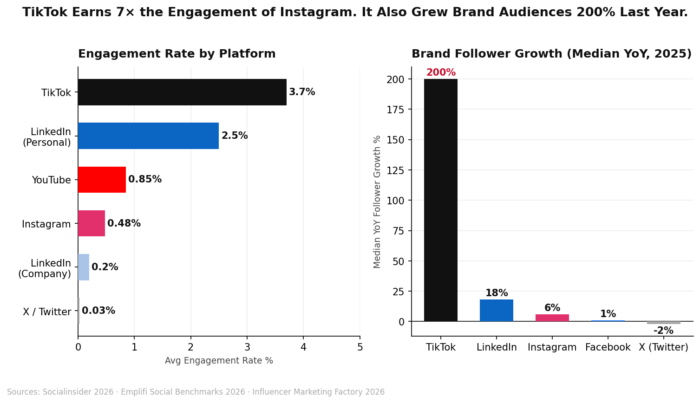
In 2026: TikTok still offers the largest organic reach opportunity for new entrants. LinkedIn personal profiles offer the highest-quality organic reach for B2B operators. YouTube offers the longest compounding return on investment. Cross-posting content built for one platform into all of them is not a distribution strategy. It is the fastest way to train every algorithm to suppress your content.
Platform-Native Rules
- TikTok (3.70% engagement, +200% brand follower growth): Entertainment first. Hook in 2 seconds. 52% video completion is the benchmark. TikTok Search rivals Google for under-30 product research.
- LinkedIn personal profiles (20–30% organic reach): The last major platform where a human with genuine expertise reaches a large percentage of their network without paid amplification. No external links in post bodies. Company pages reach only 2% of feeds.
- YouTube (the compounding channel): Content created today still drives traffic in five years. Treat it as a search engine. Keyword-first titles. Split-test thumbnails before anything else.
- Instagram (0.48% engagement, -24% YoY): 60–70% Reels for discovery. 20–30% Carousels for saves. No TikTok watermarks.
REAL AI EXAMPLE: 30 creative tests in 5 days
A DTC skincare brand was running 3 creative variants per paid social campaign and waiting 3 weeks for statistical significance. After switching to an AI-powered creative workflow using Midjourney for static creative and CapCut AI for short video, they moved to testing 30 variants simultaneously across TikTok and Instagram Reels — different hooks, visual treatments, and CTAs. The best-performing variant in the first 48 hours became the new benchmark, and 15 new challengers were generated. Cost per acquisition fell 38% in the first month. The team did not hire anyone. They changed the workflow.
CHAPTER 06
Turn AI Into a Workflow Advantage
LEAD EXPERT: Kieran Flanagan, Advisor, Former SVP Marketing, HubSpot
Why Kieran: He is one of the few senior marketing executives who has actually rebuilt a marketing function around AI from the inside of a major organisation — not as a pilot programme, but as a systemic redesign of how work gets done. His distinction between spot automation and workflow redesign is the most practically useful framework in this chapter.
Former SVP Marketing at HubSpot, leading the team responsible for growing marketing from $100M to $1B+ ARR. Co-host of the Marketing Against the Grain podcast. His writing on AI workflow design — specifically the idea that winning teams are redesigning workflows, not replacing individual tasks — has been cited by senior leaders at Salesforce, Intercom, and dozens of high-growth SaaS companies.
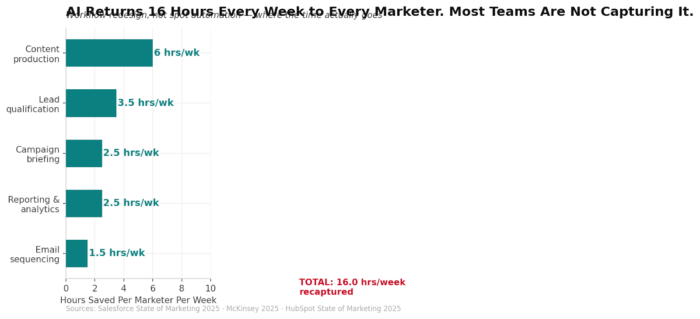
Kieran Flanagan’s argument is that the teams winning with AI are not the ones with the best individual tools. They are the ones who have redesigned their workflows around AI from first principles — identifying every point where a human was doing a task that AI could do as well or better, and systematically removing that friction.
The most common mistake: “spot automation” — using AI to replace individual tasks in an otherwise unchanged workflow. The result is a system that is faster in isolated moments but still fundamentally broken. The teams that win redesign the entire workflow, not just the individual steps.
Workflow Redesign Areas
- Content production pipeline: Research → brief → draft → GEO-optimise → repurpose → schedule → publish. Each step AI-assisted. The human role is editorial judgment at the brief and review stages, not execution.
- Lead qualification and routing: AI scores inbound leads against ICP criteria, enriches CRM records with intent data, and routes leads to the appropriate sales motion before any human touches the record.
- Campaign briefing and variant generation: AI generates the brief, writes copy variants, produces creative options, and recommends the test structure. The execution cycle shortens from weeks to days.
The HubSpot Breeze Case Study
HubSpot’s 2025 Breeze AI update rebuilt core workflows around autonomous agents. Seventh Sense analyses each contact’s engagement history and delivers emails at the precise moment each subscriber is most likely to open them. Result: 35% average email open rate lift within 90 days. That is not a tool improvement. That is a workflow redesign.
REAL AI EXAMPLE: A 7-step pipeline running on two people
A growth-stage SaaS company replaced a 4-person content team with a 2-person editorial team plus an AI workflow stack. The pipeline: Claude drafts from briefs, Surfer SEO scores and optimises, a human editor reviews and approves, n8n publishes to WordPress and cross-posts to LinkedIn, Opus Clip generates video variants, and ActiveCampaign triggers the email nurture sequence on publish. Total human time per article: 90 minutes of strategic editing. Output increased from 4 articles per month to 16. CAC from organic fell 44% in the following quarter.
CHAPTER 07
Connect Marketing to Revenue
LEAD EXPERT: Kipp Bodnar, CMO, HubSpot
Why Kipp: He sits at the intersection of marketing and revenue with more data than almost any other CMO in B2B. HubSpot processes marketing and sales data for hundreds of thousands of companies. His perspective on the gap between marketing activity and revenue outcome is informed not by theory but by the patterns he sees across that dataset every day.
CMO of HubSpot since 2012, overseeing growth to over $2.4 billion in annual revenue. Co-author of The B2B Social Media Book. His 2025 State of Marketing report — based on data from over 1,700 marketing professionals — is one of the most cited data sources on AI marketing adoption globally. Under his leadership, HubSpot’s Breeze AI update represented one of the most significant rebuilds of a major CRM around AI-native workflows.
AI does not automatically close the gap between marketing activity and revenue outcome. In many cases, AI-powered marketing creates a new version of the same problem: faster content production and wider distribution, but no improvement in the quality of leads that actually convert. The work of connecting marketing to revenue is a systems problem, not a content problem.
The Revenue Connection Framework
- Lead scoring with intent data. AI combines behavioural signals with firmographic data to score leads against ICP criteria in real time. This replaces manual qualification and eliminates the “warm body” problem: leads sent to sales before they are ready to buy.
- CRM enrichment and handoff quality. AI enriches CRM records with third-party intent data, competitive research, and engagement history — giving sales reps context they could not have gathered manually.
- Conversion architecture. The conversion path should be designed as a system, not assembled from individual campaigns. AI personalises that path based on the visitor’s industry, role, behaviour, and stage.
- Revenue-linked measurement. Every marketing KPI should be traceable to a revenue outcome. AI-powered attribution is making this more achievable, but the discipline remains a human responsibility.
REAL AI EXAMPLE: From 12% to 27% lead-to-opportunity rate in one quarter
A B2B software company had a 12% lead-to-qualified-opportunity conversion rate and a 90-day average sales cycle. They implemented AI lead scoring combining page visit history, email engagement depth, firmographic fit, and intent data signals from G2 and Bombora. Leads scoring above 75 were auto-routed to senior AEs with a pre-populated context brief. Leads scoring 40–75 entered a 3-email AI-personalised nurture sequence before sales contact. Within one quarter, lead-to-opportunity conversion rose from 12% to 27%. Sales cycle shortened from 90 to 62 days. No new salespeople were hired.
CHAPTER 08
Onboarding Is Part of Marketing
LEAD EXPERT: Elena Verna, PLG Advisor, Former SVP Growth, Miro & SurveyMonkey
Why Elena: She is the person most responsible for making product-led growth (PLG) a mainstream framework for B2B SaaS. Her argument that onboarding is not a product problem but a marketing problem — because it is the moment where the promise made in acquisition is tested — reframes how most marketing teams think about their accountability.
Former SVP Growth at Miro and SurveyMonkey. Advisor to over 30 high-growth SaaS companies on PLG strategy. Her Reforge Growth Series course on PLG has been taken by over 10,000 practitioners. Her newsletter Growth Scoop covers the intersection of AI and PLG at a depth few practitioners match. Frequently cited as the most influential voice in PLG alongside Andrew Chen and Casey Winters.
The promise made in an ad, an article, or a sales call must be fulfilled in the first product experience. If it is not, the acquisition cost was wasted. For digital products, the onboarding experience is the moment of truth.
AI-Powered Onboarding Principles
- Personalise the path to first value. AI segments users at signup based on role, industry, intent signals, and stated goals — and serves a personalised activation sequence for each.
- Reduce time to first value. The single most important metric in onboarding is time to first value. AI removes friction by pre-filling information, suggesting next steps, and surfacing contextual help at the right moment.
- Use email as an onboarding channel. The welcome sequence — a minimum of five emails triggered by signup and activation milestones — should be AI-personalised based on what the user has and has not done.
REAL AI EXAMPLE: Day-30 retention from 31% to 54% without changing the product
A project management SaaS had a day-30 retention rate of 31%. An audit revealed the problem was onboarding, not product: all new users received the same 5-email welcome sequence regardless of company size, role, or stated use case. After implementing AI segmentation at signup, three distinct onboarding paths were created: solo operators received 4 emails focused on templates; team managers received 5 emails focused on collaboration features; agencies received 6 emails focused on client reporting. Day-30 retention rose from 31% to 54% within 8 weeks. Zero product changes were made.
CHAPTER 09
Retention Is the Real Test
LEAD EXPERT: Elena Verna, PLG Advisor, Retention & Lifecycle
Why Elena (again): Verna is included for both chapters because her framework treats activation and retention as stages in the same continuous system — not as separate team responsibilities with separate metrics. In the AI era, the tools for personalising retention interventions have improved dramatically, but her core argument remains: retention depends on product value and customer fit. AI can help you respond to problems faster. It cannot create value where none exists.
See Chapter 08 for full credentials. In the context of retention specifically, her most cited work is on net revenue retention as the single most predictive metric for SaaS health. Her framework distinguishing between activity retention (are customers logging in?) and value retention (are customers getting the outcome they came for?) is the lens through which this chapter analyses what AI-powered lifecycle marketing can and cannot solve.
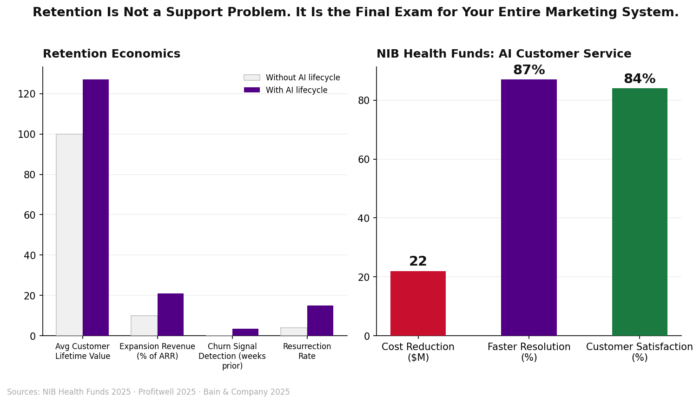
Retention is where the promises made in every earlier stage of the funnel are tested. The true proof of modern marketing is not how fast you acquire customers, but how well you keep and grow them. AI changes the economics of retention in two ways: faster identification of at-risk customers, and more personalised retention interventions.
The Retention Framework
- Churn signal detection. AI models can identify at-risk customers weeks before they cancel, based on changes in login frequency, feature usage, support ticket patterns, and engagement. Early detection gives the retention team a window to intervene before the decision is made.
- Lifecycle messaging. The lifecycle email sequence — triggered by usage milestones, inactivity thresholds, and renewal dates — is the primary retention communication channel. AI personalises this based on each customer’s actual usage patterns.
- Expansion revenue. AI identifies customers showing usage patterns consistent with readiness for a higher tier or additional seat and triggers the appropriate outreach before the customer has actively considered upgrading.
The NIB Health Funds Case Study
NIB Health Funds deployed an AI customer service layer that cut support costs by $22 million and reduced resolution times by 87%, with customer satisfaction scores reaching 84%. The freed capital was redirected toward lifecycle marketing programmes that had previously lacked capacity. Cost savings at the service layer fund growth investment at the lifecycle layer.
REAL AI EXAMPLE: Detecting churn 4 weeks before it happens
A subscription analytics company built a churn prediction model trained on 18 months of customer data. The model identified three leading indicators: login frequency below twice per week, failure to use two or more core features in any 14-day period, and zero email engagement for 21 days. When all three appeared simultaneously, it triggered a personalised retention sequence: a direct CSM outreach, an in-app prompt offering a 1:1 session, and a feature highlight email based on the customer’s original signup use case. Of customers who triggered the model and received the intervention, 61% did not churn. Without the model, the churn rate in that cohort had been 78%.
CHAPTER 10
Measure Signal, Not Activity
LEAD EXPERT: Christopher Penn, Co-Founder & Chief Data Scientist, Trust Insights
Why Christopher: He is the most rigorous voice at the intersection of marketing, data science, and AI. In an era where AI can generate more reports and dashboards than any team can act on, Penn’s argument that most marketing analytics is measuring the wrong things is the corrective most marketing teams need.
Co-founder and Chief Data Scientist at Trust Insights, advising over 200 companies on AI-driven measurement strategy. Host of the Marketing Over Coffee podcast for 18+ years. Author of seven books on marketing data and AI, including AI For Marketers (2023). Published in Harvard Business Review and MIT Sloan Management Review. Named one of the 50 Most Influential People in Sales Lead Management, multiple years running.
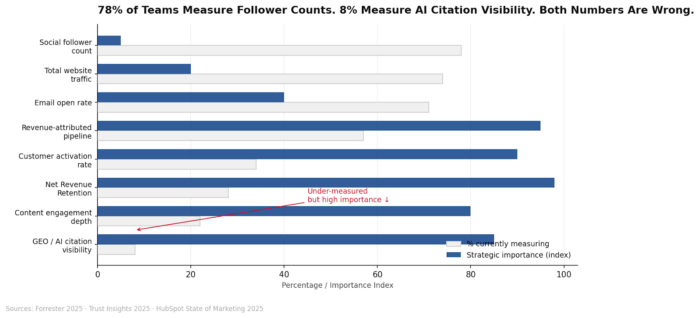
Christopher Penn’s central argument: most marketing analytics is measuring the wrong things — tracking activity that is easy to count rather than signals that actually predict revenue. The arrival of AI has made this problem worse in a specific way: AI can now generate more reports, more dashboards, and more data visualisations than any team can possibly act on.
The Signal Framework
- Define the outcome first. Before choosing what to measure, define what success looks like in revenue terms. Metrics that cannot be connected to revenue are vanity metrics, regardless of how impressive they look in a dashboard.
- Identify leading indicators. Lagging indicators tell you what happened. Leading indicators tell you what is about to happen. AI is most useful for identifying which leading indicators actually predict lagging outcomes — a correlation analysis most teams have never run.
- Design experiments, not campaigns. Every campaign is a hypothesis, every outcome is data, and every iteration improves the model. AI accelerates the experimentation cycle but cannot replace the discipline of defining the hypothesis before running the test.
REAL AI EXAMPLE: Finding the two metrics that actually predicted revenue
A content-led B2B company was tracking 23 marketing KPIs weekly. None correlated reliably with pipeline. A correlation analysis on 18 months of data identified two leading indicators that predicted qualified pipeline 6 weeks in advance with 78% accuracy: average scroll depth on pillar content pages above 65%, and newsletter reply rate above 3.2%. All other metrics were either lagging indicators or noise. The marketing team dropped 19 of their 23 KPIs, focused investment on improving those two signals, and saw pipeline predictability improve dramatically within 90 days.
CHAPTER 11
Tool Stacks by Stage
LEAD EXPERT: Paul Roetzer, Marketing AI Institute, Tool Stack Curator
Why Paul (again): The Marketing AI Institute runs the most rigorous ongoing evaluation of AI marketing tools available to practitioners. Unlike most tool reviews written by people who tested tools in isolation, his team evaluates tools in the context of real marketing systems — how they integrate, where they hallucinate, and whether they solve the problem that was actually the bottleneck.
See Chapter 01 for full credentials. The Marketing AI Institute’s annual AI Marketing Benchmark Report — based on surveys of over 1,200 marketing professionals — is the most comprehensive data source on which tools are actually being used at scale and with what results. Their MAICON conference brings together practitioners from over 40 countries annually to share implementation case studies that do not appear in vendor marketing materials.
The right tool is always the simplest tool that does the required job at the current stage. A solo creator building their first email list does not need HubSpot Breeze. A growth-stage SaaS company managing 50,000 contacts does not need to be on ConvertKit. The tools below are sequenced by stage of growth and matched to documented operator results, not press releases.
| BEGINNER Under $100/mo | INTERMEDIATE$300–600/mo | ADVANCED $1,500+/mo |
|---|---|---|
| Claude or ChatGPT — content, copyPerplexity — researchCanva AI — visualsBeehiiv / ConvertKit — emailBuffer or Later — scheduling Master prompting before adding tools. | Claude — copy and ideationSurfer SEO or Frase — SEO/GEOMidjourney — visual creativeActiveCampaign — email automationOpus Clip — video repurposingn8n or Make — workflow automation What a 3-person team did 5 years ago. | Claude + Jasper — content engineHubSpot Breeze — CRM + agentsGoodie AI — GEO monitoringSeventh Sense — email timingRunway + Descript — videon8n — agentic pipelines Full agentic marketing stack. |
CHAPTER 12
The New Marketing Moat
LEAD EXPERT: Paul Roetzer, Marketing AI Institute, The Long View
Why Paul (closing): Roetzer is the author of the argument that runs through this entire playbook. His core thesis — that AI changes the cost of execution but not the fundamentals of trust, relevance, distinctiveness, and judgment — is not a consolation prize for the sceptics. It is a strategic framework for identifying where the durable competitive advantages will actually live in an AI-saturated marketing landscape.
See Chapters 01 and 11 for full credentials. His closing argument is informed by five years of tracking what has actually happened to organisations that adopted AI early versus those that waited — and specifically by the consistent finding that tool sophistication does not correlate with marketing outcome. What correlates is the combination of genuine expertise, authentic audience relationships, and the discipline to use AI to amplify the signal rather than manufacture the noise.
Every industry transformation produces two kinds of operators: those who see the structural shift clearly enough to reorganise around it, and those who add the new technology to the old model and wonder why the results are underwhelming.
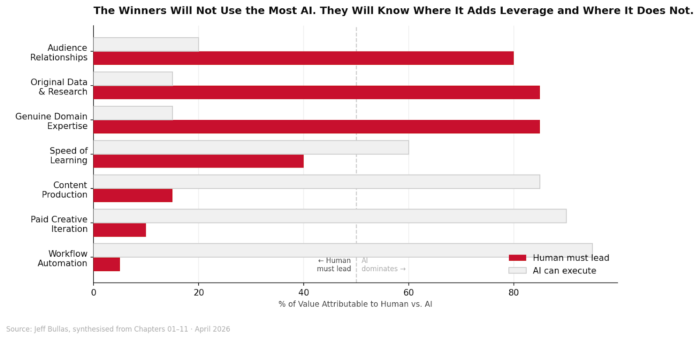
The organisations building durable marketing advantages in 2026 are not the ones with the most sophisticated tool stacks. They are the ones who understood, early enough to act on it, that AI changes the cost of execution — not the value of genuine expertise, not the power of authentic audience relationships, and not the irreplaceable quality of a human perspective that makes someone trust a voice enough to follow it.
The Four Moats That Survive the AI Era
- Audience relationships. A list of 30,000 email subscribers with 40% open rates cannot be reproduced by a competitor with a better AI stack. No tool can generate it. It can only be earned.
- Original data and research. Any AI can synthesise existing public information. No AI can produce data that does not exist yet. Operators who generate original research have a GEO moat that no competitor can buy.
- Genuine domain expertise. The operator who has genuinely done the thing has a signal that AI cannot fake and that the most sophisticated algorithms are specifically designed to detect.
- Speed of learning. The organisations that compound fastest are not those with the most tools but those with the most sophisticated feedback loops. Strategic intelligence remains exclusively human.
“The stack is the infrastructure. The moat is what you build with the time the stack gives back to you.”
REAL AI EXAMPLE: The audience relationship no competitor can copy
A 15-year-old industry newsletter with 30,000 subscribers and a 42% open rate was acquired for 11× revenue. The acquirer’s internal analysis cited one primary asset: the audience relationship. No AI tool had built it. No competitor could replicate it in 12 months regardless of their tool stack. What built it was 15 years of consistent, valuable, non-generic content sent directly to people who had explicitly asked to receive it. That relationship was valued at a premium over the content archive, the domain authority, and the existing advertiser relationships. The moat was not the content. It was the trust.