
Most people in my position or in the industry wouldn’t say this out loud. But I’m going to say it anyway.
The business model that built my career is over.
Not struggling. Not pivoting. Not going through a rough patch.
Over.
I built jeffbullas.com over fifteen years into a platform that attracted 33 million readers across 190 countries. I did it by understanding one thing before most people did: the internet rewarded those who consistently showed up with useful, clear, educational content. Show up. Teach people. Build trust. Let the audience compound.
It worked spectacularly.
And then generative AI arrived.
Not as a feature, not as a trend but as a structural demolition of everything that model was built on.
I watched it happen. I watched it happen to me.
And I had a choice: pretend this wasn’t happening, or say it out loud and figure out what comes next.
This article is me saying it out loud.
The Scarcity Model Is Gone
For two decades, the internet ran on a simple economic premise.
Information was scarce. Attention was abundant.
If you could reliably produce useful, well-structured content on topics people were searching for, you captured attention. Captured attention became traffic. Traffic became email subscribers, speaking invitations, consulting clients, product sales. The game was clear: be the most useful person in your niche, and be there consistently.
This worked because information had friction. Research took time. Writing took effort. The person willing to put in that work night after night, year after year built something other people couldn’t easily replicate.
Then the friction disappeared overnight.
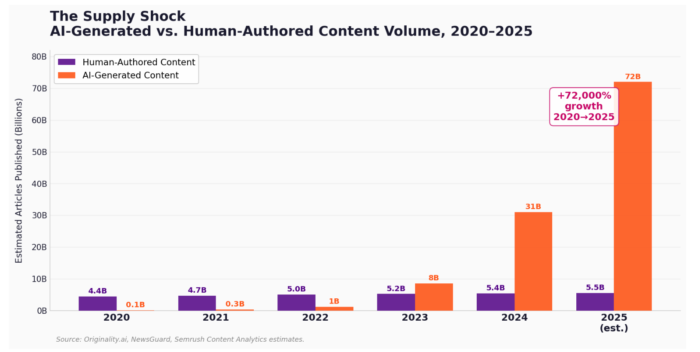
A single ChatGPT prompt now produces a 2,000-word article on “10 Social Media Strategies for 2025” in 30 seconds. AI-powered publishing platforms auto-generate and post thousands of articles per day.
Google’s AI Overviews answer users’ questions directly on the search results page no click required. AI newsletters flood inboxes with synthetic expertise, complete with confident tone and zero personal experience.
The supply of “good enough” information went to infinity. The marginal cost went to zero.
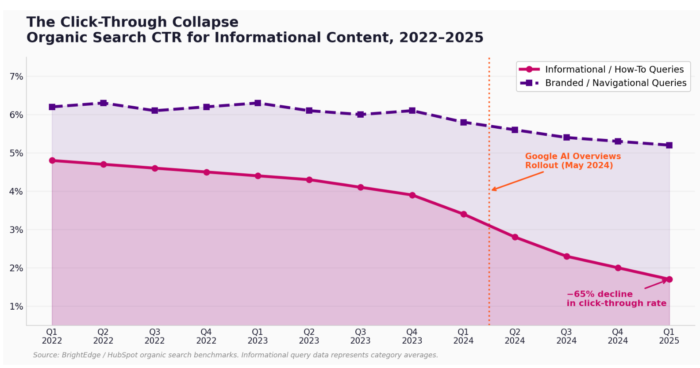
When supply becomes infinite and cost becomes zero, the market reprices the commodity fast and permanently.
The traditional blogger, the SEO-optimised educator, the generalist content creator who explains and summarises their value proposition collapsed alongside it.
I know because I felt the collapse in my own traffic. I watched my carefully researched and SEO optimized articles get scraped, synthesised, and surfaced in AI overviews that answered the question without sending a single visitor back to my site.
I watched faceless AI content farms outpublish me by a thousand to one.
This is not a content marketing problem you can optimise your way out of.
It is a structural market shift.
And it is permanent.
The Data: What the Numbers Actually Say
Let’s be clear about the scale of what’s happening.
Organic search traffic to editorial and informational content declined an average of 18–64% across major content categories following Google’s AI Overview rollout in 2024, depending on query type. Informational queries — the bread and butter of the educational blogger — were hit hardest.
Meanwhile, the volume of AI-generated content on the web is estimated to have grown by more than 1,000% since 2022.
There are now more articles published per day than humans could read in a lifetime. The signal-to-noise ratio has inverted. The internet is drowning in synthetic expertise.
And yet, and here is the critical data point most people miss.
Demand for human-guided transformation has not declined.
Coaching is a $20 billion global industry. It grew during the pandemic. It is growing now. Personal development is a $44 billion market. Executive coaching, life coaching, career coaching are all expanding.
People are not less confused about what to do with their lives. They are more confused. The acceleration of AI is making the identity question more urgent, not less.
The market did not stop valuing guidance. It stopped valuing generic information.
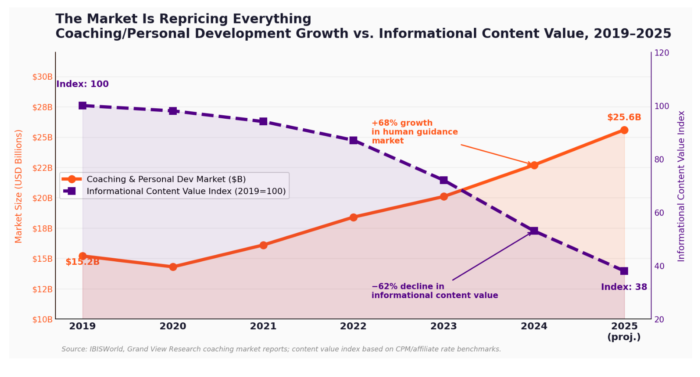
This is not a crisis for everyone. It is a crisis for those who built their business on being the most accessible source of information. It is an opportunity for those willing to offer something different.
You Cannot Compete With Free and Infinite
Here is where most people in my position get it wrong.
They respond to AI-generated competition by producing more content, faster. They add AI tools to their workflow and call it transformation.
They optimise harder. Post more. Publish more.
They are running faster on a burning platform.
You cannot out-publish a machine that never sleeps, never bills by the hour, and never runs out of ideas.
You cannot out-SEO a system that is rewriting the rules of search in real time. You cannot compete on information volume when the cost of information volume has reached zero.
The only viable move is to stop competing on information altogether.
To move to the one thing AI structurally cannot replicate:
The specific, scar-tissue-earned wisdom of a human being who has actually lived something.
Who has risked something.
Who has failed publicly and rebuilt from the ground up.
Who carries in their body and their choices a perspective that no training dataset can simulate, because it has never happened before.
Not content. Testimony.
Not education. Transformation.
Not information. Identity.
The market has already begun repricing in this direction.
It is not rewarding those who explain the most. It is rewarding those who illuminate something true about the human experience in a way that makes the reader feel less alone and more capable.
That is a different craft. A harder one. And one that AI cannot automate.
What I Had to Admit to Myself
I have spent the better part of two years being honest with myself about what I actually built.
I taught people how to grow followers. How to write better headlines. How to structure a content calendar. How to optimise for search. Much of it was useful. None of it was uniquely mine.
Anyone with enough time and diligence could have written it. And now, anyone with a $20 AI subscription can generate it.
I had built a career on being helpful. But helpful is automated now.
I had to sit with a genuinely frightening question:
What do I know that cannot be Googled?
What have I lived that cannot be simulated?
What do I believe that would be dangerous for an AI to say?
If I could not answer those questions, I had no future worth building toward.
For me, the answers came from going back further than the traffic numbers and the platform metrics.
They came from asking why, in 2009 during one of the most financially and personally difficult periods of my life .
I started getting up at 4:30am every morning to write about the internet when nobody was reading and nobody was paying.
There was no external reward. No algorithm to chase. No audience to validate the effort.
And yet I kept going.
Something in me needed to understand that. What was the engine under all of it? What made a person persist when the rational case for stopping was overwhelming?
That question eventually became Zyrro.
What the Pivot Actually Requires
Here is where most reinvention attempts die.
People write the strategy document. They refine the positioning. They redesign the website. They draft the launch announcement.
And then they hedge.
They keep producing the old content while gesturing toward the new direction. They try to hold the legacy audience while building a new one. They publish the reinvention story alongside the how-to articles, as if the market won’t notice the identity confusion.
The market notices everything.
The market punishes hedging with indifference.
A real pivot requires burning the old identity publicly and permanently.
Not metaphorically. Literally. In words your audience cannot misunderstand.
I am no longer building a media business. The old game is finished. If you want what I used to offer, there are ten thousand places to get it and most of them faster and cheaper than me.
If you want what I am building now, here is what it is and why it matters.
That declaration is terrifying.
It means losing traffic. Losing the identity that made you safe. Losing the revenue streams that felt stable. Standing in public without the armour of established expertise and saying: I am starting something new, and I do not know exactly where it ends.
But the alternative?
Staying on the burning platform, optimising the old model with diminishing returns, watching the market reprice your value year by year is a slower and more demoralising version of the same ending.
The only way through is through.
What I Am Building
I am building Zyrro.
Not another content platform. Not another AI productivity tool. Not another newsletter that tells you how to use ChatGPT.
Zyrro is an AI mentor platform built on a simple and, I believe, deeply timely premise:
When AI can execute almost anything, the bottleneck in human performance stops being capability. It becomes clarity.
Clarity about who you are. What you’re built for. What gives you energy. What problems you’re actually called to solve. How to turn that self-knowledge into daily momentum and decisions that compound over time.
I have spent two decades helping people build audiences on the internet. And I have watched brilliant, driven, hardworking people succeed at every external metric and still wake up wondering if they’re doing the right thing. You can have the traffic, the followers, the revenue, the recognition — and still feel fundamentally directionless.
The question underneath all the tactics was always the same question:
Who am I, and what am I here to do?
AI is about to make this question more urgent for more people than at any point in modern history. When the machines can do the work, the only thing that cannot be outsourced is the judgment about what work is worth doing.
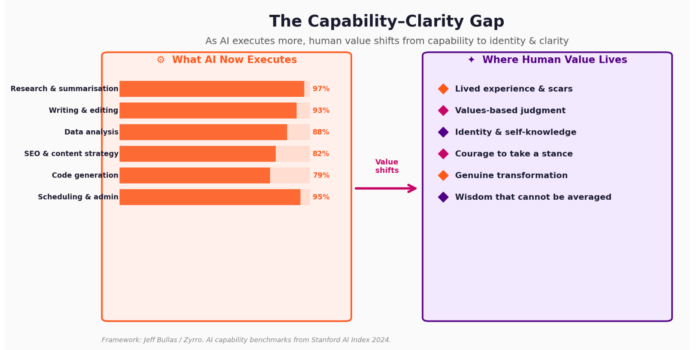
Your identity becomes your operating system. Everything else, every tool, every platform and every skill, is just an application running on top of it.
Zyrro is designed to help people build that operating system.
What This Means for You
I am not writing this to sell you something.
I am writing this because I have been watching smart, capable people make the wrong bet doubling down on information-era strategies in a transformation-era economy and I think someone needs to say it plainly.
The era of the generalist content creator is ending.
The era of the commoditised expert who explains what AI can now explain better is already over.
The era of synthetic thought leadership and the articulate, confident, personality-free content that AI generates at industrial scale is already exhausting people.
You can feel the fatigue in your own inbox.
What comes next is not more content. It is more humanity.
More specificity. More scars. More dangerous honesty. More work that could only exist because one particular person, with one particular history, decided to stop playing it safe and say the thing they actually believe.
You have a choice in front of you.
You can keep running the old playbook and churning out information that AI will commoditise before you finish publishing it and call it strategy while the market quietly depreciates your value.
Or you can do the harder, slower, more terrifying work of excavating what you know that cannot be simulated, what you have lived that cannot be averaged, and what you are building that would not exist without you.
I have made my choice.
This article is the line.
On one side: the old model, the old identity, the safe path that is quietly dying.
On the other: an uncertain, unproven, deeply personal bet on a different future.
I am walking toward the second one.
If you are doing the same, I see you.
And if you are still deciding — I hope this helps you choose before the market makes the decision for you.
The Verdict
The information economy ran on scarcity. AI ended that scarcity. The old rules no longer apply.
What survives is not the most useful information. What survives is the most human insight, that is specific, lived, irreplaceable, and impossible to simulate.
The question is not whether the market has changed.
It has.
The question is whether you will admit it in time to build something real on the other side.