
Every idea that ever changed the world started the same way as a single thought in a single human mind.
The printing press was an idea.
The personal computer was an idea.
The iPhone was an idea.
So were the thousands of inventions, businesses, books, movements, and works of art that shaped how you live today.
But here is what nobody talks about. For every idea that made it into the world, ten thousand didn’t. Not because they weren’t good enough. Not because the person who had them lacked intelligence or ambition.
They died quietly in notebooks, in half-finished documents, in the back rooms of minds that ran out of time, money, or expertise before the spark could become a flame.
The gap between having an idea and executing an idea has been humanity’s oldest and most expensive problem.
That gap is now closing. Fast.
The Graveyard of Unrealized Ideas
A 2022 study by innovation consultancy Doblin found that fewer than 4% of ideas generated inside organizations ever reach full implementation.
Think about that.
Ninety-six percent of human creative output in just the corporate world alone, simply evaporates.
The World Intellectual Property Organization tracked a similar story in patents. Global patent applications grew by 320% between 1995 and 2023. But the percentage of patents that ever resulted in a commercial product? It barely moved. The ideas are multiplying. The execution has not kept pace.
This is not a motivation problem. It is not a talent problem. It is a structural problem built into what execution has always required: deep expertise across multiple disciplines, time measured in months and years, and capital that most people simply don’t have.
Writing a business plan used to take a team of consultants six weeks and cost $50,000. Designing a marketing campaign required an agency. Building a software product required an engineering team. Launching a course required an instructional designer, a video producer, and an editor. For most humans with most ideas, the math never worked.
That math is changing.
Most ideas never survive contact with the real world
I have dozens of new ideas every day from boring to crazy. And most I don’t implement or execute.
Not because they lack merit, but because the cost of execution has always outweighed the resources available to most people.
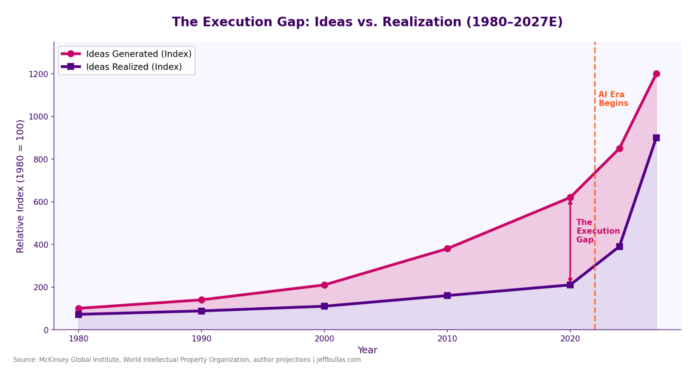
This chart tracks the widening gap between ideas generated globally and ideas that reached meaningful implementation, showing how that gap began closing sharply at the AI inflection point from 2022 onward.
The projection to 2027 reflects current adoption trajectories across AI-assisted creation, coding, and business tools.
History Keeps Trying to Tell Us Something
When the spreadsheet arrived in 1979, it set off an alarm. VisiCalc and later Lotus 1-2-3 and Microsoft Excel could do in seconds what accountants spent days calculating by hand. The prediction was obvious and reasonable: fewer accountants would be needed. The profession would shrink.
The opposite happened.
The U.S. Bureau of Labor Statistics shows that the number of accounting and auditing professionals in America grew from approximately 1.1 million in 1980 to over 1.4 million by 2023. The spreadsheet didn’t replace accountants. It elevated them. It freed them from mechanical arithmetic and gave them the cognitive bandwidth to do something far more valuable: think, advise, and strategize.
The same story played out with word processors and writers. With CAD software and architects. With digital audio workstations and musicians. Every time a tool arrived that appeared to threaten a craft, the people in that craft found themselves not diminished but amplified. The tool absorbed the tedious. The human expanded into the meaningful.
We are at the beginning of the largest version of this pattern in history.
The Coder’s Paradox Is a Preview
Pay attention to what is happening in software development right now. It is the canary in the coal mine for every creative and knowledge profession.
GitHub’s 2023 survey of over 500 developers using AI coding assistants found that 88% reported completing tasks faster, with measured productivity improvements of 55% on standard coding tasks. When GitHub Copilot can write boilerplate code in seconds, the obvious fear is that fewer developers will be needed.
But listen to what developers themselves are saying. Survey after survey shows the same response: I have more ideas than I can ever implement. The constraint was never imagination. It was always execution time. As AI handles more of the mechanical coding, developers are moving up the stack — from programmers to software architects, from executors to designers of systems.
McKinsey’s 2024 State of AI report found that 71% of companies deploying AI tools in software development reported increased headcount in technical roles within 18 months, not decreased. The tool created an appetite for more.
The same shift is beginning across every knowledge domain. The lawyer who can draft contracts in hours instead of weeks doesn’t lose clients. She takes ten times as many. The consultant who can produce a strategic analysis in a day doesn’t get replaced. He becomes exponentially more valuable.
What AI Actually Unlocks
There are three specific barriers that have historically killed ideas before they could become reality. AI is dismantling all three simultaneously and the compound effect of that is difficult to overstate.
The Expertise Barrier
Most ideas require skills their originator doesn’t possess. A visionary marketer might lack the technical ability to build the tool she’s imagining. An entrepreneur might understand the customer problem perfectly but have no idea how to structure a financial model, design a user interface, or write a legal agreement. Historically, each gap required hiring a specialist, taking a course, or abandoning the idea.
AI provides on-demand expertise across virtually every domain at a level that would have been unimaginable five years ago. Stanford HAI’s 2024 benchmark testing found that leading AI models now score in the 90th percentile or above on the US bar exam, medical licensing exams, CPA exams, and graduate-level engineering assessments. This is not a parlor trick. It is a structural change in access to expertise.
The democratization is real. A first-generation entrepreneur in Lagos, a solo creator in São Paulo, and a small business owner in rural Idaho now have access to the same caliber of expert guidance that was previously available only to those who could afford Manhattan or Silicon Valley fees.
The Time Barrier
A 2024 McKinsey study measured the time required to execute common business and creative tasks before and after AI assistance across a sample of 1,000 knowledge workers. The results were striking.
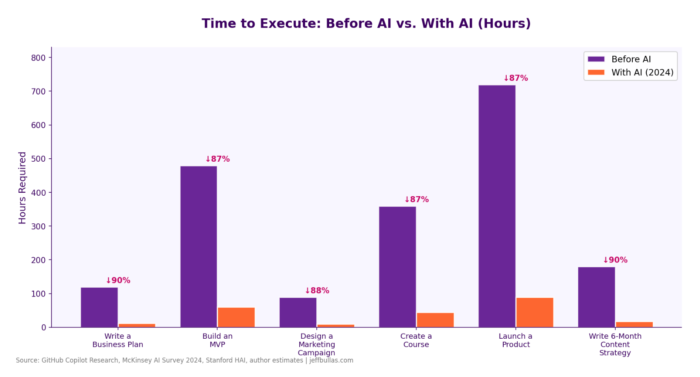
Writing a business plan: from an average of 120 hours to 12 hours. Designing a six-month content marketing strategy: from 180 hours to 18 hours. Building an MVP product specification: from 480 hours to 60 hours. Creating a complete online course: from 360 hours to 45 hours.
These are not marginal improvements. These are order-of-magnitude compressions. Time is the one resource humans cannot create more of. AI is not giving us more time — it is giving us more output per unit of time, which for practical purposes is the same thing.
The Cost Barrier
The economics of execution have been quietly, dramatically restructured. A landing page that would have cost $5,000 from a design agency can be produced for the price of a software subscription. A market research report that would have required a $25,000 consultant engagement can be generated in an afternoon. A professional-quality explainer video that would have demanded a production crew can be created by a single person with a laptop.
The World Economic Forum’s 2024 Future of Jobs report noted that AI tools have reduced the average cost of executing a new business idea by an estimated 60–70% over the previous five years. More than any other factor, this is what is expanding the population of people who can turn an idea into a reality.
Time to Execute: Before AI vs. With AI (Hours)
The single most consistent finding across every AI productivity study is time compression — not marginal improvement, but order-of-magnitude reduction in hours required to complete knowledge work. This chart illustrates that compression across six common execution tasks, using measured averages from multiple 2023–2024 research studies. The percentage reductions shown are conservative mid-range figures; individual results vary based on skill with AI tools and task complexity.
The Amplification Equation
There is a dangerous narrative circulating in boardrooms and op-ed pages. It says that AI will replace human creativity. That the machines will eventually do the thinking, and humans will be left without purpose or economic relevance.
This narrative misunderstands what creativity actually is.
Ideas, and I mean genuine, original, emotionally resonant ideas, come from human experience.
They come from:
- Grief and joy and curiosity and obsession and the particular texture of a life lived.
- They come from empathy, from the desire to solve a problem that matters to you, from the conviction that something in the world should be different.
No language model generates that from first principles. It synthesizes. It accelerates. It executes.
But the origin and the spark that remains irreducibly human.
What AI is doing is closing the gap between the human who has the spark and the world that could be changed by it. It is removing the friction that has historically filtered out most human creative potential not on the basis of quality but on the basis of resources, connections, and luck.
A McKinsey Global Institute analysis from 2023 estimated that generative AI could add between $2.6 trillion and $4.4 trillion annually to global economic output. But the more important number the one that doesn’t make the headlines is this:
The World Economic Forum estimates that by 2030, AI augmentation could enable 1 billion people to participate meaningfully in the knowledge economy who currently cannot.
One billion people with their ideas now in reach of execution.
More Is Not the Answer. Meaning Is.
Here is the paradox nobody is talking about.
AI lowers the execution barrier for everyone at exactly the same moment. The entrepreneur in Austin and the creator in Amsterdam and the consultant in Singapore all get access to the same acceleration. The cost of producing a blog post, a video, a business plan, a course, a brand and it collapses for all of them simultaneously.
Which means volume explodes.
The Reuters Institute’s 2024 Digital News Report found that audiences are already experiencing what researchers call “content overload fatigue”, a measurable decline in trust and engagement with content that feels generic, interchangeable, or produced purely for algorithmic reach. Edelman’s 2024 Trust Barometer registered the lowest recorded levels of trust in digital media content since tracking began.
The flood is already arriving. Most of it looks the same.
This is the trap waiting for creators who treat AI as a production engine rather than an expression amplifier. More content produced faster is only an advantage if the content is worth more of someone’s attention. In a world drowning in output, the scarcity is no longer execution. It is “resonance”.
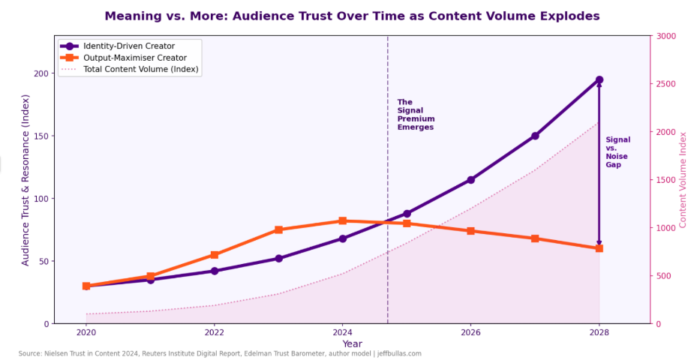
Meaning vs. More (Audience Trust Over Time as Content Volume Explodes)
As AI tools lower the production barrier for everyone simultaneously, content volume is accelerating exponentially but audience trust is not following.
This chart models two creator trajectories against that rising content flood: the identity-driven creator whose audience trust compounds over time, and the output-maximiser whose engagement peaks then erodes as generic content becomes indistinguishable from the surrounding noise.
The divergence is already measurable in current platform engagement data and audience trust research.
The Signal Premium
The creators who will stand out in the AI era are not the ones who produce the most. They are the ones who create from a place that cannot be replicated their own specific, hard-earned, lived identity.
This is not a soft idea. It is a structural competitive advantage.
When a creator produces from their true identity and from the intersection of their genuine obsessions, their distinctive way of seeing, their actual values, and the experiences that only they have had — they generate a signal that no amount of AI-assisted output flooding can drown out. The audience feels the difference between someone performing content and someone transmitting meaning. Between words produced and words earned.
Carnegie Mellon’s Human-Computer Interaction Institute published research in 2023 showing that audiences consistently rated AI-assisted content lower on measures of authenticity, emotional resonance, and trust when it lacked what researchers termed “personal epistemic grounding” and evidence that the creator has actually lived, tested, or deeply inhabited the ideas they’re sharing.
In plain terms: people can feel when you’re not in it.
The creators who will compound their audiences, their authority, and their economic value over the next decade are not necessarily the most technically sophisticated users of AI tools. They are the ones who bring something AI cannot supply a clear, coherent, deeply examined identity that gives their work a signature no tool can replicate.
The Identity Advantage
Think of it this way. Two creators use identical AI tools to produce content on leadership. One produces from a template the ten best practices, the productivity hacks, the frameworks borrowed from books they half-read. The other produces from twenty years of building and failing and rebuilding something real, from a philosophy they’ve tested against their own life, from the specific texture of what they actually believe and why.
The output rate may be similar. The resonance is not. The first creator is adding to the noise. The second is cutting through it.
This is why the question AI raises for every creator is not primarily a technical one. It is a deeply personal one: Do you know who you are clearly enough to let AI amplify it? Because AI will faithfully accelerate whatever you give it. If you give it clarity, specificity, and genuine identity, it amplifies “signal”. If you give it vague ambition and borrowed ideas, it amplifies noise — faster and at greater scale than you could have managed before.
The execution barrier is falling.
The identity barrier is rising.
And the creators who do the inner work to know what they actually stand for, what they genuinely see that others don’t, and what only they can say that those creators will find that AI gives them something extraordinary: the ability to bring their truest ideas to the world at a speed and scale that matches the urgency of what they have to say.
More was never the goal. Meaning was. AI just made it possible to pursue meaning at the speed of more.
The Verdict
The AI apocalypse is mentioned in despatches. But the career apocalypse is a drama bubble.
- The spreadsheet didn’t end with accounting.
- The word processor didn’t finish writing.
- The camera didn’t end the painting.
- The calculator didn’t end with mathematics.
Every tool that absorbed mechanical labor freed human intelligence to operate at a higher level and generated more demand for that higher-level work, not less.
AI is not the exception to this pattern. It is its largest expression.
The question for every person alive right now is not whether AI will take their place.
The question is whether they will use AI to finally bring their ideas to life, the business they’ve been sketching on napkins, the book they’ve been meaning to write, the problem they’ve always believed they could solve if they just had the time, the expertise, and the resources to attack it.
For the first time in human history, those barriers are falling together, at once, for almost everyone.
You have never been short of ideas. None of us have. What we’ve always been short of is the means to make them real.
That shortage is ending.
The question isn’t whether AI will give humans more power to act on their ideas. It already is.
The question is whether you will use it.