
The creator economy is worth over $480 billion and projected to double by 2030. Fifty million people now identify as content creators. They are the “new” influencers. Personal brands creating multi million dollar media empires.
And AI is amplifying their productivity and making it easier for them to be seen.
Why this matters
Today anyone can reach the world with zero cost. All you need is a mobile phone and a social media account.
Social media democratized attention.
AI amplifies their productivity.
You no longer needed permission or to make payment to the mass media moguls for advertising.
But in a crowded noisy world breaking through the content clutter to be visible gets harder every day as AI enables anyone to create infinite content aided by automation.
But… Is AI commoditizing influencers?
So now….every week, a new personal brand appears. Polished. Consistent. Optimised. They post the frameworks. They share the lessons. They package the insights. They grow fast.
They are all content creators. And many are hollow and are treating the internet as a “get quick rich scheme”.
For the first time in history, digital publishers publishing their content on social media amplified and enhanced by artificial intelligence can generate a credible personal brand, complete with a consistent voice, a coherent point of view, regular content, and engagement metrics for almost zero cost.
The performance of depth is now entirely separable from depth itself.
The 9 Benefits of Building a Personal Brand
Before tactics, tools, and monetisation models, there is a prior question worth answering clearly: why does this actually matter? What does a personal brand give you that a strong career, a respected CV, or a well-run business does not?
1. Attention on Demand
The ability to move a conversation, surface an idea, or put a product in front of the right people without a publicist, a media budget, or permission from any intermediary. Attention is the currency that precedes every other form of value in the digital economy. Oprah could shift a book to number one on Amazon with a single mention. At smaller but structurally identical scale, a B2B thought leader with 40,000 engaged LinkedIn followers can fill a consulting pipeline, launch a course, or shift how an industry thinks about a problem — with a single post. That leverage is not available at any price to someone without an audience.
2. Financial Sovereignty
A personal brand is the most asymmetric income engine available to an individual. Justin Welsh generates over $5 million annually from two digital courses and a newsletter. Lenny Rachitsky built a $5 million+ subscription business from a single Substack. The economics are structurally different from employment: the revenue is not capped by a salary, not dependent on a single client, and not controlled by a single employer. Once built to sufficient depth, it generates income that does not require your continuous presence to sustain — and cannot be ended by a restructure, a recession, or a change in management.
3. Pricing Power
The most underrated financial benefit. A consultant without a personal brand charges the market rate. The same expertise, made visible through a known brand, commands a premium that is routinely 5–10x that rate. Adam Grant charges $80,000 per keynote — not because of his academic qualifications alone, but because of who Adam Grant is: the author, the Wharton professor, the podcast host, the million-copy bestseller. His personal brand is the pricing mechanism. The same principle operates at every scale. People pay to work with someone they already know and trust. The personal brand makes strangers trust you before the first conversation begins.
4. Credibility That Compounds
Unlike most forms of capital, credibility increases when you spend it. Every insight shared publicly, every prediction that proves correct, every position held under pressure builds an asset that pays forward — sometimes for years, sometimes for decades, after the original piece was written. An article published in 2009 can still generate trust, traffic, and client enquiries in 2025. Credibility is the only investment whose returns compound backward through time. Spend it generously. It does not diminish.
5. Career Optionality: The Most Powerful Insurance Ever Invented
You cannot be made redundant from your own identity. The executives who navigated the wave of AI-driven layoffs fastest in 2023–24 were not the ones with the most impressive CVs. They were the ones known for something specific in public. A personal brand converts every career transition — voluntary or forced — from a crisis into a choice. You arrive at every new opportunity already known, already trusted, and already positioned. The job search becomes an inbound conversation rather than an outbound campaign.
6. Network Inversion
Without a personal brand, building relationships requires outbound effort: emails sent into uncertainty, events attended, hands extended, connections requested. With one, the direction inverts. The right people — the collaborators, the clients, the investors, the co-founders — start arriving inbound, already aligned with what you do and who you are. People who find you through your public work have pre-qualified themselves. The quality of the relationships formed through a personal brand is structurally higher than those formed through networking alone — because the relationship starts from understanding rather than introduction.
7. Platform for Change
The ability to use an audience as a lever for something beyond commerce.
- Brené Brown’s personal brand made vulnerability a culturally legitimate conversation in boardrooms worldwide.
- Malala Yousafzai turned a personal brand born from tragedy into a global education advocacy platform.
At a smaller scale, a focused B2B personal brand can shift how an entire industry thinks about a problem which is a form of influence that no corporate title, however senior, reliably delivers. The platform is yours. What you use it for is entirely your choice.
8. Legacy
The artefacts a personal brand produces such as books, articles, frameworks, recorded talks, archived newsletters outlast any job, any company, and often the creator themselves.
- Peter Drucker’s personal brand still generates consulting revenue for firms that carry his methodology two decades after his death.
- Dale Carnegie’s 1936 book still sells 200,000 copies per year.
The personal brand is the only professional investment with an indefinite holding period and the only thing built in a working life that does not depreciate when you stop showing up.
9. Identity Clarity
The most unexpected benefit and the one almost never mentioned in creator economy content. The discipline of building a personal brand forces a genuine reckoning with the question of who you actually are.
- Deciding what to stand for.
- What to say publicly.
- What to consistently decline.
People who build personal brands seriously report, with unusual consistency, that the process clarified their purpose, sharpened their sense of direction, and increased their confidence in making choices across every area of life.
The external exercise of building a brand becomes an internal exercise in building a self. Not as a side effect. As its most durable product.
“The personal brand is not a marketing strategy. It is a clarity practice — one that happens to generate attention, income, and legacy as its by-products.”
The Surprising History of Personal Brands Before the Internet Existed
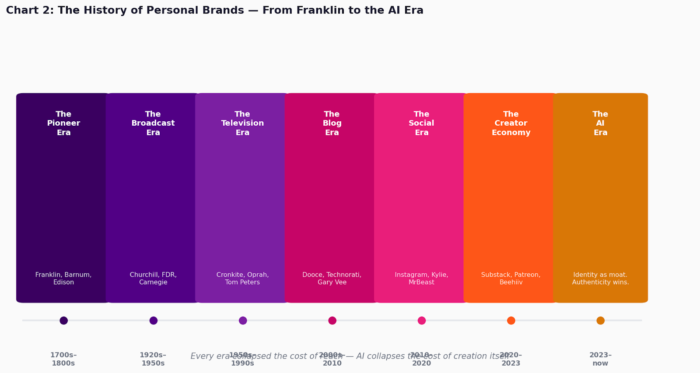
The personal brand is not a digital invention. It is as old as the desire to be known. What changes across every era is the infrastructure of reach and the mechanism by which one person’s signal travels to many minds. Understanding that history is not academic. It reveals the one principle that has held constant across 300 years.
1: Pre-Digital Era
Benjamin Franklin and the First Content Platform (1732)
In 1732, Benjamin Franklin launched Poor Richard’s Almanack under the pseudonym “Richard Saunders” — a deliberate persona constructed to reach an audience he could not reach as a printer. At its peak, the Almanack sold 10,000 copies a year, reaching more than 1% of the entire colonial American population. Franklin understood something that most modern creators are only now rediscovering: the persona is a product. The content is the distribution. He ran it for 25 years.
Poor Richard’s Almanack (Library of Congress)
P.T. Barnum and Manufactured Celebrity (1840s–1890s)
Phineas Taylor Barnum did not invent publicity. He industrialised it. He promoted Charles Stratton — a 25-inch-tall five-year-old — as “General Tom Thumb” and created a media event that preceded modern influencer marketing by 150 years. Barnum understood that the story was the product, the spectacle was the signal, and that a well-told myth could move more people than any fact. He wrote a best-selling autobiography, gave lecture tours, and built a personal brand that survived two bankruptcies. His core insight: attention is the asset before revenue is possible.
Edison vs. Tesla — The Branding War That Changed Everything (1880s)
Thomas Edison and Nikola Tesla were perhaps the greatest inventor versus greatest marketer case study in history. Edison’s genius was matched by his mastery of publicity. He staged public demonstrations, invited journalists to his laboratory, cultivated the image of the “wizard of Menlo Park,” and created the concept of the celebrity inventor. Tesla, by most technical measures the superior inventor — he gave us alternating current, the radio, and the foundations of wireless technology — died near-penniless in a New York hotel. In part because he never mastered the personal brand game. Edison won. Tesla’s ideas won. The lesson endures: identity signal determines who gets remembered, regardless of who was right.
Dale Carnegie and the First Personal Brand Manual (1936)
“How to Win Friends and Influence People” was published in 1936 and has sold over 30 million copies. Carnegie did not call it personal branding. But that is precisely what it was: a systematic framework for managing the impression you leave in other people’s minds. It taught readers to become genuinely interested in others, remember names, let others feel important — and in doing so, to build trust at scale. It remains the foundational text of the B2B personal brand, hiding inside the personal development section of every bookshop on the planet.
Carnegie’s original principles (Dale Carnegie Institute)
The Radio and Television Eras — Voice as Brand (1920s–1970s)
Franklin D. Roosevelt’s Fireside Chats (1933–1944) were, in effect, a weekly podcast — a direct, intimate communication channel between a leader and an audience of 60 million people. Churchill’s wartime broadcasts were personal brand mastery at historical scale: a voice, a cadence, a rhetoric that became synonymous with a nation’s will. The lesson of both was that consistency of presence builds trust more than any single piece of content.
Television collapsed the distance further. Walter Cronkite was declared “the most trusted man in America” not because of a credential but because of a broadcast relationship built across two decades. Oprah Winfrey’s run from 1986 to 2011 was the first billion-dollar personal brand built on television — producing a media company, a publishing platform, a network, and eventually a food and wellness empire. Oprah did not have a content strategy. She had an identity — and a channel.
The Management Consultant Era — B2B Personal Brands Emerge (1980s–1990s)
Tom Peters and Robert Waterman published “In Search of Excellence” in 1982. Peters went on to build a global consulting and speaking empire on the back of that single book — commanding $85,000+ per keynote for decades. Peter Drucker, the father of modern management, built a personal brand so durable it still generates revenue 20 years after his death. The model they established — book, speaking circuit, consulting retainer — remains the dominant B2B monetisation architecture today.
2: Digital Era Arrives
The Blog Era — The First Democratisation (2003–2010)
Blogging was the internet’s first personal brand platform. By 2007, Technorati was tracking 70 million blogs. Heather Armstrong (Dooce.com) was generating $40,000 per month from a personal blog by 2009 — making her, arguably, the first professional influencer in history. The barrier to reach had collapsed. Anyone with a computer and a thought could build an audience. Most did not last. The ones who did had something to say that was irreducibly theirs.
The Social Era — Scale Without Depth (2010–2020)
Instagram launched in 2010. The term “influencer” entered common parlance around 2016–17. Kylie Jenner was reportedly charging $1 million per sponsored Instagram post by 2019. The B2C influencer economy had arrived. But the social era also produced a trap: the algorithm rewarded frequency and novelty over depth. The shelf life of a trend-dependent creator shrank to months. The brands that survived were the ones who built something underneath the platform.
The Creator Economy Era — The Solo Media Company (2020–2023)
COVID accelerated a structural shift already underway. Substack, Patreon, OnlyFans, Gumroad, and Beehiiv gave creators the infrastructure to own their audience and monetise directly, without a platform intermediary. The concept of the “solo media company” arrived: one person with a laptop and an audience, generating seven-figure revenue without employees, investors, or permission. Justin Welsh. Lenny Rachitsky. Codie Sanchez. The thesis was proven at scale.
The AI Era — Authenticity as the Last Moat (2023–present)
ChatGPT launched in November 2022 and crossed 100 million users in 60 days — the fastest product adoption in history. By 2024, AI could produce a week’s worth of content in an hour. The production barrier — which had served as a natural quality filter — was removed. And with it, the last argument for effort-as-proof-of-value disappeared.
What the AI era does not change: the value of a lived path. Of ideas earned through experience. Of a perspective that could only come from having actually done the thing. That is what every era, from Franklin to the present, has ultimately rewarded — and what no language model, however sophisticated, can manufacture.
“Every era collapses the cost of reach. The AI era collapses the cost of creation. What remains scarce — what has always remained scarce — is genuine human signal.”
What Is a Personal Brand in the Digital and AI World?
A personal brand is not a logo, a colour palette, or a content schedule. Those are its artefacts.
At its core, a personal brand is the impression you leave in the minds of the people who encounter your work — the answer to the question: what is this person about? It is the intersection of identity, expertise, and communication. What you know, who you are, and how you share it.
The digital era moved personal brands from rooms to the internet. The social era moved them from the internet to the feed. The AI era moves them from the feed to the question of whether they are real at all. In that sequence, one thing has remained constant as the determinant of whether a personal brand lasts: the specificity of the underlying identity.
The three elements every durable personal brand shares:
- A specific point of view that cannot be generated — only lived
- Consistency of presence across time, not just output
- An audience relationship that is built on trust, not just reach
The last point is the one the AI era has exposed most clearly. Trust is not a metric. It is not a follower count, an open rate, or an engagement ratio. It is the felt sense, on the part of the reader or viewer, that the person they are following is actually there — that a real human intelligence, shaped by real experience, is doing the thinking behind the content.
“A personal brand in the AI era is a trust signal. And the only trust that survives is the kind that cannot be faked.”
The Creator Economy: The Data That Changes the Calculation
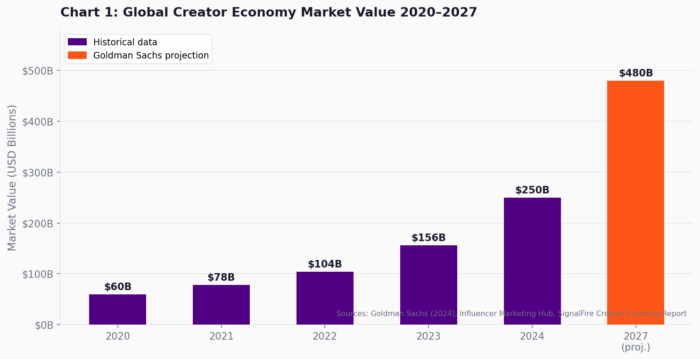
In 2024, the global creator economy was valued at approximately $250 billion, up from $104 billion in 2022. Goldman Sachs projects it will reach $480 billion by 2027. The number of people who identify as content creators and those individuals building audiences and monetising their knowledge, perspective, or personality, has grown from an estimated 2 million in 2016 to over 50 million globally today.
Goldman Sachs Creator Economy Report
Within those 50 million, the distribution of outcomes follows a sharp power law. The top 1% of creators and approximately 500,000 individuals have captured an estimated 90% of total creator revenue.
The remaining 99% share the rest.
Three data points that define the landscape:
- $480 billion projected market value by 2027 (Goldman Sachs, 2023)
- 50 million+ people globally now identify as creators (Influencer Marketing Hub, 2024)
- Top 1% of creators generate 90% of total revenue (SignalFire Creator Report, 2023)
Influencer Marketing Hub Creator Economy Report 2024
SignalFire Creator Economy Overview
The question for anyone serious about building a personal brand is not whether the opportunity exists. It clearly does.
The question is what determines whether someone lands in the 1% or the 99%. And the answer has almost everything to do with the depth and specificity of the identity signal and almost nothing to do with posting frequency.
B2C Influencers and How They Build and Monetise
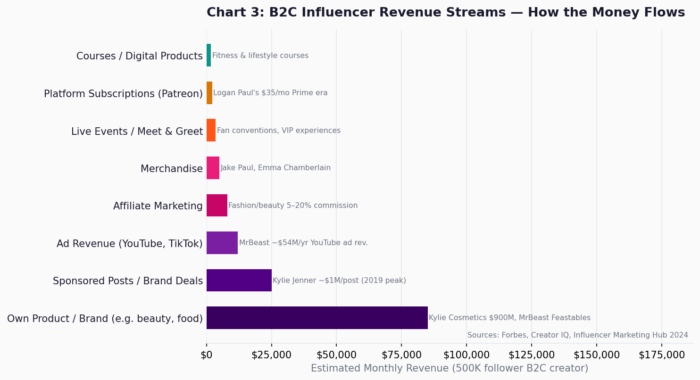
B2C personal brands operate in the attention economy at scale. Their currency is reach. Their audiences are broad, their content aspirational, and their monetisation often tied to volume — of followers, views, and brand relationships. Understanding how they actually make money reveals both the opportunity and the structural fragility of this model.
1. Own Product or Brand
The highest-ceiling B2C model. The influencer’s attention becomes distribution for a product they own equity in. Kylie Jenner’s Kylie Cosmetics reached a $900 million valuation before a partial sale to Coty. MrBeast’s Feastables chocolate brand moved $10 million in its first 72 hours on sale. Prime Hydration, co-founded by YouTubers Logan Paul and KSI, reportedly reached $1.2 billion in annual revenue in 2023.
The economics: far higher margin than brand deals, compounding brand value, and a business that can outlast the creator’s active content phase. The requirement: genuine audience trust and a product that actually fits the creator’s identity.
Prime Hydration revenue data (Forbes)
2. Sponsored Posts and Brand Deals
The most common B2C revenue stream, and the most volatile. CPM rates for sponsored social content vary from $5 (micro-influencer) to $1 million+ per post (mega-celebrity). Kylie Jenner was reportedly charging $1 million per Instagram post at her 2019 peak.
The structural problem: brand deals are rented income. They require ongoing audience growth to maintain, they disappear when brand priorities shift, and they create a conflict of interest that erodes the trust they depend on. The most successful B2C creators treat brand deals as a cash flow mechanism, not a long-term business model.
Creator compensation benchmarks (Creator IQ 2024)
3. Ad Revenue
YouTube AdSense pays content creators between $2 and $8 per 1,000 views on average, depending on content category and audience geography. MrBeast reportedly generates $54 million annually in YouTube ad revenue alone. The model rewards volume and retention — both of which require consistency at scale.
TikTok’s Creator Fund pays significantly less: approximately $0.02–$0.04 per 1,000 views, which is why the most successful TikTok creators use the platform for audience acquisition but monetise elsewhere.
4. Affiliate Marketing
Commission-based promotion of other brands’ products, typically 5–20% per sale in fashion and beauty. The model works best when the recommendation is genuinely trusted — which means its ceiling is directly correlated with the authenticity of the creator’s identity signal. The B2C affiliate market is worth $17 billion globally (Influencer Marketing Hub, 2024).
5. Platform Subscriptions
Patreon, OnlyFans, Twitch subscriptions — direct-to-fan recurring revenue for exclusive content. The model requires a deeply loyal core audience willing to pay for access. Emma Chamberlain, Philip DeFranco, and Hank Green have all built sustainable subscription revenue alongside their public platforms.
6. Merchandise
The identity-to-product model. Works when the creator’s brand has enough cultural weight to make a hoodie or a water bottle feel like belonging to something. Jake Paul’s merchandise empire has generated over $30 million in revenue across multiple drops.
B2B Influencers: How They Build and Monetise
B2B personal brands operate on entirely different economics.
- The audience is smaller.
- The content is more specific.
- The trust required is deeper.
- And the revenue per relationship is dramatically higher.
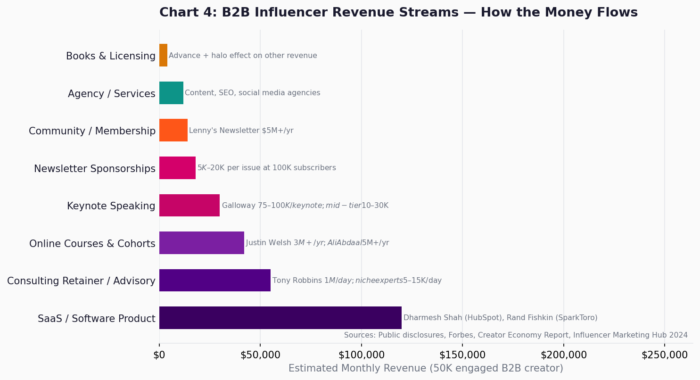
A B2B creator with 50,000 engaged LinkedIn followers can earn more annually than a B2C creator with 2 million Instagram followers.
“In B2C, you sell to the crowd. In B2B, you sell to the individual who holds the budget.”
1. SaaS and Software Products
The highest-leverage B2B model. The personal brand becomes distribution for a scalable product.
- Dharmesh Shah’s blog “OnStartups” built him an audience that became one of HubSpot’s earliest growth engines.
- Rand Fishkin’s years building Moz through public SEO education made SparkToro a pre-validated product before a single line was written.
The personal brand as a product launch mechanism is the most capital-efficient go-to-market strategy available to a B2B founder.
2. Consulting and Advisory
The highest-price-per-hour model. A B2B personal brand converts to consulting when the audience trusts your expertise enough to pay for access to your judgment.
- Tony Robbins charges $1 million for a day of personal consulting.
- More accessibly, niche B2B experts routinely charge $500–$3,000 per hour once an audience of sufficient size and specificity validates the expertise.
The consulting model is built on what the audience sees you do publicly and the thinking, the frameworks, the counter-intuitive takes.
Every piece of public content is, in effect, an audition for advisory work.
3. Online Courses and Cohort Programs
Justin Welsh earns over $3 million annually from two digital courses: The LinkedIn Operating System and The Content Operating System.
Ali Abdaal generates $5 million+ from Part-Time YouTuber Academy and Part-Time Creator Academy.
The economics are extraordinary: a course created over 60 hours of work can sell to 5,000 students at $500 each — generating $2.5 million from a one-time production effort.
Justin Welsh revenue disclosure (JustinWelsh.me)
4. Keynote Speaking
The most visible B2B monetisation model.
- Scott Galloway commands $75,000–$100,000 per keynote.
- Malcolm Gladwell earns $100,000+.
- Mid-tier thought leaders with a specific, defensible point of view regularly earn $10,000–$30,000 per engagement.
The speaking market rewards memorability but not volume, not follower count, but the single most provocative, useful, or reframing insight a speaker can deliver in 45 minutes.
One book, consistently cited, can sustain a speaking career for a decade.
5. Newsletter Sponsorships
A B2B newsletter with 100,000 subscribers can command $5,000–$20,000 per issue for a well-placed sponsorship.
- The Morning Brew model of a free newsletter, multiple sponsors per issue was acquired by Insider Inc. for $75 million in 2020.
- The Hustle was acquired by HubSpot for $27 million in 2021.
The economics of the newsletter business work when the audience is specific enough to justify a premium CPM.
The Hustle acquisition details (HubSpot blog)
6. Community and Membership
Recurring revenue from a community that pays for belonging, connection, and access to curated peers.
- Lenny Rachitsky’s Lenny’s Newsletter generates over $5 million annually at $250–$400 per year from a Substack community of 30,000 paid subscribers.
- David Perell’s Write of Passage community charges $4,000 per cohort and regularly fills 200+ seats.
How AI Helps You Build, Grow and Monetise a Personal Brand
AI does not replace the personal brand. It accelerates the parts that were always bottlenecks and exposes the parts that were always the differentiators.
Used correctly, AI is a force multiplier for human signal.
Used incorrectly, it produces generic content at scale and erodes the trust it was meant to build.
Here is how AI genuinely changes the game across every stage of the personal brand journey.
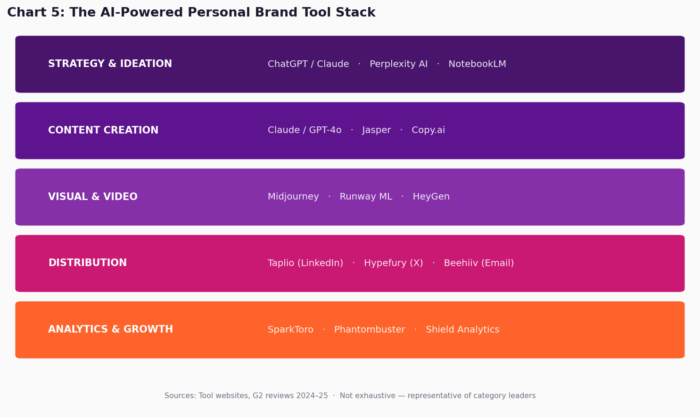
1. AI for Strategy and Ideation
The strategy layer is where AI provides the highest ROI for most creators.
Before writing a single word of content, AI can help you:
- Identify the questions your audience is actually asking (via tools like Perplexity, ChatGPT with browsing)
- Audit competitor content and find the gaps — the conversations nobody is leading
- Generate 50 headline ideas from a single topic, then select the strongest 3
- Build a 90-day content calendar from a single positioning statement
- Refine your point of view by pressure-testing it against counter-arguments
The key is using AI to expand your thinking, not replace it. The ideas that perform are the ones that originate from your lived experience. AI helps you find the angle, the hook, the frame — you provide the insight.
2. AI for Content Creation
The content creation efficiency gains are documented and substantial. A piece that once took 4 hours to research, draft, and edit can now be completed in 45–90 minutes with AI assistance — without sacrificing quality, and often improving it.
The workflow that works:
- Dictate or write a rough first draft in your own voice — 30 minutes
- Use AI (Claude, GPT-4o) to restructure, strengthen transitions, and identify gaps — 15 minutes
- Return to the draft and inject your specific examples, data, and lived experience — 20 minutes
- Use AI to generate 10 headline options and suggest structural improvements — 10 minutes
- Final edit in your own voice — 15 minutes
Total: approximately 90 minutes for a 1,500-word article that once took a full day. The 10x efficiency gain is real. The caveat: the human steps — the rough draft, the specific examples, the final voice pass — cannot be skipped without producing generic output.
3. AI for Visual and Video Content
The visual production barrier has collapsed. Midjourney and DALL·E 3 generate professional-grade custom images in 60 seconds. Runway ML and HeyGen allow creators to produce video content including AI-generated avatars without a camera or a production team.
For B2B creators, the practical application is substantial: custom hero images for every article, branded social graphics, and short-form video scripts generated and refined in minutes. The visual layer of a personal brand, which once required a designer, can now be managed by a solo creator with basic prompt skills.
4. AI for Distribution and Growth
The distribution layer is where AI-powered tools are moving fastest. Taplio (LinkedIn automation), Hypefury (X scheduling and analytics), and Beehiiv (AI-assisted email newsletter) all now incorporate AI to help creators identify optimal posting times, repurpose long-form content into platform-native formats, and A/B test hooks at scale.
The repurposing workflow that compound creators use:
- One long-form article → AI extracts 5 key insights → 5 LinkedIn posts
- One LinkedIn post → AI rewrites for X’s character limit and rhythm → X thread
- One newsletter issue → AI generates subject line variants → split test
- One podcast episode → AI transcript → newsletter summary → quote graphics
5. AI for Monetisation
AI reduces the time from “I have an idea” to “I have a product for sale” by an order of magnitude. Specific monetisation accelerators:
- Course creation: AI generates module outlines, lesson scripts, and workbook templates from a single topic brief. What once took 3 months of production now takes 3 weeks.
- Newsletter sponsorship: AI researches brand fit, drafts outreach emails, and creates media kit copy — compressing the sales cycle from weeks to days.
- Consulting intake: AI-powered intake forms and pre-meeting analysis tools allow consultants to prepare more deeply, faster — and charge accordingly.
- Book and content repurposing: AI converts a 2-year archive of blog posts into a structured book outline in 30 minutes, identifying the through-line a human would miss.
The 6-Step Identity-First Build Process
Here is the central insight most personal brand advice misses entirely: the brands that will survive the AI era are not the ones with the best content production systems.
They are the ones built on an identity deep enough that no AI can replicate it. Content is a commodity. Identity is not.
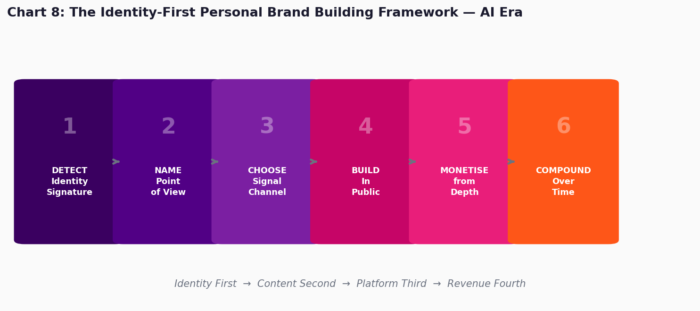
Step 1: Detect Your Identity Signature
Before you build anything, you must know what you are building from. Most personal brand frameworks start with niche selection and content pillars. These are tactical answers to a question that is fundamentally strategic: What is the specific pattern of energy, thinking, and strength that defines how you operate at your best?
Your identity signature is not invented. It is detected and excavated from the pattern of your lived experience.
- Look at the moments across your life when you lost track of time.
- The problems you kept returning to across different roles and decades.
- The frustrations that pointed toward something you cared about deeply.
These are not random. They are a fingerprint.
The questions that reveal it:
- Where has your energy risen without your permission before your rational mind approved it?
- What do you find yourself explaining to people who never asked?
- What consistently irritates you that others seem to accept without question?
- What have you been quietly circling for years, never quite committing to and never quite walking away from?
Step 2: Name Your Point of View
A personal brand without a point of view is a directory listing. The thing that converts an audience into a community is a specific, defensible perspective not an opinion on everything, but a lens. A consistent way of seeing that produces insights distinctively yours, regardless of topic.
- Galloway does this with No Mercy / No Malice.
- Godin does it with permission marketing and the smallest viable market. Brené Brown does it with vulnerability as strength. The point of view is the architecture everything else hangs from.
Develop yours by asking:
What does everyone in my field accept without questioning that I believe is wrong?
What do I know from lived experience that I rarely see acknowledged in public?
Step 3: Choose Your Signal Channel
The right platform is not the biggest platform. It is the one where your identity signal transmits most clearly.
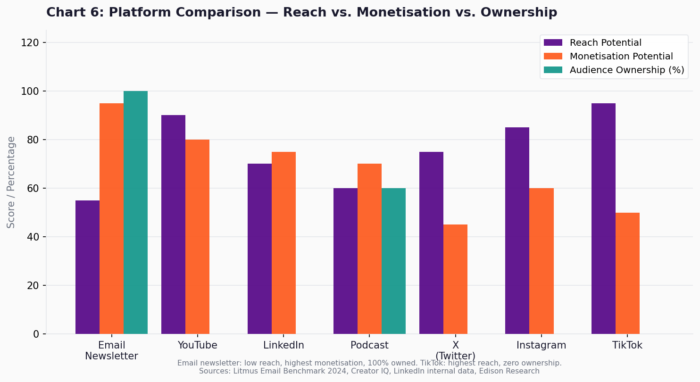
- Long-form thinkers belong on newsletters and long-form social.
- Visual storytellers belong on YouTube or Instagram.
- Systems thinkers belong on LinkedIn.
- Rapid-fire provocateurs belong on X.
Pick one primary channel and go deep. Build secondary channels through repurposing, not parallel effort.
The critical insight from Chart 6: email newsletters have the lowest organic reach but the highest monetisation potential and 100% audience ownership.
Every creator’s long-term goal should be converting platform followers into email subscribers. The platform can change the algorithm overnight.
Nobody can change your email list.
ConvertKit State of the Creator Economy 2024
Step 4: Build in Public
In the AI era, transparency has become a competitive moat. AI can generate polished insights. It cannot share the specific, messy, unpredictable experience of living through something. Building in public means documenting the journey, not just broadcasting the destination. The experiments you ran. The mistakes that revised your thinking. The specific moment the insight landed and what preceded it. This is the texture that no AI can manufacture.
Step 5: Monetise from Depth, Not Surface
The monetisation mistake most personal brands make is reaching for revenue too early and too generically. The order matters: depth first, specificity second, revenue third. And when you monetise, do it in ways that amplify the identity signal rather than dilute it.
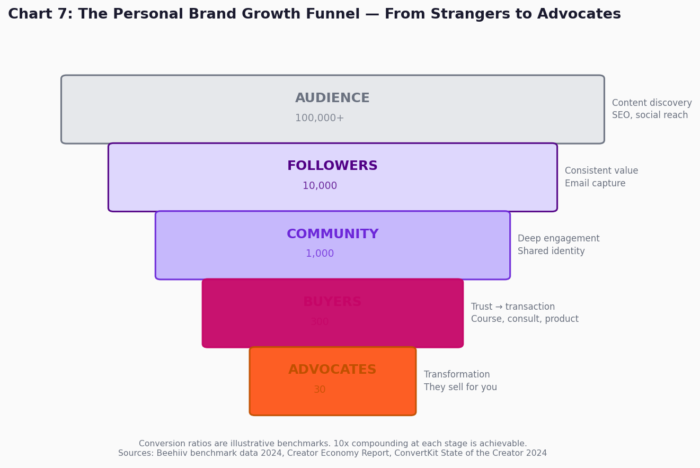
The growth funnel is not a metaphor. It is an architecture. 100,000 people encounter your content. 10,000 follow you. 1,000 engage deeply enough to enter a community. 300 buy. 30 become advocates who sell for you. The number that matters most is not the top of the funnel, it is the bottom.
Thirty true advocates compound faster than 100,000 passive followers.
Step 6: Compound Over Time
The most powerful personal brands are not the ones that grew fastest. They are the ones that compounded the longest. Compounding requires consistency without rigidity and showing up regularly with something that genuinely reflects your evolving thinking, rather than manufacturing content to feed an algorithm.
“The brands that last are the ones where the creator keeps growing. Where the audience is not just following the person — they are accompanying them.”
10 Elements Most Playbooks & Guides Leave Out
A truly complete personal brand resource covers more than content strategy and monetisation. Here are the ten elements that matter and that most playbooks omit.
1. Email List Building: Your Most Valuable Asset
Social platforms are rented land. An email list is owned real estate. Ann Handley generates $25,000+ per speaking engagement driven almost entirely by her email list of 50,000 subscribers.
The benchmark: a single engaged email subscriber is worth 10–20x a social media follower in revenue terms. Every piece of content you produce should have a path to capturing an email address.
Litmus Email Marketing Benchmark Report 2024
2. SEO and Discoverability: The Compounding Visibility Engine
Organic search traffic is the only channel that compounds without ongoing effort. A well-optimised article written in 2021 can still drive 10,000 monthly visitors in 2025. The B2B personal brands that built durable traffic assets — Rand Fishkin, Ann Handley, Neil Patel — did so by treating every piece of content as a long-term search asset, not just a one-time post.
3. Collaboration and Network Effects
The fastest-growing personal brands rarely grow alone. Podcast interviews, co-created content, newsletter swaps, and speaking referrals generate audience expansion that organic posting cannot replicate. Justin Welsh, Codie Sanchez, and Sahil Bloom all grew significantly faster because of strategic collaboration with adjacent creators at similar audience sizes.
4. Platform Risk and Diversification
Every platform has changed its algorithm at least three times in the past five years.
Any creator whose entire audience lives on a single platform of TikTok, Instagram, X and others carries existential risk.
The Bankless newsletter, Gary Vaynerchuk’s YouTube, and Tim Ferriss’s podcast all demonstrate the same principle: own your one channel, distribute everywhere else.
5. Legal and Business Infrastructure
A personal brand that generates revenue is a business.
The most common mistakes: operating as a sole trader without liability protection, failing to trademark your name or brand before someone else does, and not having standard contracts for brand partnerships, consulting, and course delivery.
These are not exciting but they are the difference between a brand that survives a dispute and one that doesn’t.
6. Personal Brand Metrics: What to Actually Measure
Most creators measure vanity metrics: follower counts, likes, impressions. The metrics that predict revenue:
- Email open rate (benchmark: 35–50% for an engaged list)
- Reply rate on direct emails (above 5% indicates genuine relationship)
- Revenue per email subscriber per year (benchmark: $1–$3 for B2C, $10–$50 for B2B)
- Speaking/consulting inquiry rate (new inbound per month)
- Course conversion rate from email list (benchmark: 1–3% per launch)
7. Reputation Management and Crisis Protocol
Every public personal brand will eventually face a moment of public challenge; That is a misquote, a controversy, a cancelled partnership.
The creators who emerge stronger are the ones with a clear protocol: acknowledge quickly, respond from values not defensiveness, and let the depth of the existing relationship do the work.
The audience almost always sides with transparency over perfection.
8. Personal Brand Evolution: How to Change Without Losing Your Audience
Every long-running personal brand evolves. Oprah moved from daytime television to a network to wellness to film production.
Gary Vaynerchuk moved from wine to social media marketing to NFTs to broader entrepreneurship.
The creators who navigate evolution successfully do it by taking the audience with them and sharing the reasoning, not just the destination.
“Here is why I am shifting toward X” is a content category that typically outperforms everything else in terms of engagement.
9. Offline to Online Integration
Speaking, masterminds, and in-person events are among the most underrated personal brand builders.
One keynote to 500 relevant people generates more genuine followers than 50 social media posts.
The creators who compound fastest combine online consistency with occasional offline depth as the event that becomes the content, the relationship that becomes the referral.
10. The Long Game: Why the 10-Year View Wins
Every creator who has built a genuinely durable personal brand shares a single characteristic: they stopped optimising for the next post and started building for the next decade.
The compound interest of a consistent, evolving point of view over 10 years is almost unassailable.
The question is not “what should I post this week?” It is “who do I want to be known as in 2035, and does what I create today serve that?”
“The personal brand is not a campaign. It is a biography being written in real time. Every piece of content is a sentence. Make sure they add up to something worth reading.”
The Verdict: The One Thing AI Cannot Clone
The AI era has not made personal brands irrelevant. It has made shallow personal brands irrelevant.
What AI cannot do is have your specific experience. It cannot hold your perspective. It cannot earn your reputation. It cannot have genuinely tried the thing, failed at it, learned from it, and revised its thinking in real time. The lived path is the moat.
The personal brands that will matter in five years are being built right now on a foundation of authentic identity and not tactics, not templates, not an optimised content calendar. On the specific, irreplaceable signal of people who know who they are, have earned the right to say something about it, and have the courage to say it consistently.
The question worth sitting with is not: “What should my personal brand be about?”
“What have I been living — for years, across every role and context — that the world would be worse off without knowing? Start there. Everything else follows.”
Key Sources and Further Reading
- Goldman Sachs Creator Economy Report (2023)
- Influencer Marketing Hub Creator Economy Report 2024
- SignalFire Creator Economy Overview
- ConvertKit State of the Creator Economy 2024
- Beehiiv Benchmark Report 2024
- Creator IQ State of Creator Marketing 2024
- Litmus Email Marketing Benchmark Report 2024
- Justin Welsh Annual Revenue Disclosure
- The Hustle acquisition — HubSpot blog
- Moz Beginner’s Guide to SEO
- Lenny’s Newsletter (Substack)
- Midjourney AI image platform