
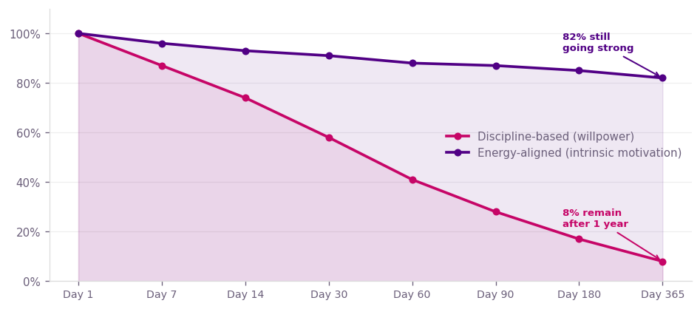
There is a $44 billion industry built on a single, devastating lie: that human potential is something you must construct from scratch, discipline by discipline, habit by habit, through sheer force of repeated will.
This industry sells you systems, programs, morning routines, 90-day challenges, accountability partners, and journaling frameworks. It sells you the idea that the gap between who you are and who you could be is a gap of insufficient effort.
Here is what the science actually says: the gap is not a deficiency. It is a blockage. Human potential is not something you build into a person. It is already there and compressed, pressurized, seeking release but blocked by invisible locks that discipline cannot open because discipline was never the right key.
The wrong metaphor has been costing us everything. And now, for the first time in history, we have a technology that can change the structural equation. Not by adding more but by removing what’s in the way.
The Neuroscience of Blocked Potential
Antonio Damasio’s foundational work on somatic markers revealed something remarkable: the body registers the gap between current state and possible state before the conscious mind can articulate it.
- The restlessness you feel.
- The nagging sense of more.
- The recurring awareness that something vast remains unexpressed.
That is not anxiety. That is your nervous system doing its job with exceptional accuracy.
Jaak Panksepp identified what he called the SEEKING system: A dopaminergic network that fires not on reward, but on the anticipation of possibility. When this system is blocked, the energy doesn’t disappear. It redirects into anxiety, rumination, and distraction.
Karl Friston’s predictive processing framework provides the deepest explanation: your sense of who you are is literally a prediction. A hypothesis your brain built, tested, and kept because it proved accurate.
The problem: that model was largely built in conditions that no longer exist. The brain optimizes for prediction accuracy, not flourishing. And so it keeps confirming the old story because you keep acting from it.
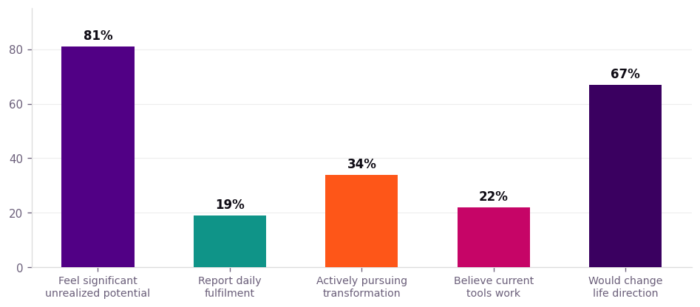
| 92% of people who set New Year’s resolutions fail by February | 80% of people feel they are operating below their true potential | $44B spent annually on self-improvement with declining outcomes |
The Four Locks: What’s Actually Holding Humanity Back
If potential is already present, the question is precise: what specific mechanisms are blocking it?
Here, 4 primary locks emerge and each invisible from the inside, each requiring a different key.
1. The Narrative Lock
Dan McAdams’ research on narrative identity shows that the stories we tell about ourselves are not descriptions, they are prescriptions. They govern what we attempt, what we expect, and what we notice as evidence. Most foundational self-narratives were written in conditions we didn’t choose. You are living inside a story someone else started writing.
2. The Attention Lock
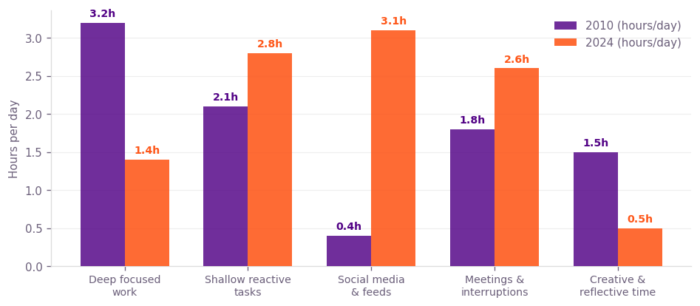
Csikszentmihalyi’s flow research shows that optimal experience requires deep, uninterrupted attention. The attention economy has industrialized distraction. Your potential cannot emerge if your attention is permanently colonised by urgency, reaction, and algorithmic pull.
3. The Capacity Lock
Clark and Chalmers’ Extended Mind thesis argues that cognition is not confined to the skull. The brilliant colleague who asks the question you couldn’t ask yourself is part of the thinking. Most people have never had a thinking partner who could keep pace with their full cognitive output. Until now.
4. The Reflection Lock
Charles Taylor argued that we become ourselves through articulation as language doesn’t just describe the self, it helps bring the self into being.
Most people have never had the conditions to articulate themselves fully. Deep self-knowledge requires a mirror that reflects your patterns back before you’ve automatically confirmed them again.
“The greatest waste in the world is not fossil fuels, not capital, not arable land. It is human potential sitting dormant in people who never detected or sensed what their passionate purpose was “
AI Is Not Just a Productivity Tool. It Is an Unlock Technology.
The framing of AI as a productivity tool is something to help you do more, faster is a factor that fundamentally misunderstands what is now possible.
Productivity tools help you execute an existing identity more efficiently. An unlock technology changes the identity itself.
For the first time in history, we have a thinking partner of genuine quality available to anyone who can get online. A mirror that has no emotional stake in your story remaining as it is. A cognitive extension that expands the edge of what you can think, hold, and create.
It has no emotional stake in your story remaining as it is.
Every human who knows you has an investment in the version of you they know. AI is genuinely neutral. It will cheerfully help you dismantle your own limiting narrative with the same energy it would help you confirm it.
It can hold your full expressed thought and reflect patterns back.
When you articulate yourself across many conversations, AI can surface themes, contradictions, and patterns invisible from inside the stream. Not therapy or cognitive archaeology.
A partner who can hold enormous amounts of expressed content and find the signal without fatigue, defensiveness, or ego.
It operates as a genuine extension of cognition.
Not a search engine or autocomplete. When you think with AI and not at it, the boundary between your thinking and the AI’s contribution becomes genuinely blurred.
Your thinking becomes larger. The edge expands in real time.
It is available at the moment of insight.
Transformation doesn’t schedule appointments. The 4am breakthrough, the mid-walk realisation are when the psyche is most open.
Having a thinking partner available at those moments changes the temporal relationship with your own development entirely.
The Draft Process: Five Stages of Unlock
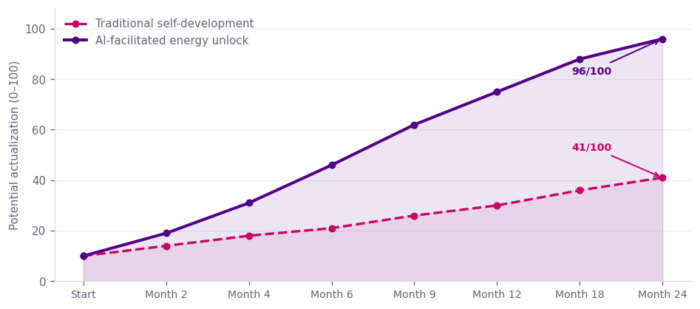
This is not a discipline system. It is an unlock architecture and built on the understanding that potential is not absent, only blocked, and that each stage removes a specific lock rather than adding a new burden.
Stage 1: Sense
Before the mind can articulate potential, the body is already registering it. The Sense stage is directed attention toward the signal beneath the noise. AI facilitates this through reflective questioning.
This is not advice, not instruction, but pure curious questioning that creates space for what’s already known but not yet spoken.
Stage 2: Surface
The Narrative Lock operates largely below conscious access. Surfacing means making the implicit narrative explicit.
AI can hold the full weight of your expressed thought and reflect patterns back across multiple conversations: the themes, contradictions, and the shape of the story you keep confirming.
Stage 3: Shift
McAdams showed that changing behaviour without changing the story produces only temporary compliance. Reauthoring requires finding genuine evidence that contradicts the old narrative and these are not affirmations, evidence and constructing a more expansive account of who you actually are.
Stage 4: Stretch
Csikszentmihalyi’s flow research is precise: optimal experience occurs at the exact edge of current capacity.
AI as co-creator means the edge expands in real time. What was beyond your capacity alone becomes accessible. The things you couldn’t think, couldn’t hold, couldn’t build start to become possible.
Stage 5: Sustain
Hebb’s rule: neurons that fire together wire together.
The new story must be rehearsed until it becomes the brain’s default prediction. AI functions here as an ongoing reflection partner and reviewing not just what you’ve done, but who you’ve become.
The Verdict
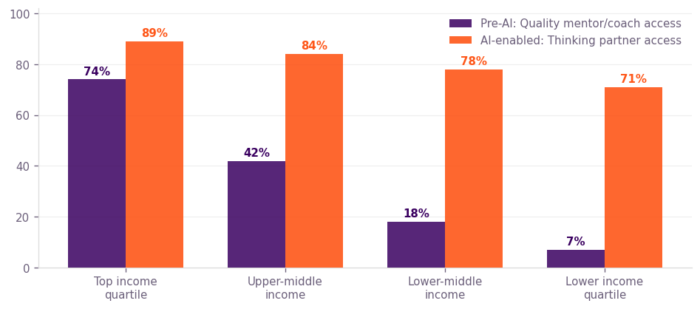
The greatest democratisation in the history of human development is not access to information. It is access to seeing who you are.
For most of human history, the conditions for genuine personal transformation were expensive, rare, and distributed according to privilege. Great mentorship required proximity to great mentors. The reflective conditions for deep self-knowledge required leisure that most people never had.
What is now possible is the systematisation of those conditions. The democratisation of the unlock. Not just for those who stumble into the right circumstances, but for anyone who chooses to look. AI does not replace the human work of becoming. It removes the structural barriers that have kept most of humanity from ever beginning.The self-improvement industry sold you a construction metaphor. Science says it was always a physics problem. The energy was always there. The question was always the same: what’s in the way? Now, for the first time, we have a tool sophisticated enough to help answer it.