
In 1956, the United States Navy introduced a weapon that would redefine what it meant to pursue a target. The AIM-9 Sidewinder was the first successful heat-seeking air-to-air missile and its principle was elegant in its brutality.
And it was unstoppable.
Lock onto a heat signature. Ignore everything else. Close the distance at speed. Don’t stop.
The early Sidewinder was crude. It could only pursue a target from behind, chasing the raw heat of engine exhaust. If the enemy banked sharply, or fired a flare bright enough to produce more heat than the aircraft itself, the missile would break lock and spiral away into empty sky. It was powerful. But it was not yet precise.
Then the engineers kept working.
Seventy years of iteration
That is what it took to produce the AIM-9X Block II, a weapon with an imaging infrared seeker that doesn’t chase heat. It recognises the exact shape of its target. It carries the target’s identity in its guidance system. When decoy flares ignite, bright, hot, designed to look more attractive than the actual aircraft, the missile doesn’t flinch. A flare doesn’t have wings. A flare doesn’t have the same profile. A flare is noise. The missile knows the difference, because it knows exactly what it is looking for.
Here is the insight that changes everything: the missile was never the interesting part. The guidance system was.
Missiles?
I became that heatseeking missile in 2009 when I started this blog. I had a curiosity about the rise of social media after joining Facebook in 2009, and that became a burning obsession that changed my life.
I created this blog on April 1, 2009 and it was where I shared my amateur insights on observing the rise of the fanatical use of social media including Twitter and Facebook that had been primed by the rise of MySpace a few years earlier and what I sensed was a revolution that would change the world. That intuition and that whisper was the start of an adventure that continues today, 17 years later.
As I wrote and shared my posts with my slowly growing Twitter followers (that is now over 500,000 followers) I started to receive affirmation for my writing and opinions as people followed, commented and shared to their followers. That affirmation turned into motivation as I wrote I learned and distilled and interpreted this new social media era.
That motivation became so profound and powerful that I started rising at 4.30 am wrote for the next 5 years on my side hustle before starting my day job at 9am to write one post, and hit the publish button and send the link to my Twitter followers.
I had discovered my mission.
The reality is that a missile without a target is an explosion looking for somewhere to happen. Raw energy. Enormous potential. Zero direction.
The moment a target is acquired and the moment the seeker locks, that same energy becomes a mission. Focused. Purposeful. Essentially unstoppable.
That missile could be you.
Or rather, it is who you become, when you answer the one question the distraction economy is specifically engineered to prevent you from ever reaching:
What am I here to build?
But there is a distraction economy designed and built to steal your time and hide your mission.
A $600 Billion Industry Built to Distract You from Your Mission
The modern attention economy does not just steal your time. If that were all it did, the maths would be recoverable. You could take a week offline, recalibrate, come back sharper.
What it steals is the signal acquisition phase, the sustained, uninterrupted interior conversation through which a human being comes to understand what they are genuinely for.
- The pull that is deeper than motivation.
- The obsession that makes 4:30am feel like a reasonable alarm.
- The specific compulsion that, once found, makes discipline irrelevant because the work is more compelling than any alternative.
The attention economy is a documented, engineered system designed to occupy that psychological space before self-knowledge can take root.
Former Google design ethicist Tristan Harris has testified before the United States Congress that the notification architectures of the major platforms were explicitly built to create compulsive checking behaviour, not to inform users, but to colonise the idle moments in which reflection and self-inquiry would otherwise occur.
They hired the best behaviour engineers in the world.
They ran experiments at a scale that would make any psychology lab weep.
And then they built a countermeasure to human purpose. Keep you distracted and picking up your phone to maximize their revenue.
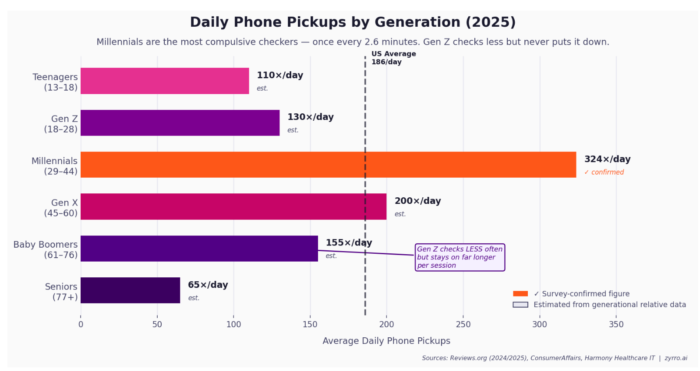
This is an infinite stream of content precisely calibrated to your individual psychology and your specific dopamine thresholds, your particular emotional triggers, your unique patterns of loneliness, ambition, and boredom, that fires continuously and keeps you reactive, distracted, and, crucially, unknown to yourself.
“Brain rot” was the term that Oxford University Press named it the Word of the Year for 2024, reflecting its emergence as the defining cultural anxiety of the age and it is not an accident. It is an output specification. It is what you get when you design a system optimised to prevent the target lock.
The Scale of the Addicted Distraction
We see distraction everywhere as people approach you on the sidewalk with a phone in their hand, not looking up but screen addicted. They can’t wait more than a few seconds to check their phone.
They cross pedestrian crossings without looking up and assuming that a similarly distracted driver isn’t checking their phone. A close friend of mine had an acquaintance who didn’t realize that type of behaviour was deadly.
But as an observer of human behaviour in the wild I am curious about how and why the distraction and obsession with the device and its app is so important.
The questions I am asking in my head watching the approaching mobile and social media addicted zombie on a street and what has become a modern and dysfunctional behaviour, and what is now seen as normal (Note: that activity is not normal) are the following existential questions that I am assuming happened to the approaching distracted person in the last 30 seconds.
- Is the sky falling in?
- Is there is a nuclear holocaust I haven’t heard about
- Has someone close to them died.
And don’t get me started about phones at the dinner table!
So for fun and with no judgment I looked at some data.
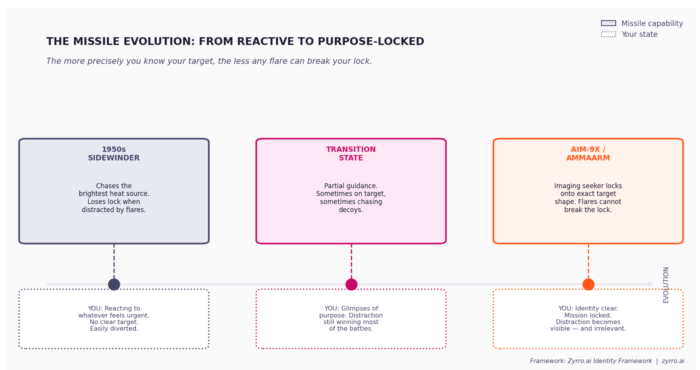
Before we examine the mechanism, we should understand the scale.
A Generation-by-Generation Audit
Research published in 2025, surveying over 1,000 Americans, found that the average person now spends 5 hours and 16 minutes on their phone every single day which is a 14% increase in a single year, on numbers that were already alarming.
That figure excludes television, desktop computers, and tablets.
The generational breakdown forces a reckoning with how total the occupation has become:
- Teenagers (13–18): 8 hours and 39 minutes per day on screens for entertainment and not counting a moment of school-related use
- Gen Z (18–28): approximately 9 hours per day across all screens; one in four report between 9 and 12 hours
- Millennials (29–44): 6 hours and 42 minutes
- Gen X (45–60): approximately 5 hours and 12 minutes
- Baby Boomers (61–76): 3 hours and 31 minutes
- Seniors (77+): approximately 2 hours and 30 minutes
Health experts recommend a maximum of two hours of recreational screen time per day. Every generation exceeds it. The youngest by a factor of 4.5.
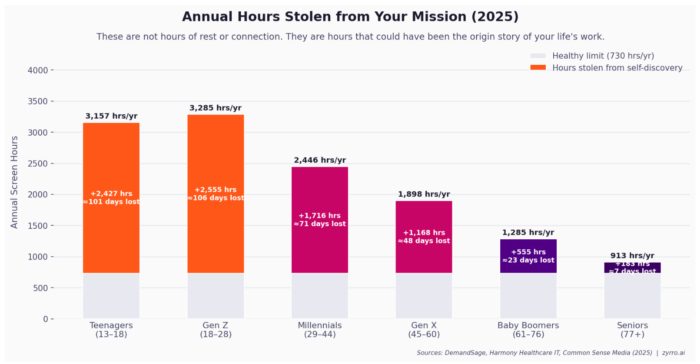
Translate the Gen Z number into annual terms and the picture sharpens painfully: 3,285 hours on screens per year for entertainment. That is 137 full days. More than four months of continuous waking life handed over to platforms that were designed, from their first line of code, to benefit from your continued distraction.
The pandemic permanently shifted the baseline. Screen time spiked by 29 minutes per day globally in 2020 and never returned.
The new floor is higher than the old ceiling. This is not a phase. It is the operating condition of modern life.
The Interruption Architecture
The screen time numbers are the strategic problem. The interruption data reveals the tactical mechanism.
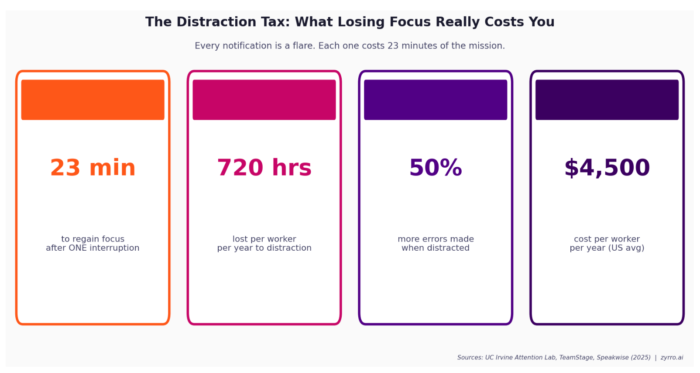
UC Irvine Attention Lab research found that it takes an average of 23 minutes and 15 seconds to return to a state of deep focus after a single interruption. The average knowledge worker is interrupted every 3 minutes. The implication is stark: most people never achieve deep focus at all during a working day. They spend the entire day in the shallows — perpetually mid-recovery, perpetually mid-context, perpetually reacting.
Companies lose 720 hours per worker per year to distraction. That is eighteen full working weeks. Jonathan Spira’s research puts the total cost to the US economy at $1 trillion per year. But these figures measure productivity.
They do not and cannot measure the compounding cost of a life spent permanently one interruption away from the question that would change everything.
The data point that receives far too little attention:
Distracted workers make 50% more errors than focused counterparts. Not 5% more. Fifty.
And neuroscientist Dr. Jared Cooney Horvath has argued in widely-cited research that Gen Z is the first modern generation to perform worse academically than the one before it. And it is declining across attention, memory, literacy, numeracy, and executive function.
The long-running “Flynn Effect”, that the steady generational rise in IQ that held across most of the 20th century may be reversing.
We are not just losing hours. We are degrading the hardware that the mission would run on.
A Missile Without a Target Is Just an Explosion
Here is the question the productivity industry has built a $43 billion empire avoiding: What if the problem isn’t execution at all?
The entire apparatus, the time-blocking frameworks, the inbox-zero methodologies, the habit stacking systems, the nine active software tools per day the average knowledge worker now juggles.
It all presupposes that you know what you are trying to do. That you have a target. That your problem is getting there faster.
Most people do not have a target. They have a vague, socially constructed approximation of success.
- A job title to achieve,
- A revenue number to hit,
- A lifestyle to perform
And they are optimising toward it with increasing efficiency while a quiet, persistent voice asks whether this is actually what they are for.
The early Sidewinder missile without a locked target was just a projectile, fast, powerful, and utterly directionless. That is the human condition inside the distraction economy: enormous capability, enormous energy, no lock.
The algorithm keeps it that way deliberately. A person without a clear identity is the ideal customer. They are permanently available for re-engagement. They click. They scroll. They react. They come back.
The moment a person acquires their target and the moment they know, with precision and intuition, what they are specifically here to build.
- When they know what energises them
- What they want to build.
- What their direction in life is
They become a different kind of entity.
Notifications lose their authority. Invitations that don’t serve the mission become visible as the distractions they always were. The algorithm has not changed. Their relationship to it has. They are now the AIM-9X, carrying the target’s precise identity in their guidance system. Flares don’t work on missiles that know exactly what they are looking for.
The Second Countermeasure: AI Without Identity Is Amplified Drift
The introduction of AI into this landscape has raised the stakes considerably and not in the way most commentary suggests.
The conversation about AI and attention is almost entirely focused on AI as a distraction generator: the infinite content, the AI-generated feeds, the frictionless creation of noise. That is real. But it is the smaller problem.
The larger problem is this: AI amplifies direction.
- If your direction is clear
- If you know what you are building,
- What signal you are following, what problem only you are positioned to solve.
AI becomes an extraordinary accelerant.
It compresses the gap between intention and execution. It handles the generic work so you can inhabit the irreplaceable work more fully.
But if your direction is unclear and if you have not yet acquired your target, AI does not give you one. It gives you faster, more sophisticated drift. You can produce more, react to more, engage with more, create more noise.
The output volume increases. The signal does not appear. You become measurably more productive at going nowhere in particular.
This is why the identity question is not a philosophical luxury. In an economy where AI can execute almost everything, the question of who you specifically are, your particular angle of vision, your irreplaceable obsessions, your unique combination of experience and conviction, is the only question that determines whether AI serves your mission or absorbs your life.
Self-knowledge is not soft. It is the operating system. Without it, every tool in the stack and including the most powerful AI ever built is a hammer in search of a nail.
Acquire the Target. Become the Missile.
You can choose your target if you know what your mission is. Finding out why you are here. That means you have a purpose that rises from your unique identity.
Or, you can decide to drift and be tempted and distracted to follow some else’s mission. To be playing on a platform and a device where you are the hunted, the product, the victim.
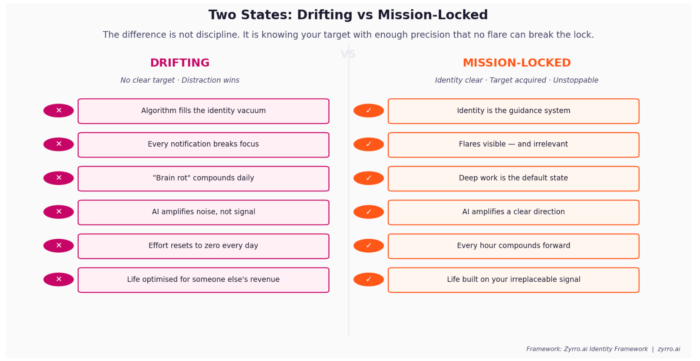
Are you drifting or are you a heat seeking missile?
The crucial distinction in the missile evolution was never speed or explosive yield. It was target acquisition precision.
The Sidewinder was defeated by flares because it could not distinguish a bright heat source from the specific thing it was supposed to be chasing. It lacked the ability to know its target well enough to reject what was merely bright. The modern imaging seeker resolved this not by making the missile faster or more powerful, but by giving it a richer, more precise model of what it was actually looking for. The target’s shape. Its profile. Its identity.
That is the work. Not productivity. Not habit systems. Not AI tool selection.
The work is knowing your own mission with enough precision that no flare, no matter how bright, how urgent, how socially validated, how algorithmically personalised can break the lock.
What That Lock Actually Feels Like
I built jeffbullas.com to more than 33 million readers over a decade, rising at 4:30 in the morning to write before the day had a chance to become noise. People ask about discipline. There was none. Not in the way people mean it. Discipline is what you need when you are doing something that doesn’t pull you.
What I had was an obsession with a question: Why was social media suddenly giving everyone a voice, and what did that mean for human communication and power? That question was mine in a way no one else owned it at that particular moment in history. It produced its own momentum. The 4:30am alarm was not an act of will. It was a response to a target acquired.
A moment in time
In 2019, at the World Youth Forum in Sharm El-Sheikh, Egypt, surrounded by some of the most ambitious young minds on the planet, I had a different kind of reckoning. I had been invited to defend social media and standing there, I realised I had built my entire career amplifying a technology I had never examined with clear eyes.
The platforms had been using me and others as much as I had been using them. I had mistaken facility for alignment. I had been the early Sidewinder, chasing the brightest heat source, not the most important target.
That inversion changed everything. And it is the founding insight of Zyrro.ai and the recognition that in the age of AI, the most urgent infrastructure gap is not more productivity tools.
It is the process and space for serious self-inquiry: the systematic work of knowing who you are, what you are for, and how to build from that with enough clarity that the distraction economy cannot break the lock.
The Compound Test
There is a diagnostic question for every activity, every invitation, every notification, every tool: Does this compound toward the mission, or does it reset to zero?
Time in deep focus on work that matches who you are compounds over time. It is like compound interest.
The output improves. The reputation accrues. The connections form around the signal. The knowledge accumulates toward something only you could build. You become more valuable over time and not through harder effort, but through clearer direction.
Time in distraction does not compound. Tomorrow’s scroll starts from zero. There is no residual. No equity. No compounding interest. Just a pure transfer of your most finite resource attention into someone else’s revenue column.
And it leaves you empty.
In a world where AI can execute almost anything, capability is no longer the variable. Direction is. And direction without self-knowledge is just speed on the wrong road.
The distraction economy, and now AI without identity, will keep firing flares that are brighter, more personalised, more perfectly calibrated to the specific shape of your vulnerability for as long as your attention is the most valuable thing on offer.
The answer is not a digital detox. It is not a better morning routine. It is not nine software tools instead of ten.
It is acquiring the target.
Your mission is to find out, precisely, specifically, irreducibly, is this.
What you are here to build.
Not what sounds impressive. Not what pays the most. Not what the algorithm rewards.
It is this.
- What pulls you.
- What compels you regardless of the outcome.
- What you would work on at 4:30am in the morning
Not because a productivity system told you to, but because the alternative of going back to sleep while the question waits, is the one thing you genuinely cannot do.
Acquire that target.
Then become the missile.
And launch.